
Last Updated 6 hours ago
SkyPanel X22 Overview


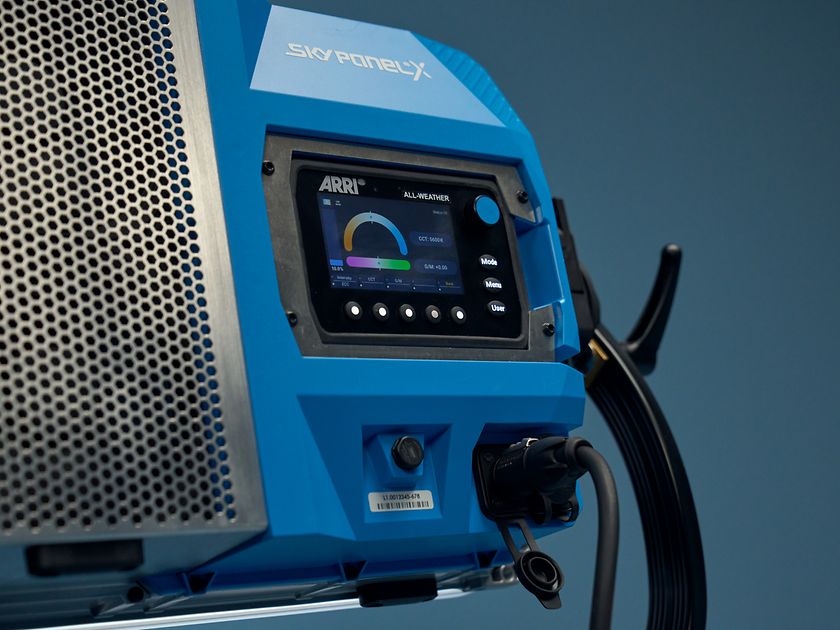
The ARRI SkyPanel X22 is a square 2:2 array made from two 800 W SkyPanel X21 lampheads. Fit two HyPer Optics for a narrow hard beam or two X21 Domes for a wider, softer source. The frame also supports mixed hard and soft optics, but it is not a single sealed 1,600 W lamphead.
The X22 Output Calculator uses ARRI’s published two-head readings. Compare complete arrays at the same mode, CCT and distance; a single X21 reading does not describe the square package. ARRI’s published open-face figures are reference data; read the operating note before using the fixture.
- RGBACL LED Array 2 × X21 modules in a 2:2 square; up to 16 zones. Learn about RGBACL
- Power1,600 W nominal; 800 W per module.
- Colour Temperature1,500–20,000 K
- WeightApprox. 30 kg fixtures only; 38 kg with modular yoke.
- Beam Angle11° HyPer, 107° Dome, 101° S60 Adapter with standard diffusion, or 121° open-face (reference). These are not a measured mixed-array footprint.
- IP RatingIP66 Follow ARRI’s setup and connector-protection requirements. IP ratings guide.
X22 Specifications
| Configuration | 2 × X21 modules · 2:2 format |
|---|---|
| Nominal power | 1,600W |
| Maximum pixel zones | 16 |
| Colour engine / CCT | RGBACL · 1,500–20,000K |
| Fixture-only dimensions | 738 × 668 × 154mm |
| Fixture-only weight | Approximately 30kg |
| With modular yoke | Approximately 38kg |
| AC supply | 100–240V AC, 50/60Hz; integrated PSU in each module |
| Weather rating | IP66, subject to the manual’s prescribed setup and connector protection |
X22 Output Calculator
Select the operating mode, optic and camera settings for one X22 array (2 X21 modules). Both heads use the same optic, mode and CCT; mixed optics aren’t calculated. Use an ARRI-published distance (1, 3, 6 or 10 m) or enter a custom distance from 1 to 100 m. Readings at other distances are estimates.
Camera Settings
F-stop is a planning estimate, not a meter reading. It uses the selected published illuminance at the target for a direct, on-axis setup. No added diffusion, bounce, filters, dimming or ambient light is included. The selected Dome or standard diffuser is already part of its published reading. Meter the actual setup; lens transmission, camera response and meter calibration can change the working stop.
How the exposure estimate works
N = √(E × ISO × t / C), where E is illuminance in lux and t = shutter angle ÷ (360 × fps) in seconds. The default incident-meter calibration constant is C = 340 (Sekonic Lumisphere reference); C = 250 is available as a flat Lumidisc reference. These are calibration assumptions applied to the selected lux value, not a simulation of a dome’s angular response or a guarantee that every meter will agree. The result is a calculated f-number, not a measured T-stop or an exposure recommendation for every subject. No ND or lens-transmission compensation is applied. The display uses a full-stop mark plus tenths of an exposure stop. For example, f/5.6 followed by a smaller 3 means three tenths of a stop above f/5.6. The display runs from f/0.5 to f/64; a lens may cover a much narrower range. This is still a planning estimate, not a measured T-stop.
The calculator uses ARRI’s readings at published distances. Results at other distances are approximate on-axis estimates for one X22 array, not new manufacturer measurements. Other CCTs, different diffusers and mixed-optic arrays need their own photometrics. Foot-candles here are converted from lux (1 fc ≈ 10.7639 lux), so rounding may differ from ARRI’s chart.
Distance estimates, comparisons & beam width
At 1, 3, 6 and 10 m the tool returns ARRI’s published readings for the selected setup. Between measured distances it fits a power curve through the two adjacent published readings. Beyond 10 m it estimates falloff using E(d) = E(10 m) × (10 ÷ d)². That assumes far-field, direct on-axis illumination, an unchanged beam and no intervening losses. The tool does not estimate below 1 m. Limits are not an accuracy guarantee; meter the actual setup.
Comparisons use the same X22 array, selected operating mode, CCT and distance. The cards show illuminance and estimated f-stop at the reference point, not total light output or equal coverage.
Ideal cone width = 2 × distance × tan(beam angle ÷ 2), using ARRI’s listed angle. Shown only at 10m or farther, it is geometry, not a measured footprint, an even-light diameter or a rigging clearance. A real rectangular panel, beam edge and falloff will differ.
View ARRI-published readings for the selected mode
Swipe sideways to see all distances on a small screen.
| Optic | CCT | 1m | 3m | 6m | 10m |
|---|---|---|---|---|---|
| 2 × HyPer Optic | 5600K | 960,000 | 106,700 | 26,700 | 9,600 |
| 2 × HyPer Optic | 3200K | 929,200 | 103,200 | 25,800 | 9,290 |
| 2 × X21 Dome | 5600K | 27,600 | 3,070 | 767 | 276 |
| 2 × X21 Dome | 3200K | 26,600 | 2,960 | 739 | 266 |
| 2 × X21 open-face | 5600K | 30,600 | 3,400 | 850 | 306 |
| 2 × X21 open-face | 3200K | 29,800 | 3,310 | 828 | 298 |
| 2 × S60 Adapter + standard diffuser | 5600K | 28,600 | 3,180 | 794 | 286 |
| 2 × S60 Adapter + standard diffuser | 3200K | 27,400 | 3,040 | 761 | 274 |
Source: ARRI SkyPanel X photometric resources · Mode data: ARRI Photometric Data V1.0, January 2024.
Choose the X22 Optics
At 10 m (32.8 ft), 5,600 K and High Output, ARRI reports 9,600 lx with two HyPer Optics, 276 lx with two X21 Domes, 286 lx with two S60 Adapters and standard diffusion, and 306 lx open-face. These are centre readings, not comparable coverage or total light output. Mixed optics require their own measurements.
Open-face operating note: ARRI publishes open-face readings, but ARRI’s operating manual calls for an approved diffuser or intensifier in use. Treat the open-face row as reference only and follow the operating manual for the assembled hardware.
Strengths and Limitations
Strengths
- Two interchangeable front optics let the same array serve as a narrow hard source or a much broader square soft source.
- Up to 16 pixels and one supported DMX profile make a paired array easier to patch than two unrelated fixtures.
- The frame can be broken down into two X21 heads when the package includes their separate mounting and power hardware.
Limitations
- An approximately 38 kg array with yoke is not a one-person soft-panel package. Account separately for equipment not included in the published weight, such as fitted optics, cabling, modifiers and retention when planning handling and support.
- A mixed HyPer/Dome array cannot be represented by either uniform-configuration calculator row.
- Matching CCT readouts do not guarantee a match between fixture modes, optical setups or two individual heads. Confirm the configuration and meter the package when colour continuity matters.
Practical Uses
- A larger square soft source with two Domes, useful when a single X21 is too small for the intended framing and working distance.
- Two HyPer Optics for greater on-axis output than one module, provided the narrow beam suits the area to be lit.
- A flexible two-head rental package: the modules can also be used separately when each has the correct support, optic and cabling.
Choose the optic before comparing output. HyPer concentrates light into a narrow beam; the Dome and S60 diffusion spread it over a much wider area. A larger centre reading does not make two setups equivalent in coverage or softness. Select the intended operating mode too: Standard, High Output, High CRI Vari Fan and the ALEXA modes have different published values.
Output and Colour
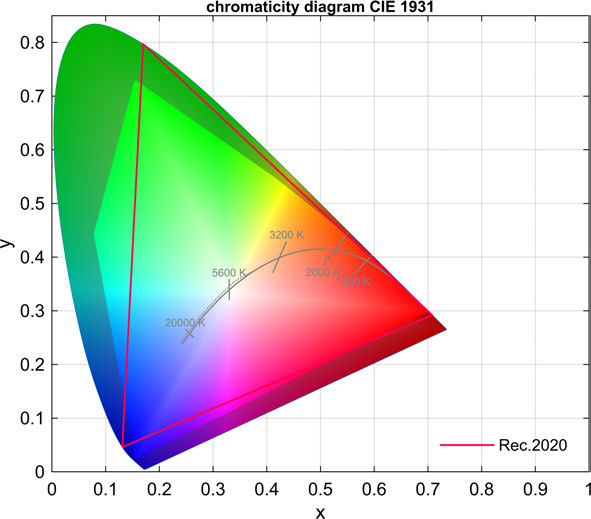
The X22 uses the same RGBACL engine as the X21 in each module. ARRI’s HyPer Optic gamut chart in the gallery characterizes the common single module. It does not establish a separately measured X22 array gamut, matching between two units, or a result for mixed optics. For a matched array, set both heads to the same output mode, CCT and tint and check what the combined beam does at the working distance.
Power and Batteries
The nominal 1,600W figure is for the X22 configuration. Each X21 contains its own power supply and has AC input/through connections plus a 48V DC input. Plan the supply from the actual fixture labels, circuit protection, voltage, connectors and upstream load; the wattage alone does not establish that an ordinary outlet or daisy-chain arrangement is suitable. Battery capability and available runtime depend on the approved DC supply and complete setup.
Control, Cooling and Camera Operation
Control options include local operation, DMX/RDM, Art-Net, sACN and CRMX. Match the DMX profile and firmware to the intended pixel arrangement. For modular arrays, confirm the operating mode, CCT, dimming, addressing and inter-module configuration before judging output. Listen to the selected fan behaviour in the actual recording position; do not assume the brightest mode is the quietest.
Modifiers, Rigging and the Working Package
The X22 needs two X21 modules plus the matching modular frame, mounting arrangement and interconnections. The X Modular Yoke uses a 28mm spigot; do not treat the bare-module weight as the supported load. ARRI also documents frame mounting with specified spigots. Use the exact assembly instructions and qualified rigging personnel rather than improvising a larger bracket.
ARRI supports mixed HyPer/Dome configurations, but the finder covers only uniform arrays matching its tables. A hybrid array has different beam coverage and is not represented by choosing a single optic here. Frame spacing needs adjustment for S60 adapters; an accessory that fits one X21 is not automatically a complete modifier for the entire array.
- Confirm the exact optic quantity, diffusion type and any grids, barndoors or softboxes on the rental list.
- Count the head, yoke, frames, optics, modifiers and cables when planning support and transport. Follow the manufacturer’s mounting and secondary-retention requirements.
- Check locking points, connector condition, optic fit and all included cable lengths before the package leaves the rental house.
Alternatives and Related Fixtures
- SkyPanel X21: choose one head for less weight, fewer cables and up to eight zones when the working distance or aperture does not need the square array.
- SkyPanel X23: three heads and up to 24 zones for a larger 2:3 aperture or more native-hard output; allow for a heavier frame and deployment.
- A dedicated large soft panel: worth considering if you only need a broad source and do not benefit from breaking the system into independent heads or fitting two hard optics.
What People Are Saying
Matthew Allard ACS tested a single SkyPanel X lamphead for Newsshooter. That is useful context for how the common module and front optics work, but its measurements are not an independent test of an assembled X22. For the square configuration itself, the NAB walk-through below shows the two-head hardware; the output numbers above remain ARRI’s.
Field Feedback at a Glance
What worked
- One control panel for two heads. ARRI’s X22 array mode can run both heads from one ALL-WEATHER panel and one DMX profile, while retaining zone control. ARRI’s X22 array setup.
- Hard or soft from the same frame. Two HyPer Optics narrow the output for a throw through a window; two X21 Domes give a much wider field from the square assembly. ARRI’s array photometrics.
- Colour accuracy of the shared head. Allard’s single-head test measured 5,592 K at a 5,600 K setting in Standard mode. This is useful when prepping the two heads, but does not establish an as-assembled X22 reading. Read the single-head measurements.
Drawbacks to plan for
- Build and transport space. Allard found even a single head and its optics bulky. The X22 adds a second head, a modular frame and daisy-chain cabling. Confirm the assembled support and case count before booking. Allard’s handling observations; ARRI modular hardware.
- No spot-to-flood control on HyPer. Allard notes that the shared HyPer optic has a fixed beam; diffusion will broaden it at the cost of output. The published two-HyPer configuration is not a substitute for a zoom Fresnel if you need to refocus the throw frequently. Read Allard’s optic comparison.
- Check colour mode on both heads. Allard measured slightly weaker colour rendering in High Output mode on one module. Set both heads to the intended mode and test the assembled panel before a colour-critical shot. See the mode-by-mode measurements.
Videos
At 07:27 of this NAB 2025 booth walkthrough, jump directly to the SkyPanel X22 segment. It is a hardware demonstration, not an independent comparative output test.
Rental and Used-Fixture Checks
Before You Book
Ask for both X21 modules and the X22 frame and harness. If you plan to use S60 adapters on both heads, confirm their spacing and the actual diffusers in the rental package before using the calculator’s S60 row.
Documentation and further reading
- ARRI technical data and downloads: model specifications, photometric charts and current document collections.
- ARRI modular system guide: configurations, frames and mixed-optic arrangements.
- ARRI current manuals: follow the exact operating, safety and assembly instructions for the rented hardware.
- SkyPanel X21 guide and family comparison: single-module specifications, shared features and reviews.