
Last Updated 22 hours ago
Studio Ceramic 250 Overview
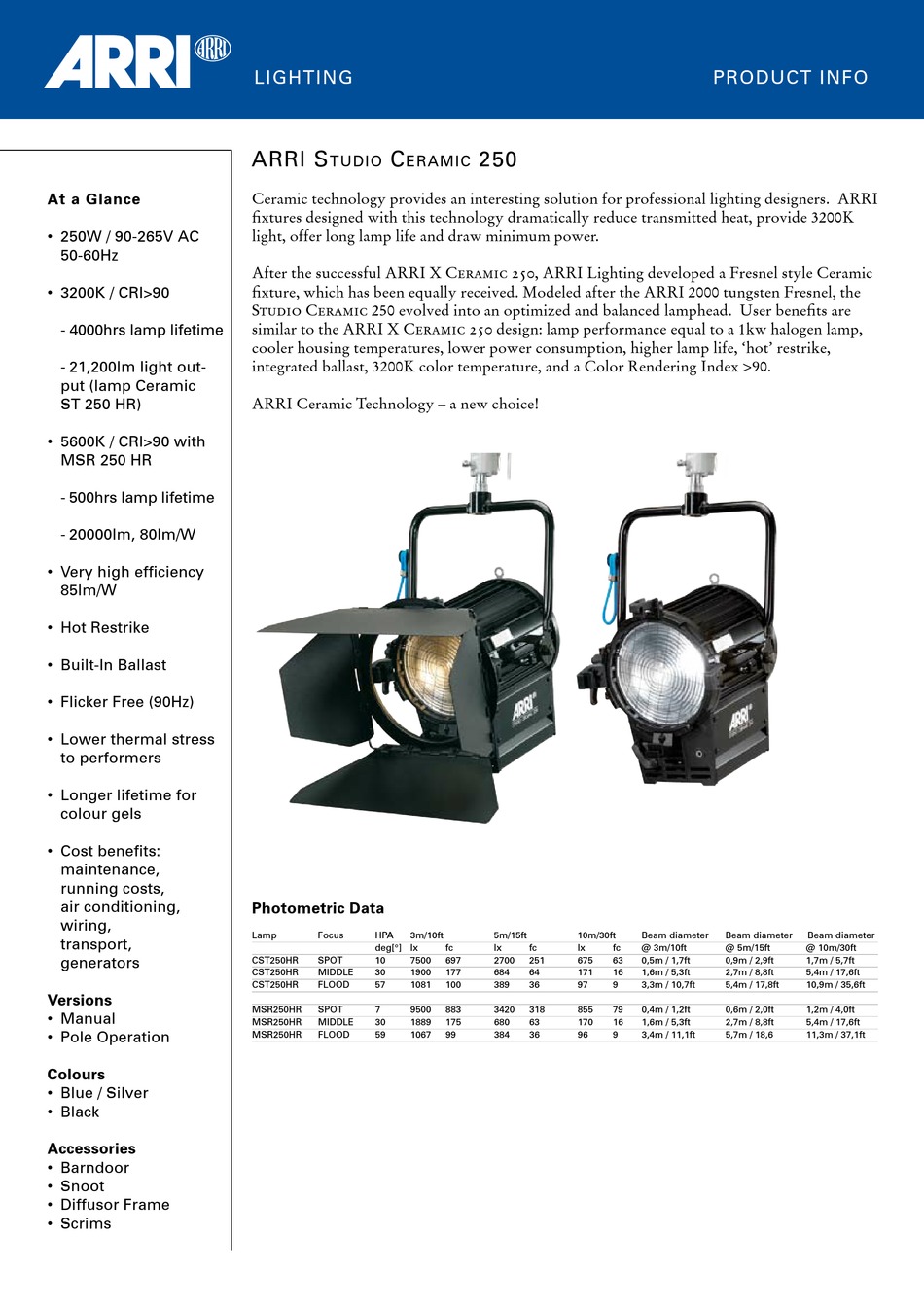
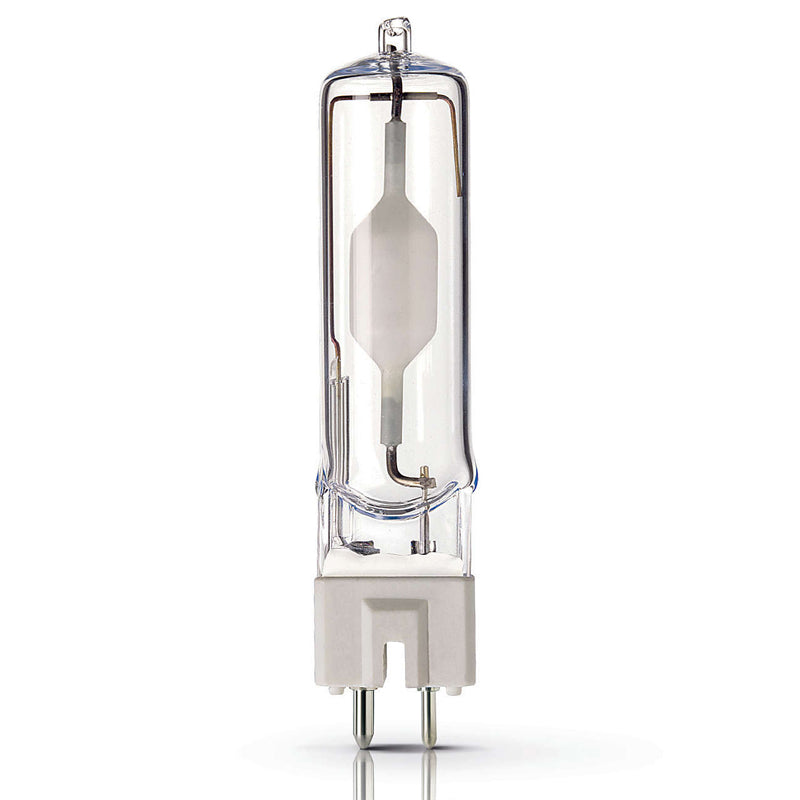
The ARRI Studio Ceramic 250 is a compact 175mm Fresnel with an integrated electronic ballast. It can run a Ceramic ST 250 HR for tungsten balance or an MSR 250 HR for daylight balance. ARRI’s photometric sheet lists the daylight setup as 5,600 K; Philips rates its MSR 250 HR lamp at 6,000 K. Meter the fitted lamp before matching other sources.
The fixture’s choice of lamp determines colour temperature. ARRI publishes separate spot-to-flood readings for each lamp, so compare the correct setup in the Output Calculator.
- Fixture Type 175 mm ceramic-lamp Fresnel
- Power 250 W lamp; integrated electronic ballast and igniter
- Colour Temperature 3,200 K Ceramic ST; 5,600 K MSR in ARRI’s test
- Weight 8.2 kg with lamp/no accessories; US catalogue says 8.4 kg
- Beam Angle 10°–57° with Ceramic lamp; 7°–59° with MSR
- IP Rating IP20 Check the exact head and connected package. Read the IP Rating Guide.
Studio Ceramic 250 Specifications
| Stand model | 539500; hanging and black-finish versions were also listed |
|---|---|
| Lamps | Philips Ceramic ST 250 HR, 3,200K, GZY9.5, 4,000h, 21,200lm; or MSR 250 HR, 5,600K, 500h, 20,000lm |
| Input | 90–265VAC, 50/60Hz; direct mains connection |
| Ballast | Integrated electronic ballast and igniter; flicker-free 90Hz square-wave operation; hot restrike |
| Current | Less than 3A at 120V; less than 1.5A at 230V |
| Lens | 175mm Fresnel |
| Focus range | 3,200K lamp: 10° spot to 57° flood; 5,600K lamp: 7° spot to 59° flood |
| Dimensions | 327 × 305 × 359mm |
| Weight | Product-information sheet: 8.2 kg with lamp, without accessories. US catalogue: 8.4 kg / 18.5 lb. |
| Mount | US catalogue stand model 539500: 16 mm (5/8 in.) mount. European product-information edition: 28 mm DIN 15560/T24ZA spigot. Confirm the actual fixture fitting. |
| Protection | IP20; 45°C maximum ambient; ±90° tilt. Product-information sheet: 80°C maximum surface temperature; operating instructions: 90°C. These are different document editions; follow the instructions applicable to the actual fixture. |
Output Calculator
Select the published setup and a manufacturer distance, or enter a custom throw where supported. The results describe centre-beam output, not the brightness across the whole beam.
Camera Settings
If the calculator does not load, use the published photometric table or source on this page. JavaScript is required.
F-stop is a planning estimate, not a meter reading. It uses direct, on-axis illuminance and includes only the optics and diffusion named in the selected setup. Meter on set to account for lens transmission, filters, added diffusion, bounce, dimming and ambient light.
How the exposure estimate works
N = √(E × ISO × t / C), where E is illuminance in lux and t = shutter angle ÷ (360 × fps). The default C = 340 is a dome reference; C = 250 is a flat reference. These are calibration constants, not a measured T-stop. A small nonzero digit is tenths of a stop above the displayed full stop.
Distance estimates and comparisons
Published points are used as given. Between published points the calculator fits a curve through the two nearest readings. Outside those points it uses the inverse-square law only when the fixture’s dataset permits it. Distances outside a configuration’s supported range are reported separately. Comparisons use one shared distance and camera setup; equal lux does not imply equal coverage.
View published readings for the selected configuration
Strengths and Limitations
The Fresnel focuses mechanically and has an integrated ballast. Changing colour temperature requires a different approved lamp or suitable filtration, not a setting on the fixture.
Practical Uses
Start in spot for a small accent or longer throw. For a wider key or a bounce, open the beam and check the level after the modifier.
Output and Colour
Optics and operation
The lamp carriage focuses from spot through a documented middle position to flood. ARRI rated both lamp options above Ra 90. The long-life 3,200K Ceramic lamp is the distinctive configuration, while the supported 5,600K MSR lamp converts the same head into a compact daylight Fresnel.
Factory Photometrics
| Lamp | Focus | 3m | 5m | 10m |
|---|---|---|---|---|
| 3,200K CST 250 HR | Spot 10° | 7,500lx | 2,700lx | 675lx |
| 3,200K CST 250 HR | Middle 30° | 1,900lx | 684lx | 171lx |
| 3,200K CST 250 HR | Flood 57° | 1,081lx | 389lx | 97lx |
| 5,600K MSR 250 HR | Spot 7° | 9,500lx | 3,420lx | 855lx |
| 5,600K MSR 250 HR | Middle 30° | 1,889lx | 680lx | 170lx |
| 5,600K MSR 250 HR | Flood 59° | 1,067lx | 384lx | 96lx |
The calculator uses the product-information sheet’s metric distance headings (3, 5 and 10 m), not its approximate feet labels (10, 15 and 30 ft). All 18 printed lux readings are retained. Calculation is limited to 3–10 m; intermediate readings are estimates, not additional factory measurements. The separate US catalogue dataset below is not combined with these configurations.
US Catalogue Photometrics
The April 2005 ARRI US catalogue, page 4 publishes this separate Ceramic-lamp dataset. Distances below use the original feet headings, not the rounded metric equivalents. Do not merge these values with the product-information edition above.
| Distance (ft) | Spot 10° (fc) | Flood 57° (fc) |
|---|---|---|
| 5 | 2,699 | 388 |
| 10 | 675 | 97 |
| 15 | 300 | 43 |
| 20 | 169 | 25 |
The same catalogue’s flood beam-diameter formula disagrees with its tabulated diameters. No beam-size estimate is derived from that formula.
Power and Batteries
The integrated ballast takes the documented AC mains supply; the fixture has no documented native camera-battery connection. ARRI’s exact-model operating instructions.
Control, Cooling and Camera Operation
ARRI specifies 90 Hz square-wave operation. Test the actual camera, shutter and light combination before relying on it for a high-speed shot.
Modifiers, Rigging and the Working Package
Confirm the 245 mm door ring and 229 mm front accessory insert. Confirm the actual spigot because the US and European documents identify different fittings.
Alternatives and Related Fixtures
Related fixture: The ARRI X Ceramic 250 is the open-face model. Its fixed spread and clip-on intensifier are a different optical system from this focusing Fresnel.
Consider the ARRI X Ceramic 250 for a wide open-face fill without Fresnel focus.
What People Are Saying
Field Feedback at a Glance
These are model-specific operating notes from ARRI’s Studio Ceramic product sheet and the identified catalogues, not an independent crew test.
What worked
- The 175 mm Fresnel gives the Studio head mechanical beam focus. ARRI’s 3200 K Ceramic test covers 10° spot to 57° flood; the 5600 K MSR test covers 7° to 59°.
- The built-in ballast and igniter let the Studio head take AC without a separate head-to-ballast cable. ARRI documents hot restrike with the approved lamps.
- ARRI’s April 2005 US Ceramic catalogue identifies the Studio 1K Fresnel accessory system. A prepared studio can check its existing doors and accessories instead of assuming it needs the X head’s separate optics.
Drawbacks to plan for
- The white balance changes by fitting a different approved lamp, not by turning a dimmer. ARRI labels its MSR photometric setup 5600 K, while Philips’s later lamp catalogue lists the MSR 250 HR at 6000 K nominal. For a critical match, meter the fitted lamp.
- ARRI’s US stand kit and European product-information sheet specify different pins (16 mm versus 28 mm). Check the exact fixture before choosing support.
- The 4000-hour figure in ARRI’s sheet applies to the 3200 K Ceramic ST lamp, not the daylight MSR. Check lamp type, condition and availability before relying on a used unit.
Hagen Keller: F-Fort and Lamp Wagons
For Paul and Damien McCarthy’s HD shoot at Munich’s Haus der Kunst, lighting designer Hagen Keller used thirteen Studio Ceramic 250 Fresnels and two Junior 5K Fresnels. The lighting later became part of the exhibition installation. In ARRI News, September 2005, pp. 64–65, Keller says the thirteen Ceramic heads replaced thirteen 1 kW tungsten Fresnels, reducing the stated load for that group from 13 kW to 3.25 kW. That excludes the two Junior 5Ks and is not a matched-output test. ARRI supplied the heads as a test project.
Videos
For an exact-model reference, use ARRI’s exact-model operating instructions. No exact-model video is included.
Rental and Used-Fixture Checks
Confirm the model plate, fitted lamp and connector. Check the actual support, intact lens and front and front accessories against the matching manual.
Documentation and Specifications
- Original ARRI Studio Ceramic 250 product-information sheet
- Original ARRI Ceramic catalogue
- Original ARRI Studio Ceramic operating instructions
Product photograph: original ARRI product document archived by ManualsLib. Browse ARRI equipment · HMI lighting · all equipment · photometric calculator.