
Last Updated 6 hours ago
Overview
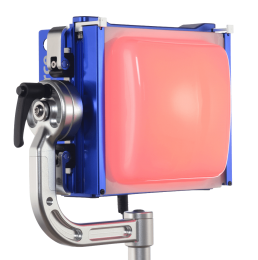
The Creamsource Micro Colour is an 80W full-colour LED panel with a 20° native beam, passive cooling and a 10–32V DC input. It combines a compact aluminium head with extensive white-light and colour controls for accents, interview backlights and battery-powered location work.
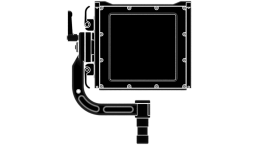
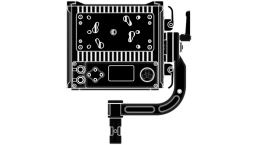
It is the colour-capable Micro, distinct from the bi-colour Micro Bender. The head weighs 3.4kg without its yoke and 4.2kg with it. The photograph shows a dome accessory fitted; the unmodified fixture has a much narrower distribution.
Key specifications
| Specification | Details |
|---|---|
| Engine / CCT | RRGBBW on current product page; 2,200–15,000K with green–magenta |
| Power / native beam | 80W / 20° half-peak |
| CRI / TLCI | Typically 95, manufacturer data sheet |
| Fixture input | 10–32V DC; max 8A |
| Supplied AC power supply | 100–240V, 50/60Hz; max 1.3A |
| Cooling | Passive, no fans |
| Head / with yoke | 3.4kg / 4.2kg |
| Body size | 223 × 207 × 108mm |
| With yoke | 300 × 331 × 108mm |
| Weather / maximum ambient | IP65 head / 40°C; standard power supply and accessories are not water resistant |
| Control | Onboard, DMX via optional adapter cable, optional wired remote |
| High-speed claim | Over 5,000fps in the specified High Speed mode |
| Rigging | Quick-release yoke, ⅜in thread, twist-on rear mounting plate |
Strengths and limitations
Strengths
- Fan-free operation suits close dialogue and quiet interview positions.
- An 80W load and broad DC input range allow practical camera-battery operation with the correct plate and lead.
Limitations
- A small face and 20° beam need additional shaping for a broad soft key.
- The yoke, battery mount, DMX adapter and lenses vary by kit; the bare head does not describe the complete cost or weight.
Practical uses
| Setup | Working approach |
|---|---|
| Interview backlight | Use the native beam to keep the backlight off the lens and background; add a spreading lens when the actor needs more room to move. |
| Colour accent | Set a hue or x,y target, then judge the colour on the actual surface and camera. A glossy wall can expose the small emitting face. |
| Quiet close key | Fit diffusion or a softbox and move the source close. Re-meter after fitting it because the wider field costs substantial centre intensity. |
Output and colour
| Distance | 3,200K — lux | 5,600K — lux |
|---|---|---|
| 1m | 12,900 | 12,340 |
| 3m | 1,400 | 1,340 |
| 4m | 790 | 750 |
The data-sheet values are for the native 20° beam. A spreading lens changes distribution and centre exposure. The same nominal beam-angle label on an accessory does not mean it transmits the native beam unchanged.
For saturated colours, judge the result on the production camera and actual set materials. A white-light CRI figure does not describe the exposure or spectral behaviour of every colour cue. Record the chosen colour mode, values and modifier for repeat setups.
Power and batteries
Use the matched supply or a DC source within the documented 10–32V range that can sustain 80W. A 95Wh battery divided by 80W gives about 71 minutes as a theoretical energy limit; usable runtime is lower after conversion losses, battery condition and shutdown reserve. Check the battery’s continuous-current limit as well as its capacity.
Control, cooling and camera operation
DMX uses the optional Micro adapter lead; the head does not have the Vortex-style set of full-size data ports. Onboard colour modes include CCT/tint, HSV, RGBW, x,y and gel selections. Order the required control cable with the lamp rather than assuming a normal DMX cable connects directly.
The Micro Colour data sheet specifies high-speed operation above 5,000fps in the dedicated mode. Test the shot’s shutter and dimming level. Camera sync is for timed flash effects; ordinary continuous-light high-speed operation is a separate function.
Modifiers, rigging and the working package
Micro lenses, domes, barn doors and SNAPBAG accessories serve different purposes. A dome spreads the light, a softbox increases apparent source area, and a grid or flags contain spill. Keep the passive cooling fins clear, especially when the head is concealed near fabric. The IP65 head does not make the attached battery plate or AC supply weatherproof.
Alternatives and related fixtures
| Fixture | When to compare it |
|---|---|
| Vortex4 | A larger hard panel with Vortex data connectivity and more output. |
| Vortex8 Soft | A much larger native soft face for broad keys. |
What people are saying
Matthew Allard ACS, Newsshooter
Allard’s hands-on review praises the construction, controls and colour performance while noting the weight and accessory cost. His 1m tests recorded about 14,400 lux at both 3,200K and 5,600K; fitting wide lenses or diffusion reduced centre output sharply. These are review-unit measurements, separate from the manufacturer’s table. View the source.
Videos
Manufacturer-hosted Micro Colour production example.
Rental and used-fixture checks
- Check the Colour model rather than the Bender, and verify the intended colour and effects modes.
- Inspect the accessory-port adapter, DC cable, twist-on plate and quick-release yoke.
- Budget the complete kit: power supply, battery plate, control lead and selected lenses.
- Run the exact camera test after fitting diffusion, not only with the open head.
Documentation and specifications
- Manufacturer product overview
- Technical specification and output data
- Operating documentation
- Micro manuals, DMX tables and firmware
Product images and technical illustrations: Creamsource. Paired-model photographs show both optical versions; kit photographs include accessories that vary by package.
Related Creamsource fixtures: Creamsource Micro Bender · Creamsource Vortex2.
Browse Creamsource lights · all equipment.