Last Updated 3 days ago
Overview
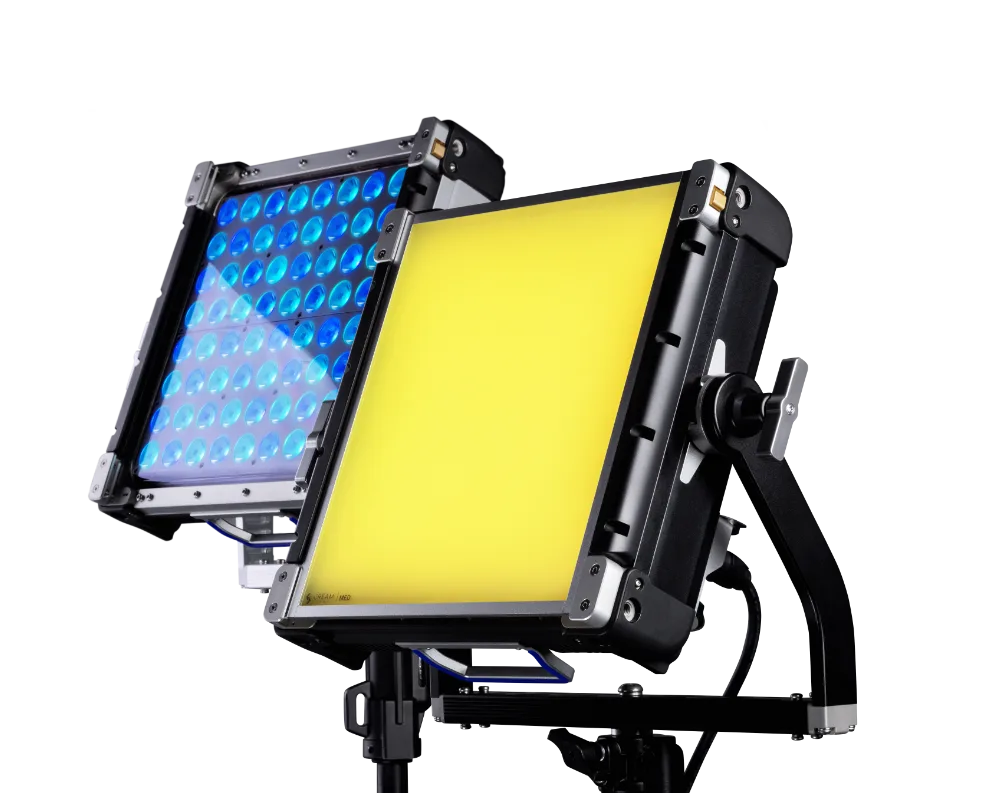
The Creamsource Vortex4 is the smaller hard-panel member of the Vortex family, with concentrated native optics, four controllable zones and an IP65-rated housing. It is distinct from both the larger Vortex8 and the Vortex4S soft model.
Vortex4 provides the hard-to-soft Vortex approach in a smaller four-zone panel. It reduces source area and weight relative to Vortex8, but remains an approximately 11.6kg head-and-yoke package before front accessories.
Key specifications
| Specification | Details |
|---|---|
| Exact model | Original Vortex4 hard panel; distinct from Vortex4S |
| Engine / white range | RRGBBW; 2,200–15,000K with tint and colour controls |
| Native optics / zones | 20° half-peak angle / four controllable zones |
| Fixture class / AC input | 325W class; 100–240V, 3.3A maximum |
| DC input | 48V, 6.9A maximum; full-brightness DC supported |
| Manufacturer colour references | Typical CRI 95; TLCI 95 |
| Head / yoke | 9.9kg / 1.72kg |
| Dimensions with yoke | 525 × 570 × 179.25mm |
| Control | Onboard, DMX, internal TimoTwo CRMX and Ethernet |
| Protection / ambient | IP65 prescribed configuration / maximum 40°C |
Strengths and limitations
Strengths
- Four zones and a narrow native beam provide directional or diffused effect-light options.
- Internal CRMX, Ethernet and full-brightness DC capability can simplify a planned location system.
Limitations
- The complete yoke-equipped fixture is heavier than the 9.9kg head figure.
- A diffuser changes the output substantially, so native lux is not a soft-panel comparison.
Practical uses
Use it where a compact panel needs directional reach, coloured light or diffusion-based soft output. The head is still substantial for a 1×1, so include its mounting and modifier load in the support plan.
| Setup | How to use this fixture |
|---|---|
| Compact hard source | Use native optics for a directional pool, bounce or window beam. Compare the coverage with the larger Vortex8 rather than assuming identical output from the smaller body. |
| Small soft key | Fit diffusion, dome or a suitable softbox, then meter the working source. The native 7,300-lux reading at 3m is not a diffused-key result. |
| Four-zone effects | Choose the matching zone/precision personality. Run a simple orientation cue before building a more elaborate moving effect. |
Output and colour
Vortex4 is a four-zone hard panel with 20° native optics, distinct from the Vortex4S soft model. Creamsource lists 7,300 lux at 3m/5,600K in native spot configuration. Flat diffusion, dome and softbox options change beam spread and exposure. Whole-panel white output also differs from a pixel effect using only part of the surface or a saturated colour.
Vortex4 Configuration and Output
| Native 20° output | 1m | 3m | 5m |
|---|---|---|---|
| 3,200K | 48,500 lux | 6,700 lux | 2,500 lux |
| 5,600K | 53,100 lux | 7,300 lux | 2,700 lux |
Photometric & exposure calculator
Estimate centre-beam illumination and the corresponding camera aperture from this fixture’s published measurements.
Estimated output
Select a configuration to calculate.
Manufacturer readings are for the stated optic, colour setting and full output, measured at the beam centre. Values between measured distances are interpolated. Point-source values outside those distances are approximate inverse-square estimates; large sources cannot be reliably extrapolated and are limited to their measured range. Exposure uses frame rate, shutter angle, ISO and the selected incident-meter calibration. Only the optics and diffusion explicitly listed in the measurement are included; additional modifiers, bounce, beam edges, ambient light, ND filters and camera exposure-index differences are not accounted for. Confirm critical exposures on set with a meter. Photometric source
Sources: Vortex4 – Creamsource; Creamsource Vortex 4 specifications.
The 20° manufacturer table describes the native hard configuration. A flat diffuser or dome spreads the light; a saturated cue or partial-zone effect changes the active emitters as well. Keep those distinctions with an exposure comparison.
The square Vortex4 occupies less space than Vortex8. Its complete kit includes the quick-release yoke and selected light-control accessories.
Tests and reviews
CineD’s CreamOS interview was produced in cooperation with Creamsource. Newsshooter’s launch article covers features, weight and the supplied package. The photometric table contains Creamsource’s figures.
Read the Vortex4 launch context; the videos below add operation and use perspectives.
Power and batteries
The 325W-class lamp accepts 100–240V AC, with 3.3A maximum listed in the current support specification. A suitable 48V DC system at up to 6.9A supports full brightness.
The PSU is built into the head. DC operation needs a separate battery system with the required voltage, continuous output and cable capacity.
Control, cooling and camera operation
| Control path | Hardware and operating notes |
|---|---|
| Direct / wired | Onboard interface and standard 5-pin DMX using the installed CreamOS profile. |
| Wireless | Internal LumenRadio TimoTwo CRMX reception. |
| Network | Ethernet and supported firmware/protocol configuration. |
| Pixels | Four zones; precision and personality determine the channel footprint. |
| Camera | High-Speed mode and dedicated sync input for the appropriate camera workflow. |
Creamsource’s specified over-5,000fps capability applies to High-Speed mode. Test the real frame rate, shutter, level and sync arrangement. For a low fade, assess the selected low-end behaviour separately from a maximum-output high-speed test.
Warm the lamp in the required cooling mode before checking sound. A smaller panel used closer to a subject can place its fans nearer the microphone than a larger source positioned farther away.
Modifiers, rigging and the working package
The 9.9kg head excludes a 1.72kg quick-release yoke: 11.62kg before modifiers, cable and support hardware. There are eight 3/8-inch rigging inserts and two filter rails. Check yoke engagement, accessory retention and the complete balance on its support. IP65 applies in the specified connected condition, and the maximum ambient rating is 40°C.
| Part | Working requirement |
|---|---|
| Head and yoke | 9.9kg + 1.72kg, or 11.62kg before accessories |
| Rigging | Eight 3/8-inch inserts and appropriate hardware |
| Front accessories | Two filter rails, retained diffuser and the chosen soft-light system |
| Connections | Prescribed sealed power/data arrangement for IP65 |
| Support | Quick-release engagement, yoke brake and cable clearance tested with modifier fitted |
Inspect front retention and yoke engagement with the accessories fitted. Maximum ambient temperature is 40°C; enclosed set pieces still need cooling clearance.
Alternatives and related fixtures
| Fixture | When to compare it |
|---|---|
| Creamsource Vortex 8 | Choose eight zones and a larger surface when the increased head/yoke and electrical load are justified. |
| Litepanels Gemini 1×1 Hard RGB LED Light Panel | Compare another concentrated hard 1×1 with its included diffuser options and different weather/power system. |
What people are saying
12Y Films : early owner impressions
The creator bought a Vortex4 after a Creamsource booth demonstration and says the video is not sponsored. It covers unboxing, accessory choices, stand mounting and a sample light show, with a link to the Gaffer & Gear comparison. Watch video.
Videos
Reviewer comparison: Andrew Lock, Gaffer & Gear episode 199, reviews the Vortex4 and compares its operating configurations. The manufacturer launch film follows separately.
Creamsource’s Vortex4 launch short film.
Manufacturer and supplier notes
CineD, Creamsource interview: CineD’s NAB discussion with Creamsource covers the Vortex4 and shared CreamOS control features, including presets and network-related changes. The article says the video was made in cooperation with Creamsource, so it should be treated as manufacturer-led coverage. Read article.
Newsshooter’s launch report discusses the Vortex4’s weight and smaller format, with links to Creamsource’s launch film and behind-the-scenes footage. Read article.
Rental and used-fixture checks
- Check all four zones, DMX precision mode and low-end fade behaviour.
- Inspect the quick-release, filter rails, seals and accessory latches.
- Run the chosen fan/High-Speed mode and verify DC supply current if used.
Documentation and specifications
Browse Creamsource lights · LED panels · all equipment.