
Last Updated 14 hours ago
Overview
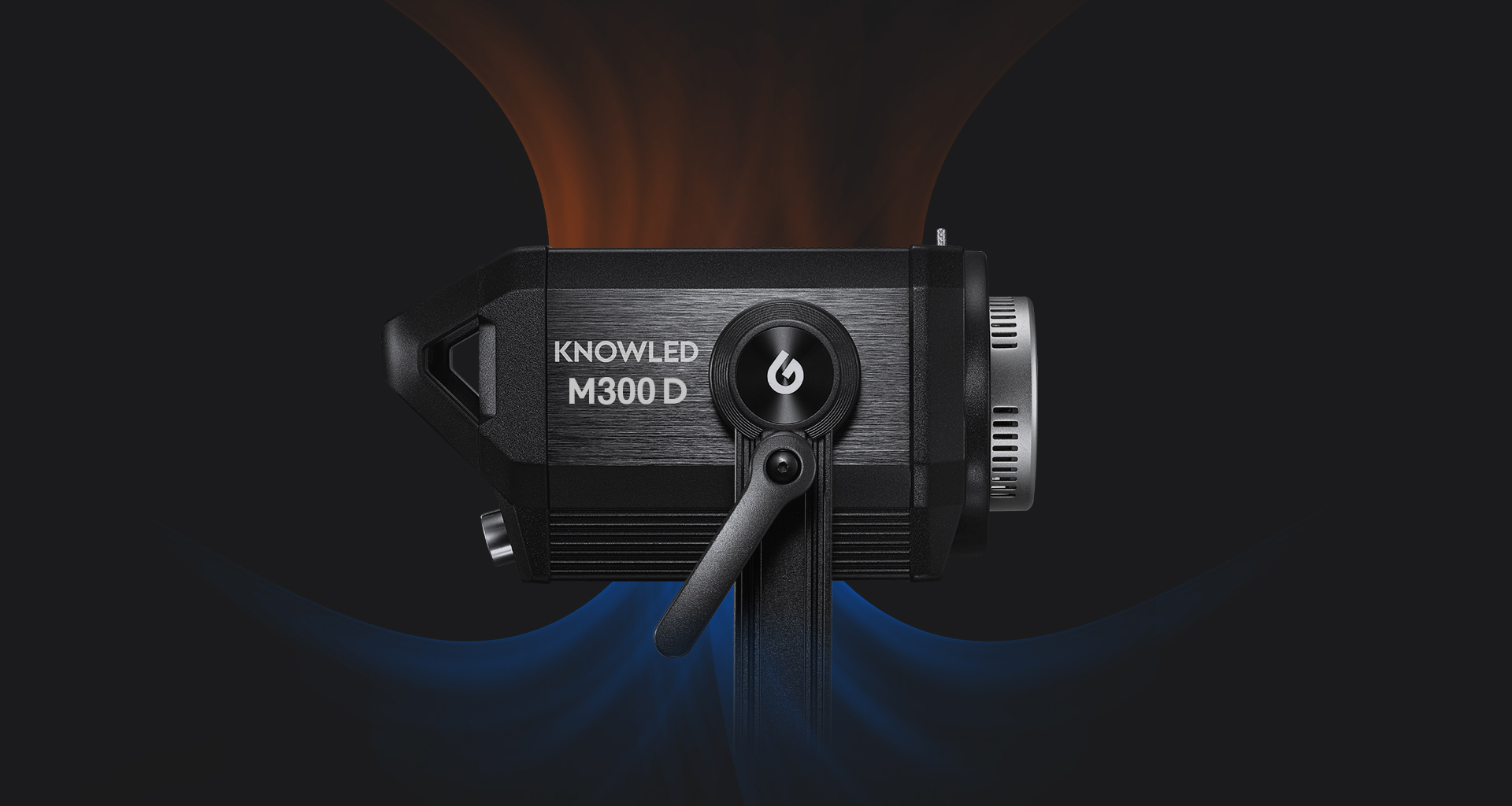
The Godox KNOWLED M300Bi is a bi-colour Bowens-mount LED fixture for larger variable-white keys, brighter interview setups and production scenes needing battery and console options. It combines a separate power/control box with wired DMX, Godox radio and Bluetooth app operation.
Its 360 W maximum input and 2800–6500 K engine identify this particular model. Battery, fan and dimming-curve settings affect the available output, so the intended power and operating modes should be set before comparing exposure.
Key specifications
| Specification | Details |
|---|---|
| Exact model | KNOWLED M300Bi; bi-colour Bowens LED light |
| Maximum electrical power | 360 W |
| Head input | 48 V DC / 7 A |
| Controller AC / DC input | 100–240 V AC, 50/60 Hz / 48 V DC |
| CCT | 2800–6500 K |
| CRI / TLCI | ≥96 / ≥97 |
| Dimming | 0–100%; linear, S-curve, exponential and logarithmic curves |
| Wired control | DMX512 |
| Wireless control | Godox 2.4 GHz; Bluetooth Godox Light app |
| Godox radio addressing | 32 channels; 16 groups (0–9, A–F); ID 1–99 or Off |
| Native CRMX | Not listed for this model |
| Local controller | Separate box with 2.4-inch display |
| Head dimensions / mass | 425.3 × 232.3 × 141.7 mm / approximately 3.5 kg |
| Controller dimensions / mass | 270.4 × 123.6 × 132 mm / approximately 2.7 kg |
| Accessory mount | Bowens; separate matching optical/modifier accessories |
| Effects | 21 variations in 7 types |
| Operating ambient | −20 to +40°C |
| Battery references | V-mount 14.8 V / 150 Wh or 26 V / 270 Wh; output depends on arrangement |
Strengths and limitations
Strengths
- Variable white avoids correction-gel changes for common settings.
- Bowens optics and a separate controller offer flexible placement.
Limitations
- Output varies with CCT and power arrangement.
- Battery voltage, fan mode and dimming curve affect available output; CRMX is not built in.
Practical uses
The M300Bi suits larger variable-white keys, brighter interview setups and production scenes needing battery and console options. The separate controller keeps the local display and power connections away from the head, while a Bowens modifier sets the apparent source size and beam character.
The variable-white engine spans 2800–6500 K, making it useful when moving between warm practicals and cooler ambient light. It adjusts the warm/cool mix rather than providing RGB hue selection or a dedicated green/magenta control.
Its 360 W maximum rating and the source configuration matter more than treating “300” as a uniform electrical or brightness specification across the KNOWLED range.
| Setup | Working approach |
|---|---|
| Interview key | Use a compatible softbox, then meter with the selected power and fan settings. |
| Hard accent | Check the exact Fresnel or projector compatibility before building a narrow beam. |
Output and colour
These are the manufacturer manual’s lux readings at 100% brightness, with bare-head and reflector setups separated. The reflector’s high central reading comes from concentrating the beam; it is not the illuminance of a large softbox or an evenly lit field.
The original bi-colour manual also includes a 4300 K row. At that setting, the M300Bi is listed at 12,900 lux bare and 135,000 lux with reflector at 1 m. CCT remains part of the measurement condition rather than an interchangeable label.
The tables represent the original documented model, not the later M300R or a proprietary-mount MG-series fixture. Check the actual modifier, fan setting, supply and exposure over the required subject area.
| CCT / configuration | 1 m, lux | 2 m, lux | 3 m, lux |
|---|---|---|---|
| 2800 K, bare | 9,960 | 2,470 | 1,170 |
| 2800 K, reflector | 103,000 | 21,700 | 9,310 |
| 3200 K, bare | 11,400 | 2,820 | 1,330 |
| 3200 K, reflector | 118,000 | 25,000 | 10,700 |
| 5600 K, bare | 13,400 | 3,350 | 1,570 |
| 5600 K, reflector | 141,000 | 30,200 | 12,900 |
| 6500 K, bare | 13,300 | 3,310 | 1,550 |
| 6500 K, reflector | 139,000 | 30,300 | 12,900 |
Power and batteries
The controller accepts 100–240 V AC and the documented 48 V DC input arrangement, then feeds the head through its matching cable. The head’s 48 V rating is not permission to connect an arbitrary nominally similar battery or supply directly to it.
The manual separately tables a single 14.8 V battery, two 14.8 V batteries, a single 26 V battery, a mixed-voltage arrangement and two 26 V batteries. The reference packs are 14.8 V / 150 Wh and 26 V / 270 Wh. Follow the actual controller instructions and discharge requirements; watt-hours alone do not establish current capability.
The table below reproduces the maximum displayed dimmer settings for CCT mode with the linear curve and Auto or High-Speed cooling. They are mode-specific dimmer limits, not percentages of measured lumens or a universal battery-power ratio. Other curves and fan modes have different tables in the manual.
| Manual battery arrangement | Maximum displayed dimmer, linear CCT mode |
|---|---|
| Single 14.8 V | 30% |
| Two 14.8 V | 60% |
| Single 26 V | 60% |
| 14.8 V + 26 V, manual-listed arrangement | 90% |
| Two 26 V | 100% |
Control, cooling and camera operation
Auto and High-Speed cooling permit the documented full dimmer range on AC. Low-Speed and Fan Off impose lower ceilings. The displayed ceiling changes with the selected dimming curve, so “fan off at 25%” is only an accurate shorthand for the linear curve in the stated mode.
The AC-powered CCT-mode limits below come from the manual’s model-specific table. FX mode uses a linear response by default and has separate supply/cooling tables. Record mode, curve and fan state with the cue rather than assuming a percentage has the same meaning everywhere.
For dialogue, listen after warm-up at the actual microphone and meter the intended quiet setup. A reduced fan setting changes the available intensity; the full-power photometry should not be used unchanged as the quiet-mode exposure budget.
| AC CCT cooling mode | Linear | S-curve | Exponential | Logarithmic |
|---|---|---|---|---|
| Auto | 100% | 100% | 100% | 100% |
| Fan Off | 25% | 38% | 60% | 7% |
| Low-Speed | 60% | 48% | 80% | 20% |
| High-Speed | 100% | 100% | 100% | 100% |
DMX512 provides the wired console route. Set the appropriate fixture personality and starting address, and test intensity, CCT, effects and blackout using the actual controller. The Godox radio channel/group/ID system is separate from DMX addressing.
A compatible Godox 2.4 GHz remote and the Bluetooth Godox Light app provide wireless options. The specifications list approximately 60 m for the proprietary radio and 30 m for Bluetooth under suitable conditions. Neither figure is a guarantee through walls or scenery, and neither route is native CRMX.
The controller offers four dimming curves and seven effect types with 21 variations. Use the exact model’s manual for channel mapping and available parameters. Check the intended shutter, frame rate and low fade on camera instead of assuming all control modes behave identically.
Modifiers, rigging and the working package
The Bowens mount supports compatible reflector, softbox and optical options. Confirm the accessory’s emitter clearance, power rating, optical suitability and mechanical support. A fitting that twists into place does not by itself establish compatibility with every Fresnel or projection attachment.
Support the controller using the specified clamp/support arrangement and retain strain relief on the head cable. Include the reflector, modifier and cable leverage when balancing the yoke. The separate head and controller weights are more useful than treating either one as the whole kit mass.
Inspect the COB protection, Bowens catch, yoke locks, fan, head cable and controller connectors. Test both AC and the intended battery configuration, both CCT endpoints, DMX, app pairing and low-level dimming. Verify the matching controller and head lead are included in a used package.
USB is reserved for the manufacturer firmware procedure in the manual. Use the correct model file and stable power; it is not an alternative power input or a general device-charging port. Check the actual controller firmware before relying on a later seller description.
Alternatives and related fixtures
The Aputure LS 300x and Nanlite Forza 300B II use different colour, controller and battery systems. Choose M300Bi for the complete documented head/controller package, control routes and output in the intended optical and power configuration.
| Fixture | Choose it for |
|---|---|
| KNOWLED M300D | The alternative white-light engine in the same size class. |
| Nanlite Forza 300B II | A different controller, accessory and power package. |
What people are saying
Graham Sheldon: good hardware, a weaker app
Sheldon likes the M300Bi’s output, case, accessories and controller. He finds the physical menus intuitive but criticises the limited Bluetooth app available in 2022. His meter tests also show the expected output reduction toward warmer white settings. Read or watch the full account.
Videos
CineD: M300Bi review
A hands-on review of this model.
Rental and used-fixture checks
Verify the exact model, power components and control profile. Inspect mounts, optics or diffusion, connector locks and cables. Test a slow fade, colour matching and the complete intended remote-control path before rigging.
Documentation and specifications
official M200D/M300D/M200Bi/M300Bi family page and Godox original operating manual with photometrics and output-limit tables.
Product photograph: Godox / KNOWLED official product photograph.
Browse Godox lights · COB lights · all equipment.