
Last Updated 10 hours ago
Overview
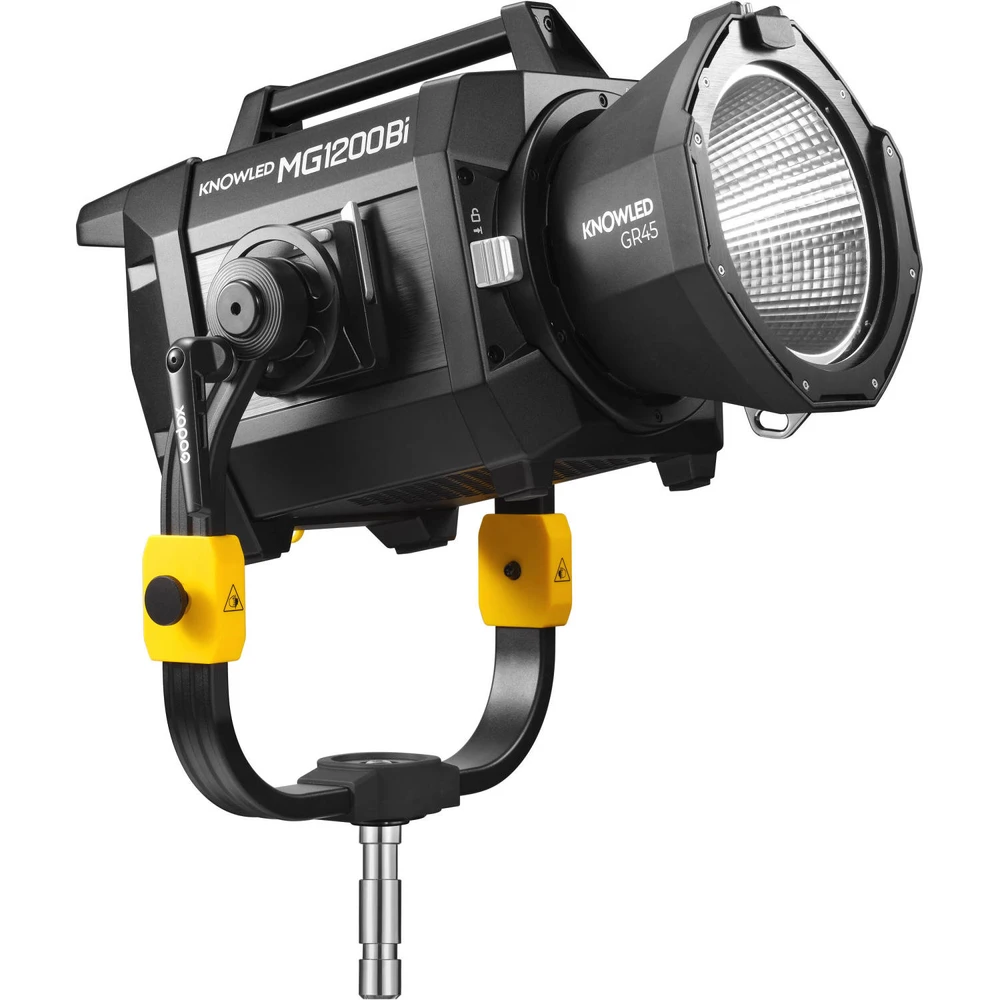
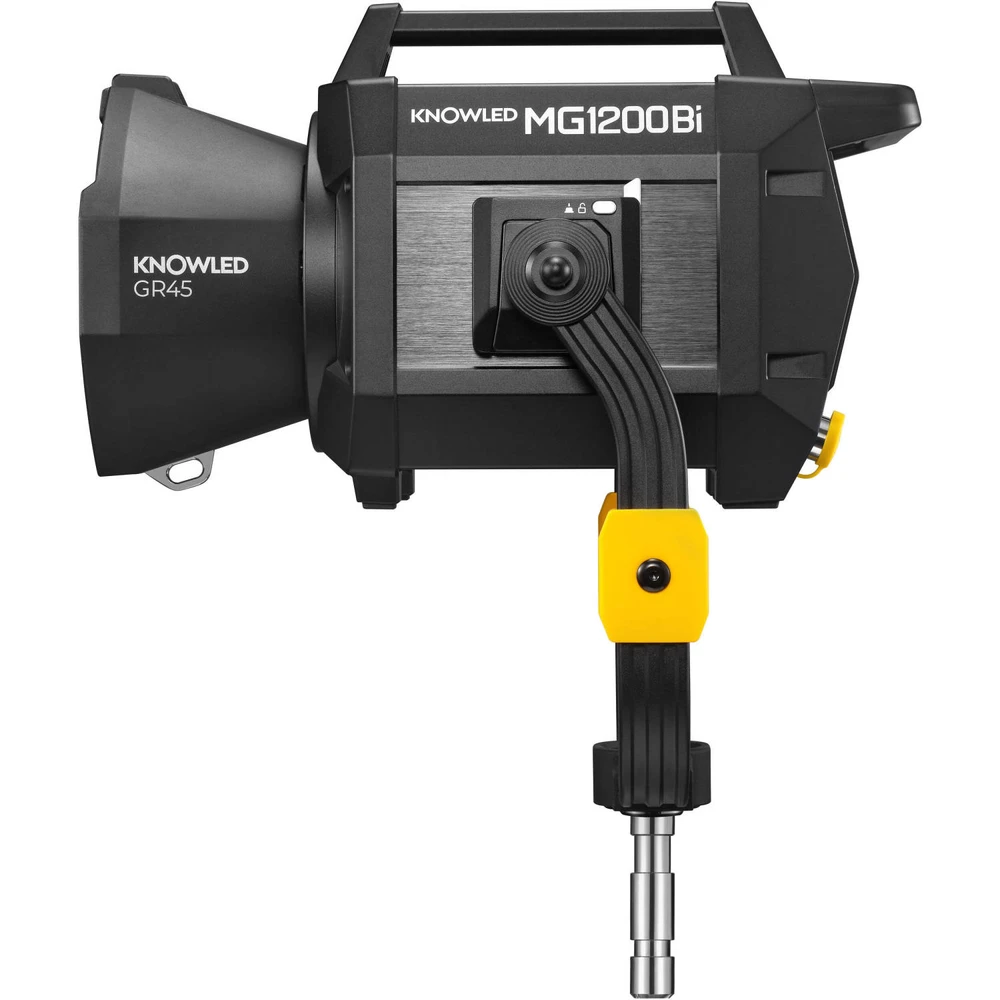
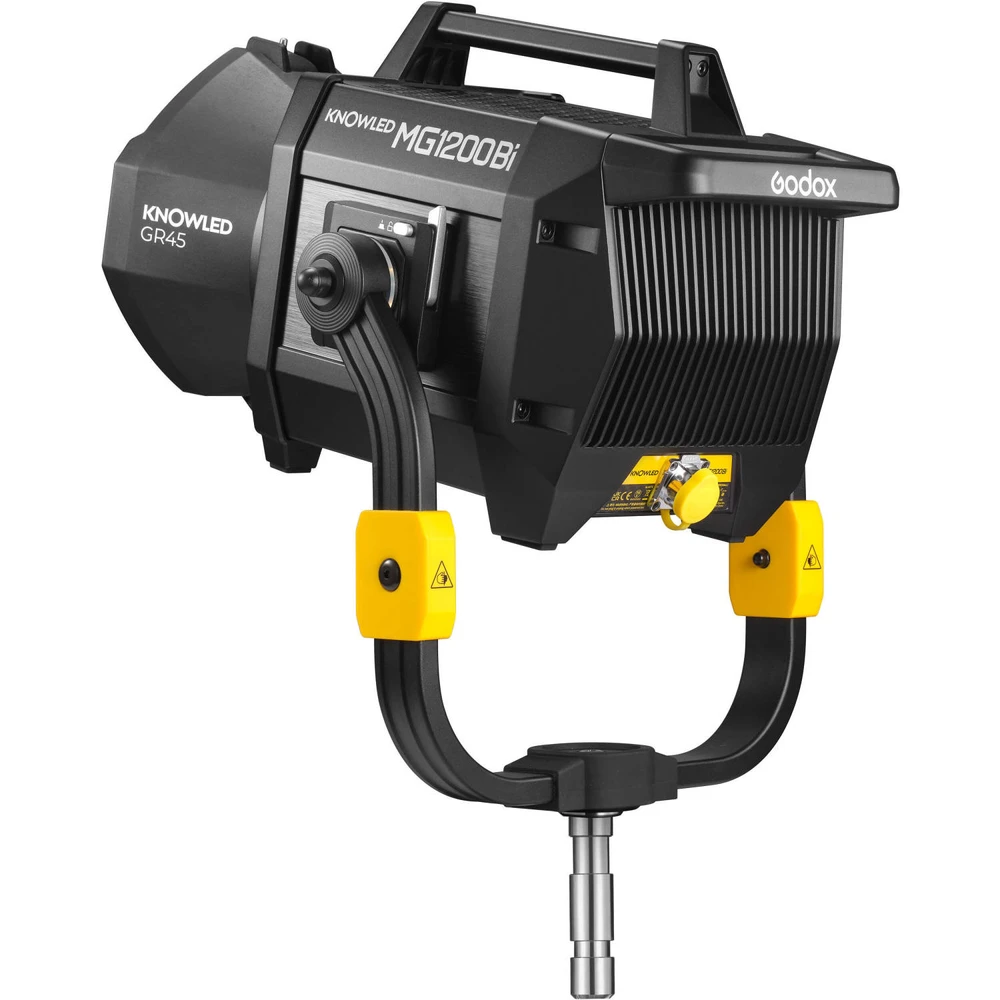
The Godox KNOWLED MG1200Bi is a 1,200 W bi-colour COB with interchangeable G-mount optics. The choice of optic changes the job it can do. At 5 m and 5,600 K, Godox measures 2,590 lux bare, 10,500 lux with the GR45 reflector and 30,100 lux with the GF14 Fresnel in spot. For a window push, quote the head and the optic together.
- Fixture TypeBi-colour COB LED with interchangeable Godox G-mount optics.
- Power Requirement1,200 W light engine; 1,400 W maximum input. Separate AC controller.
- Colour Temperature2,800–6,500 K Variable white-light output.
- Weight and MountApprox. 16 kg with yoke and reflector; controller approx. 6.68 kg. G-mount optics.
- Beam ControlInterchangeable G-mount reflectors and the GF14 focusing Fresnel change beam coverage.
- IP RatingIP54 The operating manual lists IP54 for the head and controller; the international product sheet lists IP65. Verify the exact unit and operating conditions instead of assuming the higher rating. IP Rating Guide.
Key specifications
| Specification | Details |
|---|---|
| Type | Bi-colour COB, Godox G mount |
| Power | 1,200 W light engine, 1,400 W maximum input |
| Supply | 100–240 V AC, 50/60 Hz, 14 A maximum |
| CCT and dimming | 2,800–6,500 K, 0–100%, four dimming curves |
| Colour rendering | Average CRI ≥96, TLCI ≥96, TM-30 Rf ≥92, Rg 97–103 |
| Head and controller | Approx. 16 kg with yoke and reflector. Separate controller approx. 6.68 kg. |
| Control | DMX512/RDM, CRMX, Art-Net, sACN, Bluetooth, 2.4 GHz, onboard |
| Protection grade | Manual lists IP54. International product sheet lists IP65. See the documentation below. |
Output Calculator
Select the published setup and a manufacturer distance, or enter a custom throw where supported. The results describe centre-beam output, not the brightness across the whole beam.
Camera Settings
If the calculator does not load, use the published photometric table or source on this page. JavaScript is required.
F-stop is a planning estimate, not a meter reading. It uses direct, on-axis illuminance and includes only the optics and diffusion named in the selected setup. Meter on set to account for lens transmission, filters, added diffusion, bounce, dimming and ambient light.
How the exposure estimate works
N = √(E × ISO × t / C), where E is illuminance in lux and t = shutter angle ÷ (360 × fps). The default C = 340 is a dome reference; C = 250 is a flat reference. These are calibration constants, not a measured T-stop. A small nonzero digit is tenths of a stop above the displayed full stop.
Distance estimates and comparisons
Published points are used as given. Between published points the calculator fits a curve through the two nearest readings. Outside those points it uses the inverse-square law only when the fixture’s dataset permits it. Distances outside a configuration’s supported range are reported separately. Comparisons use one shared distance and camera setup; equal lux does not imply equal coverage.
View published readings for the selected configuration
Choose the G-Mount Optic
Choose by coverage before comparing centre-beam lux. Start with the wider reflector for a bounce, the GF14 when the visible beam must change width, or projection optics when the edge or shape is part of the shot. The Fresnel’s narrow setting is not a substitute for a larger lit area.
Strengths and limitations
Strengths
- A 2,800–6,500 K range lets the same head work with warm practicals or daylight. Its 1,200 W light engine is designed to operate across that range.
- The G-mount reflector family, focusing Fresnel and projection attachments give the crew several distinct beam shapes from one head.
Limitations
- Godox lists 16 kg for the head with yoke and reflector, plus 6.68 kg for the controller. A Fresnel or projection attachment changes the balance and working weight.
- The fan-off setting caps the linear dimmer at 15%. A full-output exterior setup and a quiet dialogue setup can require different exposures.
Practical uses on set
| Setup | Placement |
|---|---|
| Day exterior through a window | Check how much of the window must be covered from the lamp position. The GR15 gives the highest centre reading in the table. A wider optic can be more useful if the beam has to cover a full opening. |
| Book light | Use the reflector to fill the bounce evenly, then judge the diffusion frame from the subject’s mark. A very narrow centre spot can leave much of the bounce unused. |
| Pattern or shaft on a set | A G-mount projection attachment gives a focused pattern or cut. For a broader shaft with an edge you can adjust on the head, compare GF14 spot and flood before choosing the working distance. |
Output and colour
Output by optic and distance
| Optic at 5,600 K | 3 m | 5 m | 7 m | 9 m |
|---|---|---|---|---|
| Bare head | 6,290 / 584 | 2,590 / 241 | 1,490 / 138 | 994 / 92 |
| GR45 reflector | 29,100 / 2,703 | 10,500 / 975 | 5,530 / 514 | 2,910 / 270 |
| GF14 Fresnel, spot | 86,100 / 7,999 | 30,100 / 2,796 | 15,300 / 1,421 | 9,180 / 853 |
| GF14 Fresnel, flood | 20,600 / 1,914 | 7,910 / 735 | 4,510 / 419 | 2,750 / 255 |
| GR15 reflector | 149,000 / 13,843 | 49,900 / 4,636 | 24,400 / 2,267 | 14,600 / 1,356 |
| GR30 reflector | 64,700 / 6,011 | 22,600 / 2,100 | 11,200 / 1,041 | 5,610 / 521 |
| GR60 reflector | 15,900 / 1,477 | 5,870 / 545 | 3,340 / 310 | 1,730 / 161 |
With the GF14 at 5 m, rotating from flood to spot takes the published centre reading from 7,910 to 30,100 lux, just under two stops. The beam also gets narrower. If you need to cover a defined width, set the beam first and meter what lands at the actor’s mark.
Power requirements
The controller accepts 100–240 V AC, 50/60 Hz. Godox lists 1,400 W maximum input and 14 A maximum on its specification sheet. Use the input rating for power planning. The 1,200 W rating describes the light engine. For portable power, check the AC source’s continuous capacity and the other loads sharing that source.
Control, cooling and camera operation
Control is available at the unit, by Bluetooth app or optional 2.4 GHz remote, via DMX/RDM or built-in CRMX, and over Ethernet with Art-Net or sACN. The fan has Auto, Medium, High and Off settings. Auto and High permit full dimmer travel. Medium depends on ambient temperature. On the linear curve Fan Off is limited to 15%. Establish the fan setting before recording room tone or exposure references.
Modifiers, rigging and the working package
The G mount accepts GR15, GR30, GR45 and GR60 reflectors, the GF14 Fresnel and dedicated projection optics. Check the accessory lock and recognition contacts when fitting an optic. Set the yoke balance with the actual optic installed and allow clearance behind the head for tilt and the head cable.
Godox’s operating manual specifies IP54 for the head and controller. The international KNOWLED product page lists IP65 for both. Confirm the rating on the supplied unit and its matching documentation before planning wet-weather use.
Alternatives and related fixtures
| Fixture | Choose it for |
|---|---|
| Godox KNOWLED MG1200R | A G-mount option when the shot needs saturated colour as well as adjustable white. |
| Godox KNOWLED MG2400Bi | A higher-output bi-colour head when the throw or amount of diffusion calls for more light. |
| Aputure STORM 1200x | A competing high-output variable-white system when the rental package uses Aputure optics. |
What People Are Saying
Field Feedback at a Glance
What worked
- The reviewer found the output strong enough for handheld stills at 1/250 s in his reflector test. Photo Café’s hands-on test.
- He measured CRI close to 97 with a Sekonic C-800. Photo Café’s hands-on test.
- He noted that the controller has a dedicated attachment point for securing it to the stand with the matching clamp. Photo Café’s hands-on test.
Drawbacks to plan for
- He found the roughly 16 kg head, yoke and reflector unwieldy enough to recommend a two-person lift onto the stand. Photo Café’s hands-on test.
- He felt considerable heat in front of the fixture during testing. Use modifiers approved for the head. Photo Café’s hands-on test.
- The reflector he tested concentrated light into a small bright center. A center reading alone did not describe the coverage. Photo Café’s hands-on test.
Interviews and high-speed work
The Digital Cinema Society’s road test follows Cameron Cannon, Brad Haskell and Enrique Del Rio across interview, small-crew and high-speed work. The high-speed segment uses a Phantom Flex, giving it a documented camera context. Digital Cinema Society road test.
Optics and meter tests
Gaffer & Gear compares the bare head, the GR45, the GR15, the Fresnel and the projection mount. The later sections cover DMX behaviour, AC draw and dimming. Start at 14:17 for the Fresnel comparison. Gaffer & Gear’s MG1200Bi review.
Videos
Gaffer & Gear tests the MG1200Bi and its optics, including the Fresnel and projection mount.
Meet the Gaffer’s Cine Gear walkthrough shows spot and flood, projection and the G-mount mechanism.
Rental and used-fixture checks
- Specify the reflector angle or Fresnel by model on the rental order. Godox’s K1, K2 and K3 lists carry different reflector selections.
- Inspect the mount, contact pins, tilt locks and locking head cable. Run the unit with the actual optic and fan setting, then test the intended dimming cue and listen from the boom position.
Before You Book
Specify the exact G-mount optic and ask for a head cable that reaches the controller position. If heat, sound or power is limiting, test the intended fan mode, dimming level and current draw with the complete setup before the shoot. Check the rating label on the rental unit rather than assuming the manufacturer’s conflicting water-protection figures describe that revision.
Documentation and specifications
- Godox operating manual and photometric tables
- Godox KNOWLED MG1200Bi product specifications
- Godox DMX mode chart
- Godox USA product photographs and kit information
Browse Godox lights · COB lights · all equipment.