
Last Updated 6 hours ago
SL200III Overview
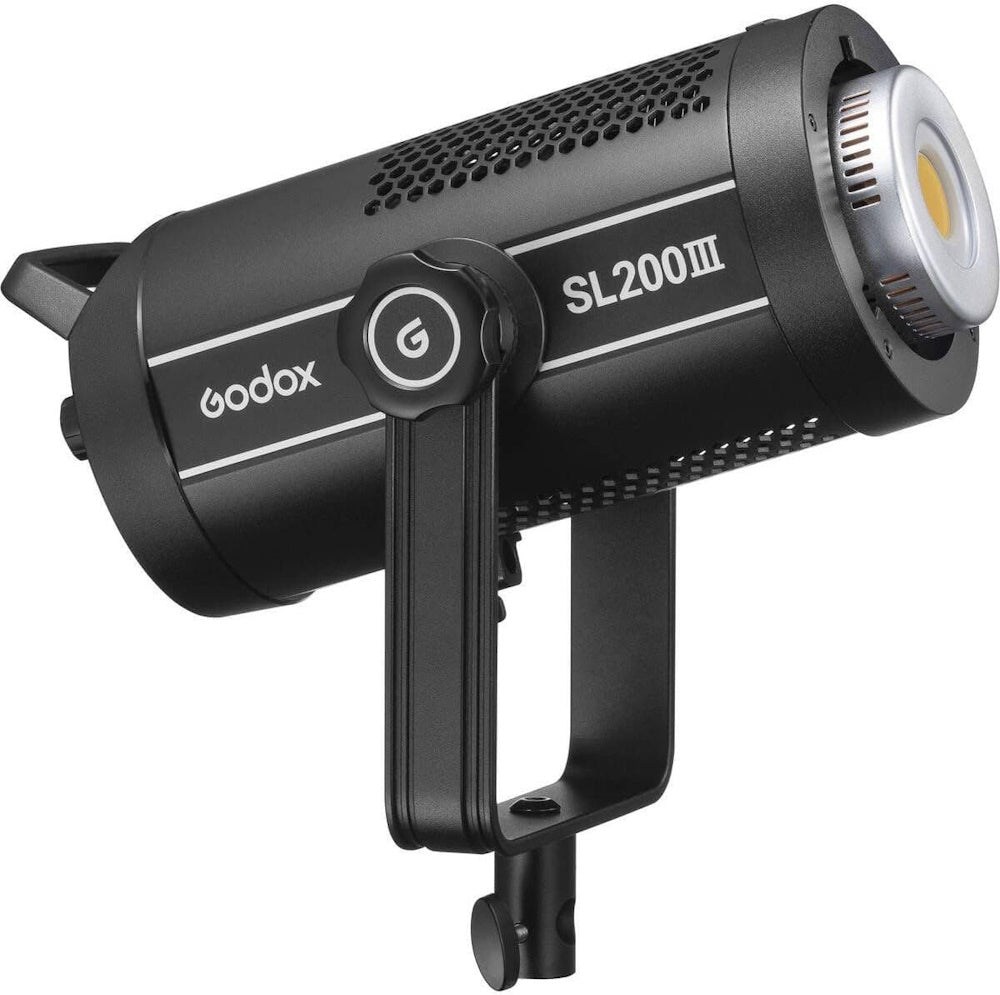
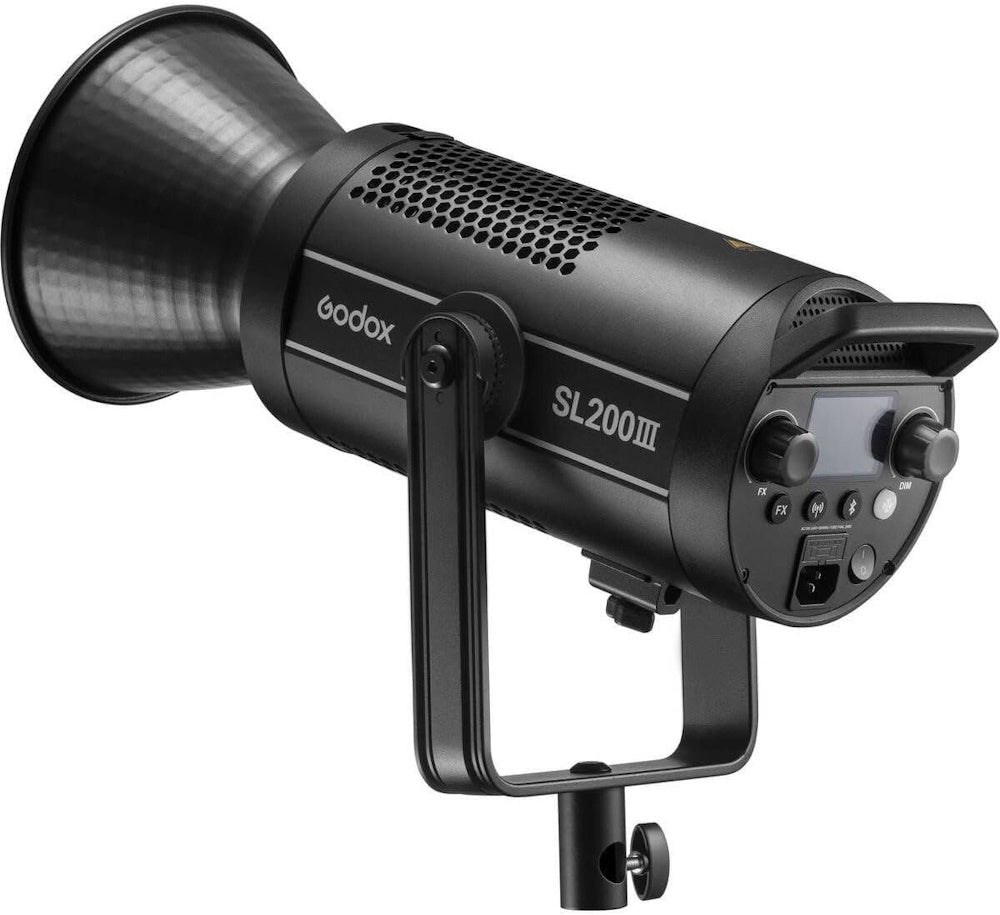
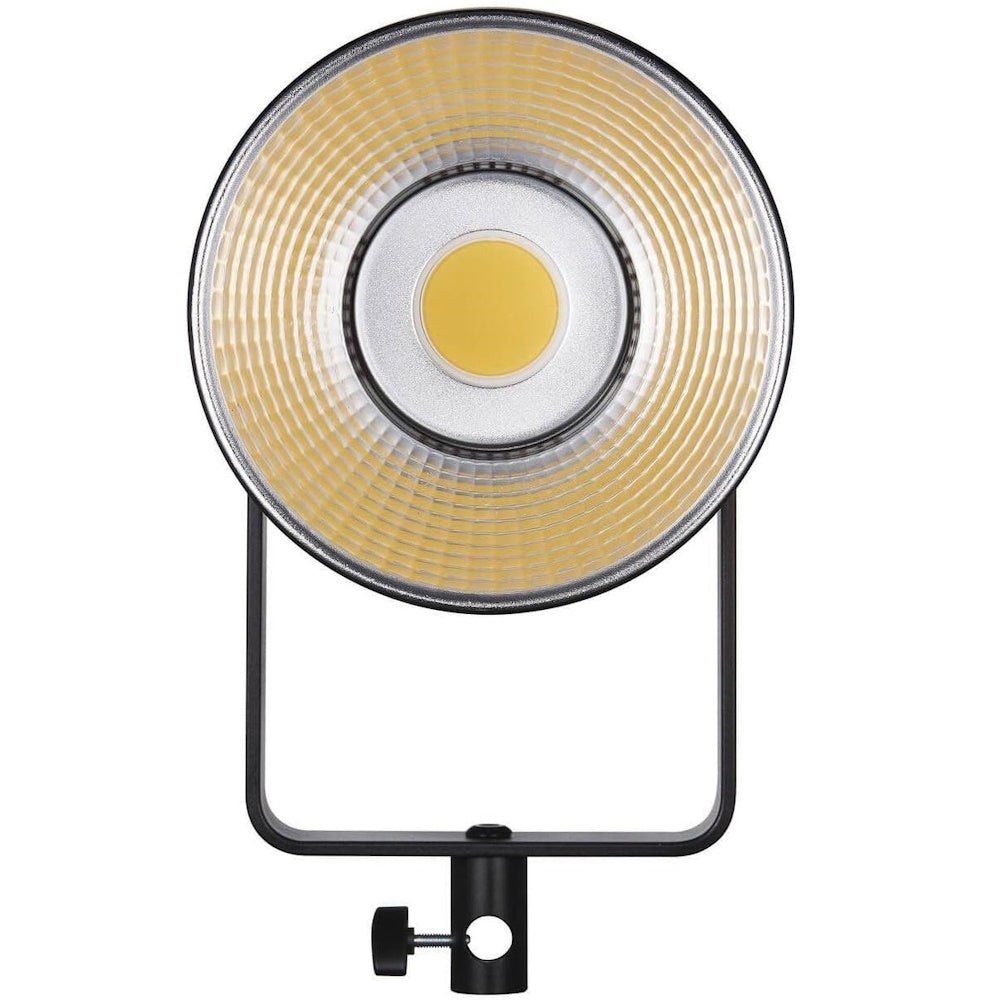
The Godox SL200III is a 215 W maximum daylight COB with a Bowens mount, rear controls and direct AC input. The SL200III provides more headroom than the SL150III when an interview key needs to sit farther back. The comparison below uses the supplied reflector on each fixture.
- TypeFixed-daylight COB LED with Bowens S mount.
- Power215 W max. 100–240 V AC, 50/60 Hz. No native battery input listed.
- Colour Temperature5,600 K ±200 K Fixed daylight.
- WeightApprox. 3.0 kg Fixture net weight.
- Beam AngleNo published angle in the linked manual. The supplied reflector and bare head have separate measurements.
- IP RatingNot documented Godox says the fixture is not waterproof. IP rating guide.
SL200III Specifications
| Specification | Details |
|---|---|
| Fixture | Daylight COB, Bowens S mount |
| Colour temperature | 5,600 K ±200 K |
| Maximum power | 215 W (Godox manual) |
| Power connection | 100–240 V AC, 50/60 Hz, 2.1 A |
| Colour rendering | CRI approx. 96, TLCI approx. 97 |
| Dimming and effects | 0–100%, 8 built-in effects |
| Control | Local controls, 2.4 GHz wireless remote and Bluetooth app |
| Dimensions | 367 × 200 × 160 mm |
| Weight | Approx. 3.0 kg |
Output Calculator
Select the published setup and a manufacturer distance, or enter a custom throw where supported. The results describe centre-beam output, not the brightness across the whole beam.
Camera Settings
If the calculator does not load, use the published photometric table or source on this page. JavaScript is required.
F-stop is a planning estimate, not a meter reading. It uses direct, on-axis illuminance and includes only the optics and diffusion named in the selected setup. Meter on set to account for lens transmission, filters, added diffusion, bounce, dimming and ambient light.
How the exposure estimate works
N = √(E × ISO × t / C), where E is illuminance in lux and t = shutter angle ÷ (360 × fps). The default C = 340 is a dome reference; C = 250 is a flat reference. These are calibration constants, not a measured T-stop. A small nonzero digit is tenths of a stop above the displayed full stop.
Distance estimates and comparisons
Published points are used as given. Between published points the calculator fits a curve through the two nearest readings. Outside those points it uses the inverse-square law only when the fixture’s dataset permits it. Distances outside a configuration’s supported range are reported separately. Comparisons use one shared distance and camera setup; equal lux does not imply equal coverage.
View published readings for the selected configuration
Strengths and Limitations
- Strength. A single mains lead serves the head. The 200’s extra output can offset some of the loss from moving the light back for a wider interview frame.
- Limitation. The difference from the SL150III is about 0.4 stop at 3 m with the stock reflectors. A large frame of diffusion or a major increase in distance can consume that advantage quickly.
Practical Uses
| Setup | Placement |
|---|---|
| Wider interview shot | Place the softbox outside the wide camera’s eyeline, then check key level at both the sitting and standing marks. Select the fan mode before setting the final exposure. |
| Hard slash or bounce | Use the reflector for a hard accent, or back the lamp away from a bounce until the board fills evenly. For a book light, check that the bright patch on the bounce stays inside the diffusion frame. |
Output and Colour
Godox measured the following configurations at full brightness. Each cell gives lux followed by the equivalent foot-candles, rounded to the nearest whole foot-candle.
| Configuration | 1 m lux / fc | 2 m lux / fc | 3 m lux / fc |
|---|---|---|---|
| 5,600 K · bare head | 7,920 / 736 | 2,070 / 192 | 1,000 / 93 |
| 5,600 K · supplied reflector | 95,600 / 8,882 | 21,500 / 1,997 | 9,080 / 844 |
At 2 m the bare reading is 2,070 lux and the reflector reading is 21,500 lux. These are two different beam distributions. For a white cyclorama or a wide wall, take a second reading away from the centre before deciding how many heads will cover it.
Power and Batteries
The SL200III takes 100–240 V AC at 50/60 Hz. Godox lists 215 W maximum and 2.1 A at the input. If the set moves off mains, specify an appropriate AC power source for the fixture and the other loads it will share.
Control, Cooling and Camera Operation
The rear panel offers dimming and eight effects. The optional RC-A6 uses the 2.4 GHz receiver, and the Godox Light app connects over Bluetooth. For silent mode the manual provides two displayed ranges, 0–33% or 0–100%. Fan-on strong-power mode is the full-power reference. Check exposure and the finish of a fade in the mode you intend to shoot.
Modifiers, Rigging and the Working Package
The body is 367 mm long before the reflector is added. Check how far the housing swings behind the stand when aiming over a product table. A Bowens lantern can give broad overhead fill, while flags or a skirt control what reaches the backdrop.
Alternatives and Related Fixtures
| Related fixture | When to compare it |
|---|---|
| amaran 200d S | A daylight alternative if your studio already uses the amaran control system. |
| Aputure Light Storm 300d II | A higher-power daylight system with a separate controller for larger modifiers. |
What People Are Saying
The notes below distinguish published specifications, demonstrations and practical setup advice from independent owner measurements.
Field Feedback at a Glance
What worked
- A single AC-powered head for a studio key. The SL200III combines local controls and AC input in the lamp body, so it does not require a separate VL II controller to place. Godox operating manual.
- Choose the modifier that shapes the job. The Bowens mount lets the same daylight head take the supplied reflector for a tighter beam or a compatible softbox for a larger apparent source. Godox operating manual.
- Control from the light or the app. Godox’s SL III family video shows the control workflow. The SL200III’s intensity can be managed locally or remotely; the adjustable CCT shown for Bi models does not apply. View source.
Drawbacks to plan for
- Fixed at approximately 5,600 K. The SL200III is not the SL200IIIBi. Allow for suitable CTO and transmission loss when you need to warm the source. Godox operating manual.
- AC input, not the VL battery arrangement. The manual lists 100–240 V AC and 215 W maximum for this model. Do not book it expecting direct support for a VL-series V-mount pack. Godox operating manual.
- Check the light with the actual modifier. The reported advantage over SL150III with both stock reflectors at 3 m is roughly 0.4 stop; a larger diffusion frame or longer distance can erase that working margin. Godox operating manual.
Operating modes
See Godox’s series demonstration for the control layout. The daylight and bi-colour heads are separate models.
Videos
Godox demonstrates the SL III controls across its daylight and bi-colour models. The colour-temperature adjustment shown applies to the Bi versions.
Rental and Used-Fixture Checks
Before You Book
Confirm the label reads SL200III. The SL200IIIBi has a different colour range and different readings. Test silent mode and fan-on operation separately, checking both exposure and room tone.
Documentation and Specifications
VIDEO SALON’s SL III launch comparison (Japanese) distinguishes the SL200III daylight fixture from the SL200IIIBi. The Godox manual is the operational reference for this model.
- Godox operating manual and illuminance tables (PDF)
- Godox series specifications
- GodoxOnline product photographs and kit listing
Browse Godox lights · COB lights · all equipment.