
Last Updated 4 days ago
Overview
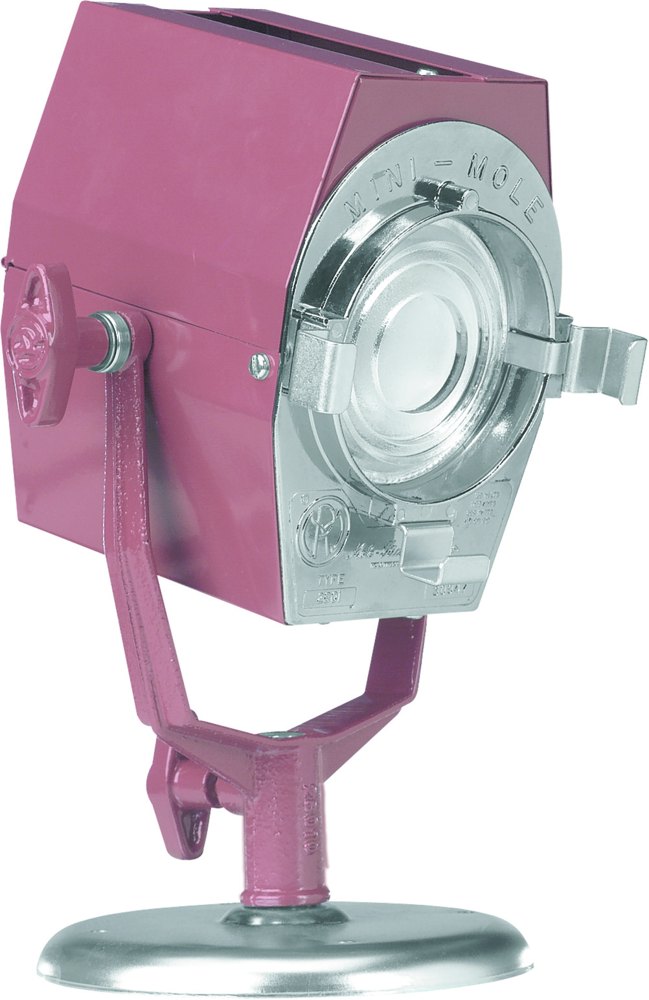
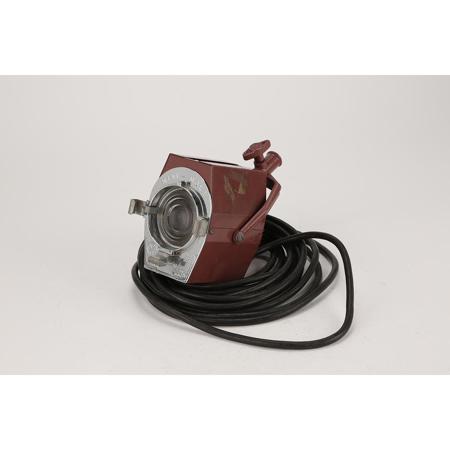

The Mini-Mole Solarspot is a small focusable Fresnel for accenting a face, prop or set detail. Its top-opening body is a useful way to distinguish it from the 200 W Midget.
- Colour Temperature 3,200 K in the factory output test
- Weight 4¾ lb (2.15 kg) with cable and base plate
- Beam Angle 12°–58° field angle
- IP Rating No numeric rating confirmed. Read the IP rating guide.
- Power 200 W 120 V lamp in factory output test
- Fixture Type Tungsten Fresnel
Key Specifications
| Specification | Details |
|---|---|
| Manufacturer and model | Mole-Richardson 200W Mini-Mole |
| Source or rated power | Type 2801, 200 W tungsten Fresnel |
| Optics, colour or format | Spot-to-flood focus, top-opening housing |
| Head or system detail | 4¾ lb with cable and base plate |
| Fresnel lens | 3 in. |
| Standard wire scrims | 4 7/16 in. Full single 28071S, full double 28071D |
| Diffuser frame | 28050 Moledisc, standard clips |
| Lamp socket | Double-contact bayonet |
Replacement lamps
Match the globe to the supply voltage and keep within the head’s 200 W maximum. The optional larger clips accept 5⅛-inch diffusion retainers. Check the clips on a rental head before packing a frame.
| Lamp code | Power | Voltage | Colour temp. | Ushio rated life |
|---|---|---|---|---|
| ESR | 100 W | 120 V | 2,850 K | 750 h |
| ESP | 150 W | 120 V | 2,900 K | 1,000 h |
| FEV | 200 W | 120 V | 3,200 K | 50 h |
Mole’s bulletin lists a 250 W ESS in the globe table but rates the head at 200 W maximum. Keep the load within the marked rating. The chart below applies to the 200 W, 120 V, 3200 K test lamp. Mole specifies a burn position within 30° of vertical, base down. Mole-Richardson specifications, page 2.
Output Calculator
Select the published setup and a manufacturer distance, or enter a custom throw where supported. The results describe centre-beam output, not the brightness across the whole beam.
Camera Settings
If the calculator does not load, use the published photometric table or source on this page. JavaScript is required.
F-stop is a planning estimate, not a meter reading. It uses direct, on-axis illuminance and includes only the optics and diffusion named in the selected setup. Meter on set to account for lens transmission, filters, added diffusion, bounce, dimming and ambient light.
How the exposure estimate works
N = √(E × ISO × t / C), where E is illuminance in lux and t = shutter angle ÷ (360 × fps). The default C = 340 is a dome reference; C = 250 is a flat reference. These are calibration constants, not a measured T-stop. A small nonzero digit is tenths of a stop above the displayed full stop.
Distance estimates and comparisons
Published points are used as given. Between published points the calculator fits a curve through the two nearest readings. Outside those points it uses the inverse-square law only when the fixture’s dataset permits it. Distances outside a configuration’s supported range are reported separately. Comparisons use one shared distance and camera setup; equal lux does not imply equal coverage.
View published readings for the selected configuration
Strengths and Limitations
- A narrow Fresnel beam can add a precise glint without lighting nearby scenery.
- Its small lens gives little natural wrap on a face.
Practical Uses
Use it to put an isolated highlight on a product or a narrow back edge on an actor. The spot and flood values differ considerably at the same distance.
Output and Colour
The manufacturer reports centre intensity in foot-candles at marked distances in feet. The table expresses the same locations in metres and includes the corresponding lux.
| Configuration | Distance | Lux | Foot-candles |
|---|---|---|---|
| 200 W · 120 V · flood | 1.524 m | 969 | 90 |
| 200 W · 120 V · flood | 3.048 m | 269 | 25 |
| 200 W · 120 V · flood | 4.572 m | 107.6 | 10 |
| 200 W · 120 V · spot | 1.524 m | 8,396 | 780 |
| 200 W · 120 V · spot | 3.048 m | 2,099 | 195 |
| 200 W · 120 V · spot | 4.572 m | 969 | 90 |
Photometric source and test conditions.
Power and Batteries
Mole’s spot and flood readings use a 200 W, 120 V globe at 3,200 K. A lower-wattage globe changes the output even at the same focus setting.
Mole’s legacy globe table lists a 250 W ESS, but the rating line on the same sheet says 200 W maximum. Follow the rating on the head and do not take the legacy lamp table as permission to exceed it. Verify the exact voltage on the lamp and observe its stated burn position.
Control, Cooling and Camera Operation
Adjust beam spread with the rear focus knob. The through-cord switch is for on/off control. An external tungsten dimmer also warms the lamp as it lowers output. Keep diffusion off the hot housing and let the head cool before handling or opening it.
Modifiers, Rigging and the Working Package
The top opens for relamping. The optional snoots can isolate small highlights that would be awkward to cut with a large flag.
Alternatives and Related Fixtures
For a larger Mole tungsten accent light, see Mole-Richardson Betweenie 300W (Type 3131).
What People Are Saying
The operator accounts below show why the Mini-Mole was useful as a concealed source or an eye light. Mole’s Type 2801 sheet supplies the model-specific figures and lamp limits.
Field Feedback at a Glance
What worked
- A small, tight highlight. At 5 ft (1.52 m), the 200 W, 120 V factory test gives 780 fc in spot in a 0.6 ft field. That is useful for an eye light or a product glint without lighting as much of the surrounding set.
- Access from either side of the rig. Front and rear focus knobs let the operator adjust the beam even when one side is obstructed; the hinged top gives lamp access with the power off and head cool.
- Small front accessories can trim the patch. Mole documents the 28060 snoot set and 280108 Focal Spot for jobs that need more control than the bare 3-inch Fresnel.
Drawbacks to plan for
- Not a soft source on faces. The 3-inch lens gives little wrap at ordinary working distances. Add separate diffusion when a hard eyelight or highlight is not the goal.
- Match the FEV voltage to the label. Mole lists separate 120 V and 220 V FEV entries. The calculator uses only the 120 V chart; neither the shared code nor the head’s 120/240 V rating makes the lamps interchangeable.
- Burn position and wattage limit the rig. The bulb table specifies operation within 30° of vertical, base down; verify the installed globe before tilting. Do not treat the same sheet’s legacy 250 W example as permission to exceed the 200 W head rating.
Mole’s Type 2801 lamp, accessory and photometric sheet.
A small head you can hide in frame: Owen Roizman told the authors of Masters of Light that he favoured Mini-Moles and other small heads because he could conceal them behind furniture or practical fixtures. His account mentions the Mini-Mole by name without specifying its exact lamp. Owen Roizman interview.
A precise eye light: A lighting breakdown for the music video Habit lists a 200 W Mini-Mole with 216 diffusion and a medium snoot to put an eye light on the lead singer. Production lighting breakdown.
Videos
Illustrated setup: Type 2801 manufacturer setup illustration. Mole shows the Mini-Mole on its supplied 5½ in base plate and ⅝ in spud. See the globe table on page 2 for the approved lamp position before aiming the head.
Rental and Used-Fixture Checks
Check the 2801 badge, opening mechanism and lens. Confirm the installed globe before relying on the 200 W output figures.
Documentation and Specifications
- Mole-Richardson Type 2801 data sheet and performance tables
- Ushio lamp catalogue and rated life
- Mole-Richardson Type 2801 accessory list