
Last Updated 14 hours ago
Overview
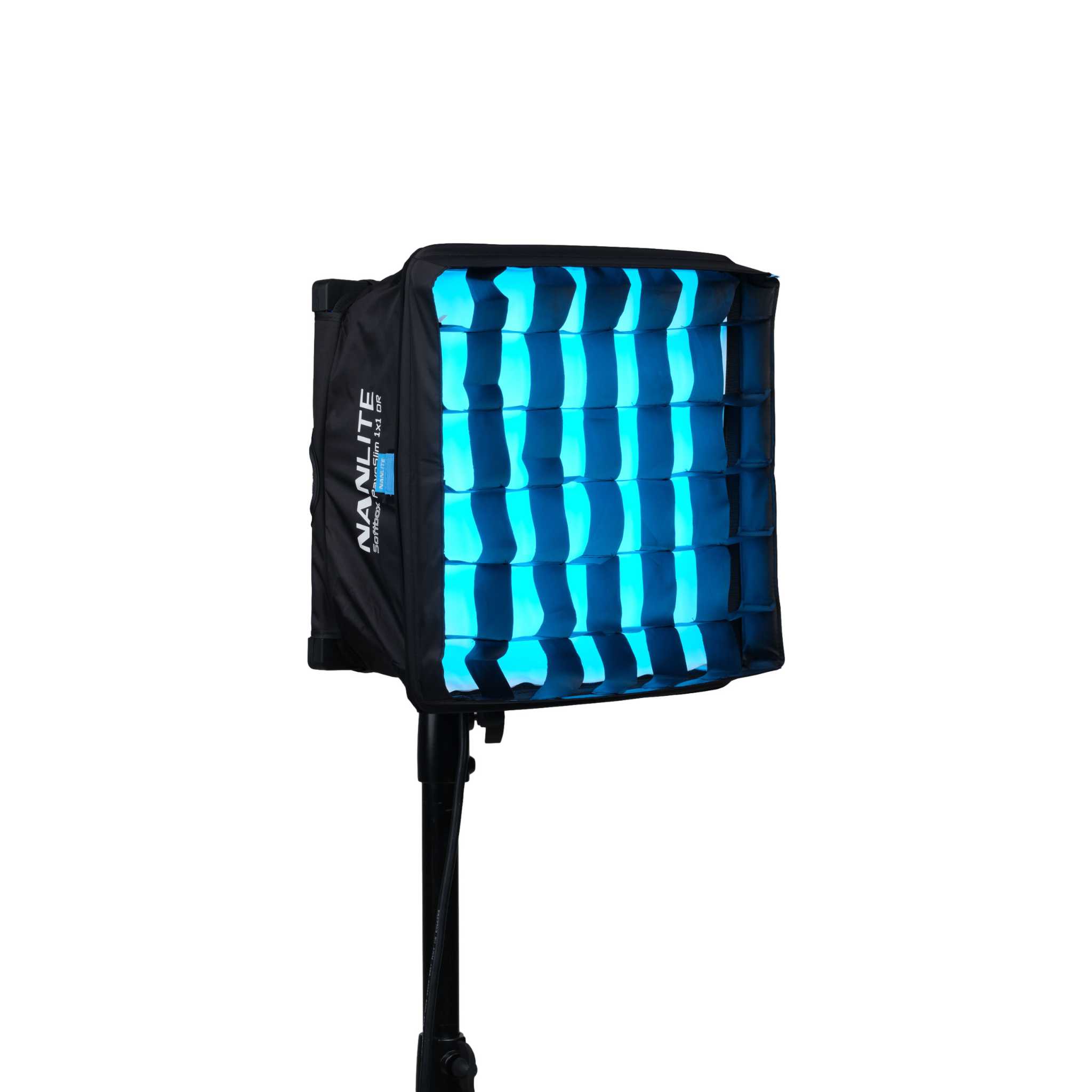
The Nanlite PavoSlim 60C is a thin, nominal one-foot-square RGBWW LED panel with a separate power/control unit. It combines a rigid metal head, full-colour controls and integrated CRMX in a package useful for close keys, small interiors, interviews and concealed colour accents.
The 60C is the colour model, distinct from the bi-colour 60B. Its rated electrical power is 72 W, not simply the “60” in the product name. The emitting head weighs 0.94 kg; the controller, batteries, mounting hardware and diffusion are additional parts of the working package.
Key specifications
| Specification | Details |
|---|---|
| Fixture type | Nominal 1 × 1 ft rigid RGBWW panel |
| Rated power | 72 W |
| Colour engine / white range | RGBWW; 2700–7500 K; G/M ±150 |
| Dimming | 0–100% |
| Colour metrics | Average CRI 96; TLCI 97; TM-30 Rf 94 / Rg 100 |
| SSI references | 83 at 3200 K; 74 at 5600 K |
| AC input | 100–240 V, 50/60 Hz at the controller |
| DC / battery options | V-mount 14.4–26 V; two 7.4 V NP-F batteries through the designated holders |
| Head dimensions | 306.3 × 300.65 × 18.6 mm |
| Controller dimensions | 146.45 × 111.48 × 175 mm |
| Component mass | Head 0.94 kg; controller 1.37 kg |
| Control | Onboard, NANLINK, LumenRadio CRMX, wired DMX/RDM with correct adapter |
Strengths and limitations
Strengths
- The rigid, shallow head gives a quick-to-mount soft-light platform.
- RGBWW, tint adjustment and integrated CRMX suit mixed production rigs.
- Several diffusion options change the balance of output and softness.
Limitations
- The rigid emitting area cannot be rolled or reshaped like a fabric mat.
- Controller, battery and cable weights are additional to the head specification.
- Bare-panel and diffused lux figures describe different source configurations.
Practical uses
The compact square head is useful for a close interview key, a small fill or a source hidden above a doorway or behind set dressing. The slim bare body helps placement, while the softbox creates a deeper assembly. The scene still needs room for its stand, cable exit and control unit.
At close distances a square softbox produces a different catchlight and reflection from a long strip. Decide whether the subject needs wrap, a broad reflected highlight or controlled direction, then choose the diffuser and position. A larger source may be preferable if the panel has to sit farther from the subject.
For colour accents, HSI or gel mode can set a practical background colour without adding a physical gel. Inspect the level through the camera: a saturated colour is not as bright as the white-mode figure in the table, and the colour of a reflective surface can change the result.
| Setup | Working approach |
|---|---|
| Interview key | Place the diffused face close enough for the required wrap; use a grid or flags when light must stay off the background. |
| Confined interior | Use the shallow profile to fit the rig, with the controller separately supported and accessible. |
| Product reflection | Orient the square face to shape the visible highlight, then assess its reflection in the actual object. |
Output and colour
Nanlite publishes separate measurements for the bare head and for the softbox with each supplied diffuser. The following values are centre illuminance in lux at the stated CCT and distance. They are manufacturer measurements, not independently retested figures or an average across the entire beam.
The Standard diffuser costs substantial centre level compared with the bare panel. That is part of choosing a more diffused source, not a fault inferred from the table. Use the configuration actually intended for the scene; the bare white-light number cannot describe a heavily diffused saturated-blue cue.
| Configuration | 1 m, lux | 3 m, lux |
|---|---|---|
| Bare panel, 3200 K | 6,362 | 769 |
| Bare panel, 5600 K | 7,074 | 849 |
| Softbox + Lite diffuser, 5600 K | 3,034 | 349 |
| Softbox + Standard diffuser, 5600 K | 1,525 | 166 |
The RGBWW engine provides CCT, HSI, RGBW, gel and effects modes. The documented white range is 2700–7500 K with ±150 green/magenta adjustment in the fixture scale. Nanlite lists 151 gel emulations and 15 built-in effects; availability and parameter control should be checked against the installed firmware and chosen DMX personality.
Published averages are CRI 96, TLCI 97 and TM-30 Rf 94 / Rg 100, with SSI 83 against the 3200 K reference and 74 against the 5600 K reference. These metrics describe white settings and references, not a guarantee that every colour cue matches another manufacturer or every camera.
Use CCT and tint to match practical white sources, then inspect the image on the production camera. Gel names are useful starting points, but an LED emulation and a physical filter on another lamp need not produce identical spectra, brightness or colour on fabrics.
Power and batteries
The controller accepts 100–240 V AC, 50/60 Hz, suitable 14.4–14.8 V or 26 V V-mount batteries, or two 7.4 V NP-F batteries in the designated holders. Those NP-F holders are a feature of the 60C controller; they must not be assumed on a 120C or 240C. Use suitable matched packs with adequate discharge capability.
The controller and head form a matched system. Support the interconnect and use the correct cables; the panel connector is not a generic battery input. Before a power-source change, keep the level within the capability of the incoming supply and test the handover with the actual battery/controller combination.
Runtime depends on the operating level, colour mix, battery capacity and condition. For a long interview or unattended rig, establish the required duration and confirm it with the selected power source. The controller’s battery acceptance does not establish that every pack with the same mount can sustain full output.
Control, cooling and camera operation
The C-series control unit includes LumenRadio CRMX as well as Bluetooth/2.4 GHz NANLINK options and onboard control. CRMX is the production wireless-DMX path; the app path is a separate connection. Set the console profile, DMX address and radio pairing for the intended system rather than assuming any wireless remote uses the same protocol.
The operating manual specifies a separate compatible adapter cable for wired DMX input/output. Include it when hiring the light for a conventional XLR DMX chain. RDM, profile selection and firmware are part of that control setup; test a low fade, blackout and loss/recovery of the actual signal route.
The USB port serves firmware updates. Keep a note of the installed firmware and operating mode when matching several heads, especially if a used fixture is being mixed with a newer rental package.
Modifiers, rigging and the working package
The 60C head is a rigid panel rather than a flexible textile mat. Use the rear mounting system, universal holder or baby-pin holder as instructed. Corner 1/4-20 points and compatible magnetic accessories provide additional placement options, but a magnet is only as reliable as its attachment and the supporting surface.
The controller has its own quick-release mounting arrangement and must be supported rather than left hanging from the head cable. Account for batteries and modifiers in the total rigging load, and use appropriate secondary retention for elevated fixtures. A thin head does not make a complete overhead installation weightless.
The kit’s softbox, diffusers and eggcrate need to fit the exact model. Inspect the rear mount, connectors, face, diffusion and locking parts before a shoot. Keep heat-dissipation paths clear, protect the controller and head from wet conditions outside the manual, and check panel uniformity at both white and saturated settings after transport.
Alternatives and related fixtures
A larger panel gives more source area at a given distance. A LiteMat 4 Plus is a different, larger variable-white system with a separate controller ecosystem. Choose the 60C for its small rigid colour head and complete app/CRMX package, rather than assuming every thin panel shares the same light quality or power system.
| Fixture | Choose it for |
|---|---|
| PavoSlim 120C | A longer rectangular face and different power package. |
| amaran F21c | A fabric-mat RGBWW system with different structure, controller and wireless control. |
What people are saying
Matthew Allard: fast setup and useful output
In his review of the 60C and 120C, Allard likes the rigid backing, mounting system, soft light and output for the power draw. He found the diffusion preserved CCT well and the app straightforward, while noting that output varies across the white range.
Videos
PavoSlim 60C and 120C operation
A walkthrough of the two smaller full-colour panels and their controls.
Rental and used-fixture checks
Match the 60C head to its controller, extension cable and power hardware. Inspect the rigid backing, mounting points and emitting surface, softbox attachments and diffusion. Test CCT, a saturated colour, low-level fades, CRMX pairing and the intended battery arrangement before rigging.
Documentation and specifications
official model information and photometric tables and manufacturer operating manual.
Product photograph: Nanlite official US product photograph.
Browse Nanlite lights · LED panels · all equipment.