
Last Updated 14 hours ago
Overview
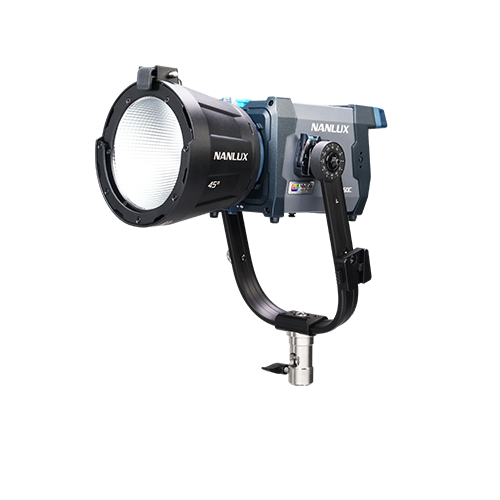
The Nanlux Evoke 150C is a 150W full-colour point-source LED using the eight-emitter Nebula C8 engine. It combines a 1,000–20,000K white-light range with extensive tint and colour control in a weather-resistant fixture.
The 150C brings the Evoke system into a compact all-in-one source for tight spaces and portable work. Its FE mount, direct battery input and USB-C power option are the details to understand before building a small kit.
Key specifications
| Specification | Details |
|---|---|
| Rated power | 150W |
| Engine | Nebula C8: deep red, red, amber, lime, green, cyan, blue, indigo |
| CCT / tint | 1,000–20,000K; G/M ±200 |
| CRI / TLCI | 98 / 98 averages |
| SSI | 86 at 3,200K; 78 at 5,600K |
| TM-30 averages | Rf 96; Rg 100 |
| Bare beam | 47° |
| Mount | FE; supports the specified FM accessory ecosystem |
| AC input | 100–240V, 50/60Hz; 2A maximum |
| DC / alternate input | 14.4–28V; USB-C PD3.0 12–28V, minimum 60W |
| Head / separate yoke | 2.11kg / 0.54kg |
| Weather rating | IP66 |
| Dimming | 0–100%, 0.1% increments |
| Control | Onboard, NANLINK, CRMX; wired controller and wired/network options as discussed below |
Strengths and limitations
Strengths
- The compact FE head combines colour control with several power routes.
- Nebula C8 offers a wide white range, tint and colour modes.
Limitations
- FM accessory compatibility should be verified for the actual attachment.
- The selected fan mode and accessory affect usable output.
Practical uses
The 150C is particularly useful for mobile accents, a close key, practical enhancement and a small rig that needs extensive colour choices. Its compactness is the reason to choose it when there is little room to place a bigger head.
For more throw or a larger diffusion setup, compare the 600C class. For a different portable full-colour ecosystem, compare the STORM 80c by mount, power source and actual modifier output rather than a simple wattage ratio.
| Setup | Working approach |
|---|---|
| Soft key | Choose the modifier and working distance first, then meter the diffused result. |
| Colour interaction | Check the actual hue through the camera and leave enough output for saturated settings. |
Output and colour
Selected 5,600K readings are listed below. The 45° reflector is the configuration identified here; the optional 25° reflector and Fresnel produce different results.
| Distance | Bare | 45° reflector |
|---|---|---|
| 1m | 12,160 lux | 22,230 lux |
| 2m | 2,940 lux | 4,950 lux |
| 3m | 1,328 lux | 2,155 lux |
C8 uses eight coloured emitter types, including deep red and indigo. The physical engine should not be confused with the names of its control modes. RGBW mode, for example, describes a set of user controls rather than four physical emitter types.
The documented modes include CCT, HSI, HSIW, RGBW, x,y, gel and effects. CCT/tint is appropriate for white-light matching; x,y coordinates are useful for a specific chromaticity target; HSI is often convenient for an exploratory colour effect. Record the mode as well as its values when reproducing a look.
The broad white-light range and tint adjustment do not establish the same exposure at every setting. Saturated blue or red can be much dimmer than white, and different camera systems can render those colours differently. Test the intended colour on the actual surface and camera.
Power and batteries
The 150C accepts direct AC, a compatible 14.4–28V battery arrangement and supported USB-C PD power. The minimum 60W PD input specification is a minimum accepted source, not a promise of unrestricted 150W operation from a 60W charger. Check the negotiated power and fixture behaviour.
Its yoke battery holder organizes the external V-mount battery; the battery is not built into the lamp. Add the pack, cable and modifier to the working weight. The USB-C port’s power capability is model-specific and should not be assumed on another Evoke.
Control, cooling and camera operation
The 150C has built-in CRMX and NANLINK app control. Wired DMX uses an extension adapter, and Art-Net/sACN requires the appropriate LAN extension arrangement. Include those accessories when the shoot depends on a wired console or Ethernet network.
The user manual distinguishes the extension port from the USB-C connection. The ability to connect a wired controller does not mean that a full-size DMX or network socket is already on the compact housing.
The manual specifies a 50% maximum brightness in Low Speed and 15% in Off. Pause temporarily stops the fan while allowing the documented maximum until temperature management returns it to Smart. Pause therefore is not the same operating condition as a sustained fan-off setting.
Choose and test the required sound mode before setting exposure. A cool lamp on the bench may behave differently after it has warmed during a long scene. Listen from the microphone position and leave space around cooling paths.
Modifiers, rigging and the working package
FE is a compact electronic mount, not the large NL interface used by the Evoke 2400B. Nanlux documents compatibility with supported FM accessories and offers FE options such as the FL-12E. Confirm the exact accessory rather than assuming that every Nanlux product uses the same mount.
The small head works well where placement is difficult: beside a car seat, behind a piece of scenery or close to an object. A compact softbox can provide a useful nearby key. A narrow optic changes the beam and central exposure, but cannot turn it into a large-area high-output source.
The published head and yoke figures are separate: 2.11kg for the head and 0.54kg for the yoke, before the chosen reflector, cable and other accessories. Use the complete load when selecting support. The fixture photograph does not communicate all the leverage of a large modifier.
IP66 is a rating for the specified fixture arrangement, not for arbitrary adapters, batteries or distribution. Follow the manual’s connection and sealing instructions. Suitable support, secondary restraint and cable management still matter in an indoor setup and in weather.
Alternatives and related fixtures
| Fixture | Choose it for |
|---|---|
| Evoke 600C | A different size, mount and power package in the C8 range. |
| Aputure STORM 80c | A separate colour-engine, optical and app ecosystem. |
What people are saying
Matthew Allard: strong colour with package caveats
Allard likes the 150C’s build, colour performance and straightforward controls. Two FM accessories he tried did not fit, despite advertised backward compatibility, and D-Tap power did not provide full output. Those are useful checks for a compact location kit. Read or watch the full account.
Videos
Rob Ellis: Evoke 600C and 150C
A lighting demonstration made with Nanlux, covering both C8 fixtures.
Rental and used-fixture checks
Verify the exact model, power components and control profile. Inspect mounts, optics or diffusion, connector locks and cables. Test a slow fade, colour matching and the complete intended remote-control path before rigging.
Documentation and specifications
Nanlux Evoke 150C product page · English user manual · DMX reference · Official firmware and downloads.
Product photograph: Nanlux.
Browse Nanlux lights · COB lights · all equipment.