
Last Updated 5 hours ago
Overview
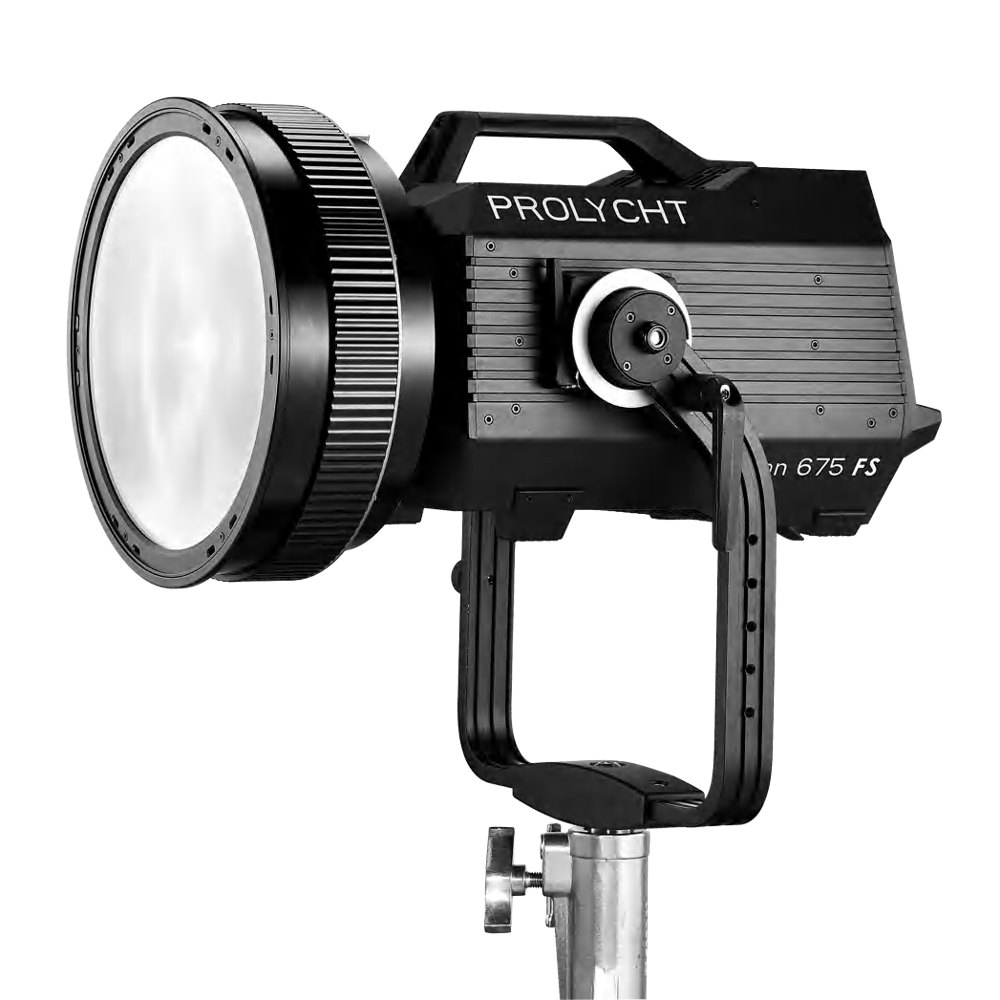
The Orion 675 FS is a six-colour point-source fixture with the power unit built into the head. Its broad bare field, two reflector options and accessory Fresnel give it several distinct working distances.
Compare the bare head, reflectors and Fresnel at equal distance; the tightest beam is not always the most useful one. Start with the Output Calculator to compare published readings and plan exposure.
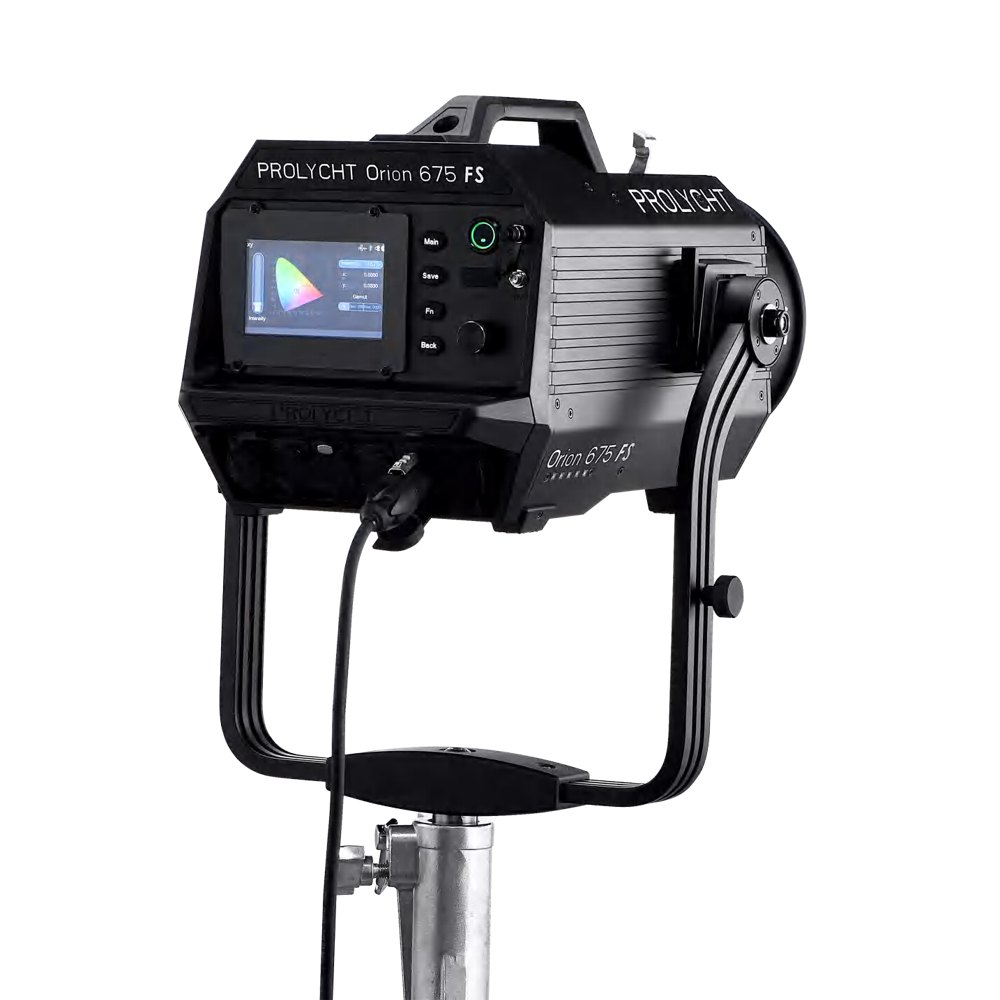
- RGBACL LED Point Source Six-emitter full-colour engine with a Bowens accessory mount. Learn about RGBACL.
- 675 W Maximum Input Integrated power supply with 100–240 V AC input or a manufacturer-specified 46–50 V DC source.
- Colour Temperature 1,800–20,000 K Tunable white with green–magenta adjustment.
- Weight 12 kg with yoke or 9.5 kg without it. The quick-release yoke mounts on a 28 mm spigot.
- Beam Angle 80° bare; 55° and 30° reflectors. The optional Fresnel is specified at 15°–50°.
- IP Rating Prolycht describes the unit as weather rated but does not give a numerical IP code in the cited datasheet. Do not assume a specific level of water protection. IP rating guide.
Key specifications
| Specification | Details |
|---|---|
| Manufacturer and model | Prolycht Orion 675 FS |
| Source or rated power | 675 W maximum input |
| Optics, colour or format | RGBACL, 1,800 to 20,000 K |
| Head or system detail | 12 kg with yoke, integrated power unit |
Photometric Output Calculator
Estimate centre-beam illumination and the corresponding camera aperture from this fixture’s published measurements.
Estimated output
Select a configuration to calculate.
Manufacturer readings are for the stated optic, colour setting and full output, measured at the beam centre. Values between measured distances are interpolated. Point-source values outside those distances are approximate inverse-square estimates; large sources cannot be reliably extrapolated and are limited to their measured range. Exposure uses frame rate, shutter angle, ISO and the selected incident-meter calibration. Only the optics and diffusion explicitly listed in the measurement are included; additional modifiers, bounce, beam edges, ambient light, ND filters and camera exposure-index differences are not accounted for. Confirm critical exposures on set with a meter. Photometric source
Strengths and limitations
- An integrated supply reduces the number of separate boxes at the floor position.
- The 12 kg head carries that weight at the yoke.
Working with the Orion 675 FS
Use the 30° reflector to push colour farther into a set. If coverage matters more than the brightest point, compare it with the 55° reflector or the bare head at the same distance.
Output and photometrics
| Configuration | Distance (m) | Factory Lux | Calculated Foot-Candles |
|---|---|---|---|
| 5,600 K · 80° bare | 3 | 2,220 | 206.2 |
| 5,600 K · 80° bare | 5 | 830 | 77.1 |
| 5,600 K · 80° bare | 7 | 538 | 50.0 |
| 3,200 K · 80° bare | 3 | 1,900 | 176.5 |
| 3,200 K · 80° bare | 5 | 706 | 65.6 |
| 3,200 K · 80° bare | 7 | 458 | 42.5 |
| 5,600 K · 55° reflector | 3 | 7,380 | 685.6 |
| 5,600 K · 55° reflector | 5 | 2,520 | 234.1 |
| 5,600 K · 55° reflector | 7 | 1,370 | 127.3 |
| 3,200 K · 55° reflector | 3 | 6,250 | 580.6 |
| 3,200 K · 55° reflector | 5 | 2,150 | 199.7 |
| 3,200 K · 55° reflector | 7 | 1,170 | 108.7 |
| 5,600 K · 30° reflector | 3 | 14,000 | 1,300.6 |
| 5,600 K · 30° reflector | 5 | 4,400 | 408.8 |
| 5,600 K · 30° reflector | 7 | 2,280 | 211.8 |
| 3,200 K · 30° reflector | 3 | 11,800 | 1,096.3 |
| 3,200 K · 30° reflector | 5 | 3,770 | 350.2 |
| 3,200 K · 30° reflector | 7 | 1,950 | 181.2 |
| 5,600 K · 50° Fresnel flood | 3 | 5,260 | 488.7 |
| 5,600 K · 50° Fresnel flood | 5 | 1,980 | 183.9 |
| 5,600 K · 50° Fresnel flood | 7 | 1,140 | 105.9 |
| 3,200 K · 50° Fresnel flood | 3 | 4,440 | 412.5 |
| 3,200 K · 50° Fresnel flood | 5 | 1,700 | 157.9 |
| 3,200 K · 50° Fresnel flood | 7 | 973 | 90.4 |
| 5,600 K · 15° Fresnel spot | 3 | 28,100 | 2,610.6 |
| 5,600 K · 15° Fresnel spot | 5 | 9,810 | 911.4 |
| 5,600 K · 15° Fresnel spot | 7 | 4,900 | 455.2 |
| 3,200 K · 15° Fresnel spot | 3 | 23,900 | 2,220.4 |
| 3,200 K · 15° Fresnel spot | 5 | 8,310 | 772.0 |
| 3,200 K · 15° Fresnel spot | 7 | 4,190 | 389.3 |
| 5,600 K · 30° Fresnel medium | 3 | 18,108 | 1,682.3 |
| 5,600 K · 30° Fresnel medium | 5 | 6,690 | 621.5 |
| 5,600 K · 30° Fresnel medium | 7 | 3,390 | 314.9 |
| 3,200 K · 30° Fresnel medium | 3 | 15,300 | 1,421.4 |
| 3,200 K · 30° Fresnel medium | 5 | 5,650 | 524.9 |
| 3,200 K · 30° Fresnel medium | 7 | 2,890 | 268.5 |
Photometric source and test conditions.
The manufacturer’s October 2022 data sheet supplies twelve CCT-and-optic configurations at 3, 5 and 7 m. The calculator uses those metric headings and is limited to 3–7 m. Intermediate readings are estimates; the chart does not identify photometric dimmer, fan or supply settings. For the 3,200 K Fresnel flood at 3 m, the PDF prints 4,440 lux, while the manufacturer’s product page lists 4,400 lux. This table and calculator use the PDF edition; the discrepancy is not silently averaged.
Independent Measurements
In Matthew Allard’s controlled reflector test, the 675 FS at a 5,600 K setting measured 55,700 lux with the 55° reflector and 123,000 lux with the 30° reflector. He metered 1 m from the attachment edge. That difference is a centre-beam result, not a claim that the narrower beam lights the same area more evenly. These are independent test observations, not calculator inputs.
Power and controls
The integrated supply keeps the power unit on the head. Prolycht rates the system at 675 W maximum and supports CCT with green-magenta correction.
Control, Cooling and Camera Operation
The manufacturer datasheet lists wired DMX, CRMX and Ethernet/Art-Net. Confirm the board profile, dimming curve and control mode before cueing. Newsshooter’s test found the Silent mode limited the fixture to 30%; check noise and usable level at the actual subject and microphone positions before committing to it.
Optics and mounting
The 80° native field narrows to 55° or 30° with the published reflectors. The Fresnel has its own focus-dependent output curve.
Fixture Size and Working Package
Unlike the Orion 300 FS package, the 675 FS carries its supply on the head. The datasheet lists 9.5 kg without yoke and 12 kg with yoke before adding the optic, and a 46–50 V DC battery input on a 3-pin XLR. Confirm the package includes the required power system and that the chosen reflector or Fresnel is the one used for your output estimate.
Comparable fixture
For a higher-output multicolour point source, see Aputure STORM 1000c.
What People Are Saying
Field Feedback at a Glance
What worked
- Allard’s reflector test shows why the 30° optic is useful for throw: it puts more light on-axis than the 55° reflector. Matthew Allard ACS, Newsshooter.
- His modifiers locked into the ProLock mount without wobbling. Matthew Allard ACS, Newsshooter.
- The optional Fresnel showed little visible color fringing and no side light leaks in his test. Matthew Allard ACS, Newsshooter.
Drawbacks to plan for
- The head and yoke weigh about 12 kg together. Allard suggested a second person when removing the head from a stand-mounted yoke. Matthew Allard ACS, Newsshooter.
- Silent mode capped the dimmer at 30%. At 1 m with the 30° reflector, he metered 33,300 lux in Silent mode. Matthew Allard ACS, Newsshooter.
- Swapping the reflector changed the measured color temperature. At the 5,600 K setting, he read 5,515 K with the 55° reflector and 5,382 K with the 30°. Matthew Allard ACS, Newsshooter.
Matthew Allard ACS, Newsshooter
Allard measured 27,800 lux at the centre of the beam from 3 m with the 15° Fresnel. His readings fell appreciably off-axis, so the centre reading is not a good guide to how evenly the light covers a wider subject.
Field coverage and further reading
Video
Orion 675FS Test BTS with Kees Von Oostrum, ASC
Rental and used-fixture checks
Allow for the weight on the yoke and the clearance of a large modifier. Test local controls, fan behaviour and the DMX profile used by the board operator.
Before You Book
- Book the yoke, 28 mm support, compatible power lead and exact reflector or Fresnel first.
- Check total rigged weight, optic lock and tilt clearance, including the power lead and modifier.
- Run the chosen power source to shooting level, then check fan noise, required DMX mode and the camera at the actual dimmer level.