
Last Updated 6 days ago
Overview
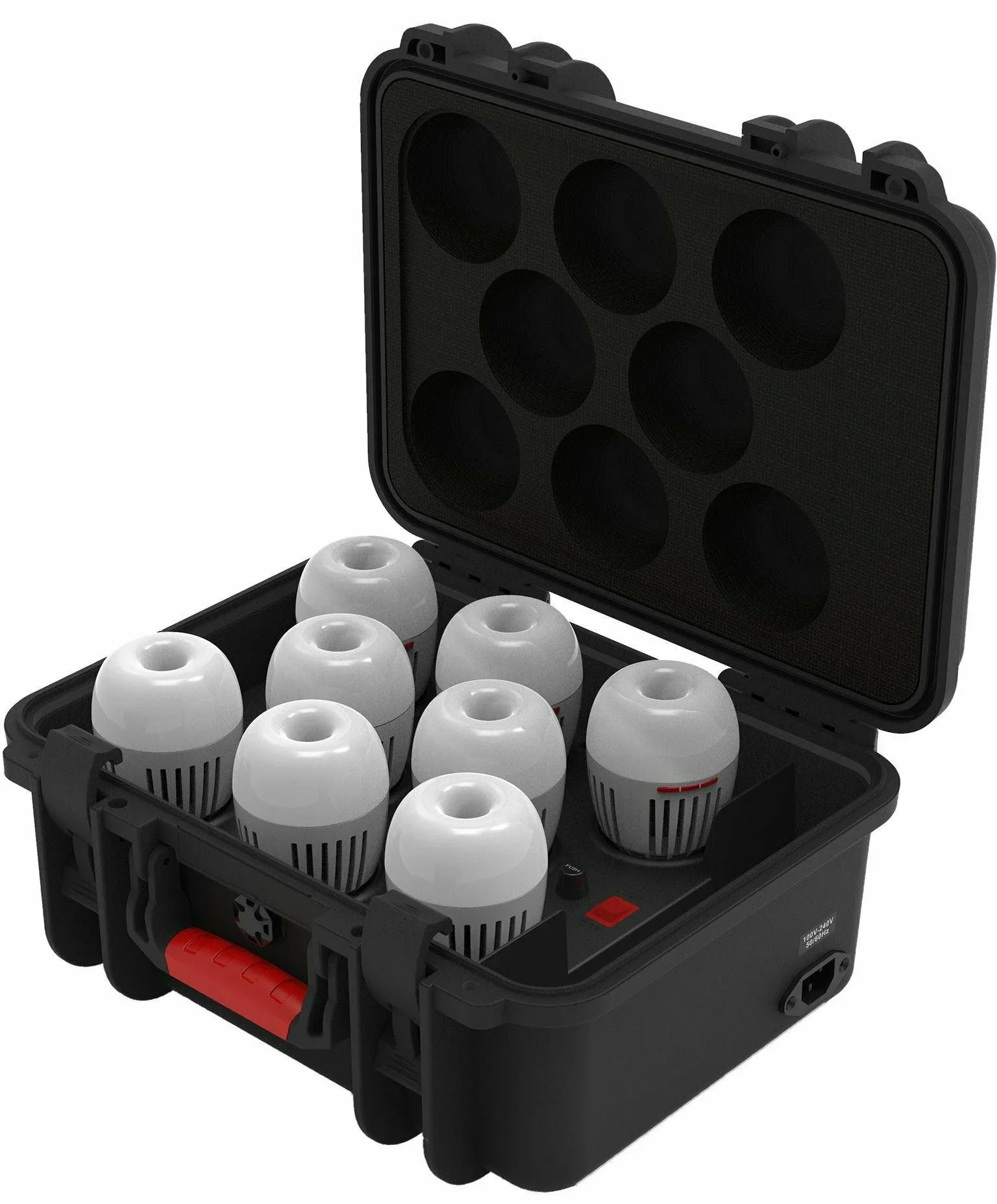


The Aputure Accent B7c 8-Bulb Kit combines eight RGBWW battery-capable practical bulbs with a protective charging case. The kit’s main advantage over loose bulbs is the charging, transport and spare-bulb workflow.
The kit contains eight standard B7c bulbs in a charging and transport case. It simplifies charging and spare management for sets with several practical lamps.
- Eight RGBWW Practical Bulbs Eight individual, battery-capable Accent B7c bulbs in a charging and transport case. Learn about RGBWW
- 100 W Maximum Case Draw 100–240 V AC case input; 12 W maximum electrical input and 7 W LED output rating per bulb.
- Colour Temperature2000–10000 K Per-bulb white range; colour and individual/group adjustments through Sidus Link.
- Weight 5.20 kg Loaded Case. 3.304 kg empty; eight E27 charging sockets. Each 240 g bulb fits compatible E26/E27 practical fixtures.
- Beam Control Broad frosted bulb output. Use the practical’s shade or separate flags to contain spill; the case is not a light modifier.
- No Published IP Rating Aputure marks the case rating N/A and advises keeping the bulb away from liquids. How to Read an IP Rating.
Key Specifications
| Specification | Details |
|---|---|
| Contents | Eight Accent B7c RGBWW bulbs and an eight-socket charging case |
| Per-bulb white range / output | 2,000–10,000K / 570 lumens manufacturer reference |
| Per-bulb socket / body | E26/E27; approximately 70 × 118mm |
| Per-bulb runtime | Over 70 minutes maximum brightness; over 20 hours near minimum |
| Per-bulb recharge | Approximately 2 hours in standby or powered off |
| Case AC input / maximum draw | 100–240V / ≤100W |
| Case dimensions | 35.8 × 28.4 × 16.7cm |
| Case weight | 3.304kg empty; approximately 5.2kg loaded |
| Charging positions | Eight E27 sockets |
| Control | Per-bulb onboard/Sidus Link; no native DMX/CRMX |
| Case weather rating | No IP rating specified |
Output Calculator
Select the published setup and a manufacturer distance, or enter a custom throw where supported. The results describe centre-beam output, not the brightness across the whole beam.
Camera Settings
If the calculator does not load, use the published photometric table or source on this page. JavaScript is required.
F-stop is a planning estimate, not a meter reading. It uses direct, on-axis illuminance and includes only the optics and diffusion named in the selected setup. Meter on set to account for lens transmission, filters, added diffusion, bounce, dimming and ambient light.
How the exposure estimate works
N = √(E × ISO × t / C), where E is illuminance in lux and t = shutter angle ÷ (360 × fps). The default C = 340 is a dome reference; C = 250 is a flat reference. These are calibration constants, not a measured T-stop. A small nonzero digit is tenths of a stop above the displayed full stop.
Distance estimates and comparisons
Published points are used as given. Between published points the calculator fits a curve through the two nearest readings. Outside those points it uses the inverse-square law only when the fixture’s dataset permits it. Distances outside a configuration’s supported range are reported separately. Comparisons use one shared distance and camera setup; equal lux does not imply equal coverage.
View published readings for the selected configuration
Charging and heat: The kit specifications give the 100 W limit for the entire case. Aputure’s bulb charging guide gives approximately two hours from empty in standby or off. Charging while the LEDs are on is slower, and charging pauses if internal temperature rises above 45°C. The safety guide also warns that the shell can become hot during extended use.
Strengths and Limitations
Strengths
- One organised case charges and transports eight matching practical bulbs.
- Charged spare bulbs can reduce turnaround time between practical-heavy setups.
Limitations
- Loaded-case weight and charging time are separate from the small per-bulb specification.
- A kit does not add DMX/CRMX, and the same per-bulb runtime and shade-fit limits remain.
Practical Uses
Use it to prepare several practicals together and keep replacement bulbs charged between setups. Check the physical fit of each practical and confirm the required battery or AC operating mode before the lighting cue.
| Setup | How to use this fixture |
|---|---|
| Room of practicals | Label each bulb by lamp position in the app. Match through the actual shades rather than assuming identical bulb settings produce identical practicals. |
| Narrative switch cue | Set AC or Battery mode separately on every bulb according to the actor’s action. Test the mains switch before the shade is finally dressed. |
| Long practical-heavy day | Keep charged spares in the case and rotate them deliberately. A bulb count, label and charging check reduces confusion between discharged and ready units. |
Output and Colour
Each of the eight B7c bulbs has the same 570-lumen rating, CCT range and runtime as the individual bulb. Sidus Link groups bulbs around a room; the case provides charging and transport, without adding DMX control.
Sources: Aputure Accent b7c 8-Bulb Kit: aputure.com reference; Aputure Accent b7c 8-Bulb Kit: aputure.com reference.
Lumen ratings, colour settings and runtimes are per bulb. The combined lighting result depends on the position, shade and intensity of each practical.
Use the individual B7c page for the operating behaviour of one bulb. For kit planning, the extra questions are how many practicals must work simultaneously, which need battery operation, and how many charged spares remain available during takes.
Power and Batteries
The case accepts 100–240V AC and draws up to 100W while charging eight E27 positions. Per-bulb recharge is approximately two hours in standby or powered off. Allow a suitable dry, ventilated charging position with access to the mains connection.
For a practical that must follow a switch or dim cue, see the B7c example in the lamp socket adapter guide.
Each bulb retains its own battery, operating mode and runtime. A charged case is not a shared battery feeding eight dressed practicals. Count ready bulbs and test each charging position; a single working socket does not verify the whole kit.
Control, Cooling and Camera Operation
| Control path | Hardware and operating notes |
|---|---|
| Individual bulbs | Onboard buttons and each bulb’s AC/Battery mode. |
| Grouped operation | Sidus Link naming and grouping; keep labels consistent with the set positions. |
| Charging case | Charging and transport only; no DMX/CRMX receiver or eight-zone fixture personality. |
| Replacement bulb | Pair and match it before the next take, including stored settings and switch behaviour. |
For continuity, keep the practical position, shade, colour and intensity together in the lighting notes. Do a visible comparison when swapping a bulb, since battery condition and stored settings can differ across a rental kit.
Test the entire actor-operated cue, including any lamps that must remain lit when switched mains power is absent. A correctly grouped app scene does not establish that every bulb has the correct local AC/Battery mode.
Modifiers, Rigging and the Working Package
The kit includes eight bulbs, a charging case and the specified mains lead. The case has no stated IP rating and requires a dry, ventilated charging location. Each B7c needs an E26/E27 lamp with clearance for its roughly 70 × 118mm body.
| Package item | Count or requirement |
|---|---|
| B7c bulbs | Eight, individually labelled and tested |
| Charging case | All eight charging positions, lid and latches |
| Mains components | Correct power cable and specified spare fuses |
| Dressed practicals | Socket, shade clearance and ventilation checked for each lamp |
| Spare workflow | Separate ready/discharged identification and suitable charging access |
The case is a charging and transport device, with no specified IP rating. It does not provide overhead mounting for dressed bulbs. Each practical still needs its own sound mechanical support and sufficient clearance for the larger bulb body.
Alternatives and Related Fixtures
| Fixture | When to compare it |
|---|---|
| Aputure Accent B7c | Use the individual-bulb entry for exact operating modes and per-bulb specifications. |
| Godox KNOWLED C7R Bulb | Compare the C7R's battery and practical accessories if a different bulb ecosystem is being considered. |
What People Are Saying
Graham Sheldon, CineD
Sheldon likes the single-cable charging and protective case. He describes typically using three or four bulbs while leaving others in reserve, and recommends testing the bulbs in practical fixtures with the art department. He also identifies the exposed case power input as something he would like better protected. Read article.
Reddit, R/cinematography
A kit owner says the B7c package has accompanied them on most narrative and music-video jobs since purchase. View discussion.
These practical points combine the accounts above with Aputure’s exact eight-light kit and per-bulb specifications. The published output figures are the manufacturer’s measurements under the stated conditions.
What Works
- One cable serves all eight charging slots: Sheldon found it easier to top up and protect the bulbs in one case instead of finding separate outlets during prep.
- Use practicals and keep reserves: Sheldon often put three or four bulbs into the shot while holding others charged. Labelling the bulbs by lamp lets the operator match cues and avoids swapping a discharged bulb into the wrong practical.
- Internal batteries leave a stand-alone bulb usable: A B7c can stay in an unpowered practical in Battery mode when a lead would give away the set dressing. Check AC mode instead if an actor’s lamp switch must trigger the cue.
What to Watch For
- The case is a charger, not a light or console node: Aputure lists 570 lm and 110 lux at 1 m and 5,500 K per bulb, not as eight combined beams. The case takes AC and adds no DMX or CRMX control to the bulbs.
- Full output and near-minimum runtime differ: Aputure lists 70+ minutes at maximum per bulb, and 20+ hours near minimum. Do not book a full-output night on the longer number; rotate charged bulbs or use suitable mains where appropriate.
- Check physical fit and protect the case inlet: The roughly 70 × 118 mm bulbs do not fit every shade or socket recess; Sheldon also flags the exposed case mains input. Test the dressed practicals and keep the charging position protected.
Videos
New Layer reviews the B7c bulbs and eight-light charging case.
Rental and Used-fixture Checks
Before You Book
- Count eight bulbs and confirm every charging position works.
- Label bulbs in the app and compare their colour, battery condition and stored settings.
- Test the intended AC/Battery mode and practical-switch cue on every dressed lamp.
Documentation and Specifications
- Aputure Accent b7c 8-Bulb Kit: aputure.com reference
- Aputure Accent b7c 8-Bulb Kit: aputure.com reference
Browse Aputure lights · bulb lights · all equipment.