
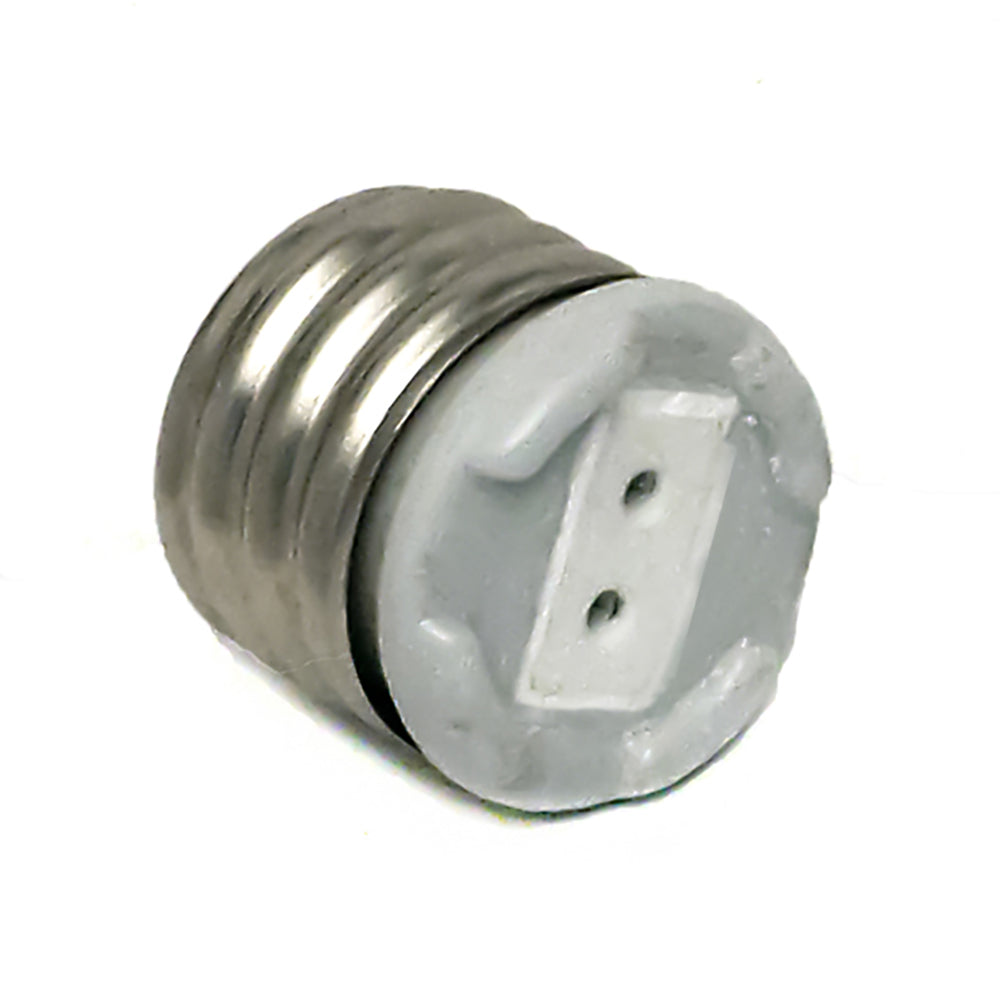
A socket adapter has two ends. The first size below is the socket already on the fixture. The second is the lamp the adapter accepts. An E12-to-E26 extender and an E26-to-E12 reducer serve opposite purposes. Neither changes the supply voltage. A lamp that fits can still have the wrong voltage, lamp type or heat output for the fixture.
Identify the Socket, Then Check the Whole Setup
On a prep bench, read the part numbers before you try the fit. Work with the fixture disconnected and cool. If the fixture, lampholder or adapter is damaged, unmarked or modified, set it aside for the rental house or a qualified electrician.
- Read the fixture label. Record the model, supply voltage, lampholder designation, permitted lamp type and maximum load. The original fixture limit still applies after adding a reducer or splitter.
- Read the lamp marking. Match the exact base and voltage. For an LED, use the actual input watts, not the incandescent-equivalent number on the box. Check enclosure and dimming restrictions on the exact bulb.
- Read both ends of the adapter. Match its male end to the existing socket, and its female end to the new lamp. Check the voltage, wattage and current limits that apply to the exact part and operating conditions; none of those markings change the supply voltage.
- Check clearance and load. An extender lifts the bulb toward the shade, diffusion or glass. A splitter adds weight and leverage to one socket. Check the fixture’s instructions for both physical clearance and total load, including any outlets on a combination adapter.
- Decide how to cue it. Verify the exact lamp/dimmer pairing and control method. For an approved setup, record a camera test at the frame rate, shutter and lowest level you’ll actually shoot. Look for banding, flicker, a jump at the low end and whether it comes back at the right level after power is cut.
Screw-Base Conversions
The ratings below apply to the named adapters only. Check the markings and instructions for the exact fixture, lamp, adapter and dimmer, if used. Match the lamp voltage to the supply and stay within the lowest applicable load limit. Check lamp type, heat clearance, enclosure and location restrictions separately. A part’s rating or certification does not establish approval for the assembled fixture. If markings or instructions are missing or conflict, ask the manufacturer or a qualified electrician before using the setup.
Edison Screw, Twist-Lock and Two-Pin Base Codes
E means Edison screw. The number identifies the nominal thread diameter in millimetres, not the operating voltage. Terms such as medium and mogul describe families; retain the exact code when ordering. IEC 60061 lamp-cap and lampholder reference · BJB base drawings and standard references
Scroll the table sideways to see all columns.
| Code | What to look for | What a similar part doesn’t tell you |
|---|---|---|
| E12 / E14 / E17 | Candelabra, small Edison screw and intermediate screw, respectively. | A small screw base or candle-shaped envelope does not tell you which size or voltage the fixture requires. |
| E26 / E27 | Medium Edison screw. Keep the exact code from the part and fixture. | Similar threads are not enough to confirm contact geometry, voltage or approval. Use a combination the manufacturer specifies. |
| E39 / E40 | Large Edison screw, often called mogul or giant Edison screw. | A mogul bipost is a different connection. Mole’s Type 245 and 2461 Skypans are bipost, not E39/E40. |
| GU10 / GU5.3 | GU10 has twist-lock contacts; GU5.3 uses straight pins. MR16 can describe the shape of either lamp. | Philips lists both a 120 V GU10 MR16 and a 12 V GU5.3 MR16. Match both base and voltage. |
| GY9.5 / G22 | Both use two pins; the exact cap and lamp code identify different systems. | A two-pin description does not make a Triolet tungsten lamp interchangeable with the original Joker-Bug 800’s G22 discharge-lamp system. |
Scroll the table sideways to see all columns.
| Existing fixture socket | Lamp accepted | Example part | Adapter rating |
|---|---|---|---|
| E14 European socket | E12 candelabra lamp | Satco 92-401 | 75 W, 120 V |
| E12 candelabra socket | E17 intermediate lamp | Satco 92-405 | 75 W, 120 V |
| E26 medium socket | E12 candelabra lamp | Satco 92-400 (historical) | 75 W, 250 V |
| E12 candelabra socket | E26 medium lamp | Satco 90-1519 | 75 W, 120 V |
| E39 mogul socket | E26 medium lamp | Satco 92-410 | 660 W, 600 V |
| E26 medium socket | GU10 lamp | Satco 90-2433 | 660 W, 250 V |
Satco lists a ½ in (13 mm) extension for the 92-405, a 1 in (25 mm) extension for the 90-1519 and a ¾ in (19 mm) extension for the 90-2433. All three shift the lamp forward. Satco describes its 90-2433 GU10 reducer as having no locking feature. Its 92-400 E26-to-E12 reducer appears in the older catalogue. Satco’s later components guide lists that part as unavailable.
Practical Lamp Accessories
Screw-in Socket Dimmer
The dial controls a single incandescent lamp. Westek specifies 100 W maximum for the 6009B and documents incandescent compatibility only. A dimmable LED marking does not establish compatibility with this dial. For LED, check the lamp and dimmer maker’s exact pairing, then test the low end on camera. Westek 6009B documentation
Outlet to Medium Lampholder
Plugs into a receptacle and accepts a medium-base lamp. Leviton rates this indoor adapter at 660 W, 125 V. Leviton 61 documentation
Lampholder to Outlet (“Pig Nose”)
Screws into a lampholder and provides a two-pole, two-wire outlet. Leviton lists 125 V and 660 W. There is no equipment-grounding contact. Do not use this adapter to power equipment that requires grounding. Leviton 125 documentation
Porcelain Pony Cleat
This keyless, medium-base porcelain lampholder has open terminals and mounts to a surface. Leviton rates this part for incandescent use at 660 W, 250 V. This is a component for an installed assembly, not a plug-in adapter for a set practical. Leviton 19062 documentation
Pull-Chain Socket with Two Outlets
The pull chain switches the lamp socket. Both outlets remain live while the supply is on. Leviton’s accessory catalogue (B-40) specifies 660 W maximum total at 125 V for this two-pole, two-wire indoor adapter. The total is shared by the lamp and both outlets. Leviton 1406 documentation
Twin Lamp Socket
Splits one lampholder into two. Leviton’s current product page gives 660 W, 250 VAC for the black indoor 128; its older OEM catalogue gives 125 V for the 128 family, while an earlier Leviton catalogue lists 250 V for an ivory 128. The catalogues disagree, so verify the exact device marking and its matching instructions. Apply the fixture limit to both lamps combined, not to each lamp. Leviton 128 documentation
On-Camera Example: A Table Lamp Needs a Dim Cue
If the ordinary bulb and the installed dimmer are compatible, test the cue at low output before the shot. A dimmed incandescent gets warmer; an LED can flicker, drop out or behave differently at the same dimmer position. An internally controlled practical bulb can give you a separate intensity cue without relying on the table lamp’s wall dimmer. Leviton’s dimmer guide distinguishes incandescent, LED and other load types.
For example, the Aputure Accent B7c accepts E26/E27 and can dim from its controls or Sidus Link. In Standard (AC) Mode the fixture’s power switch controls whether the bulb is on. In Battery (DC) Mode cutting AC can produce a brief interruption followed by resumed light, so confirm the power mode before counting on the switch for a blackout. Aputure B7c power modes
Fixture-Specific Adapters
K5600 Joker 800 Bug-A-Beam Pin Set
K5600 lists the P0800S4PINS pin set in its Joker² 800 W Bug-A-Beam kit. The original Joker-Bug 800 uses a G22 lampholder, but the socket type alone does not establish that Joker² parts fit the original head. Use K5600’s specified parts for the exact head and conversion kit. K5600 Joker² kit listing (store login may be required) · Original Joker-Bug 800 specifications
Chimera Triolet Medium-Base Reducer
Chimera includes a reducer for the Triolet’s E39/E40 socket to accept E26/E27 lamps. The 9930 product sheet lists 1,000 W for the fixture; that figure does not grant the same limit to every lamp, adapter, dome or lightbank. Chimera describes separate 120 V and 220 V versions. Verify the fixture label, the lamp voltage and the modifier’s exact rating. Chimera Triolet FAQ Mogul to medium reducer documentation
Chimera Triolet Two-Pin Adapter
Converts the Triolet’s E39/E40 socket to GY9.5. Chimera’s tested list includes EHD (500 W, 120 V), FLK (575 W, 115 V) and EHG (750 W, 120 V), used with frosted dome 99303000. 99304000 documentation
The 99303000 dome has its own 750 W / 120 V rating. Chimera warns that exceeding its wattage limit can damage or break the glass. The Triolet body’s higher maximum does not override the dome.
Scroll the table sideways to see all columns.
| Lamp codes | Nominal rating | Source detail |
|---|---|---|
| EHC, EHD | 500 W / 120 V | Chimera identifies EHD as its most common choice. |
| FLK | 575 W / 115 V | Listed by Chimera. |
| GLA | 575 W / 115 V | Chimera lists GLA but prints 1115 V; voltage shown here is from the OSRAM 54516 lamp sheet. Check the exact lamp marking. |
| GLC | 600 W / 115 V | Listed by Chimera. |
| EHF, EHG | 750 W / 120 V | Listed by Chimera at the dome’s wattage limit. |
Mole-Richardson 5 kW to 2 kW Socket Adapter
Mole lists 1921 as the 5 kW to 2 kW adapter for the Type 245, which uses a mogul bipost socket. This part is unrelated to an Edison-screw mogul reducer. Mole’s accessory entry does not identify the 2 kW lamp by code or give measured output for that setup. Confirm the lamp with Mole before using the adapter. 1921 documentation
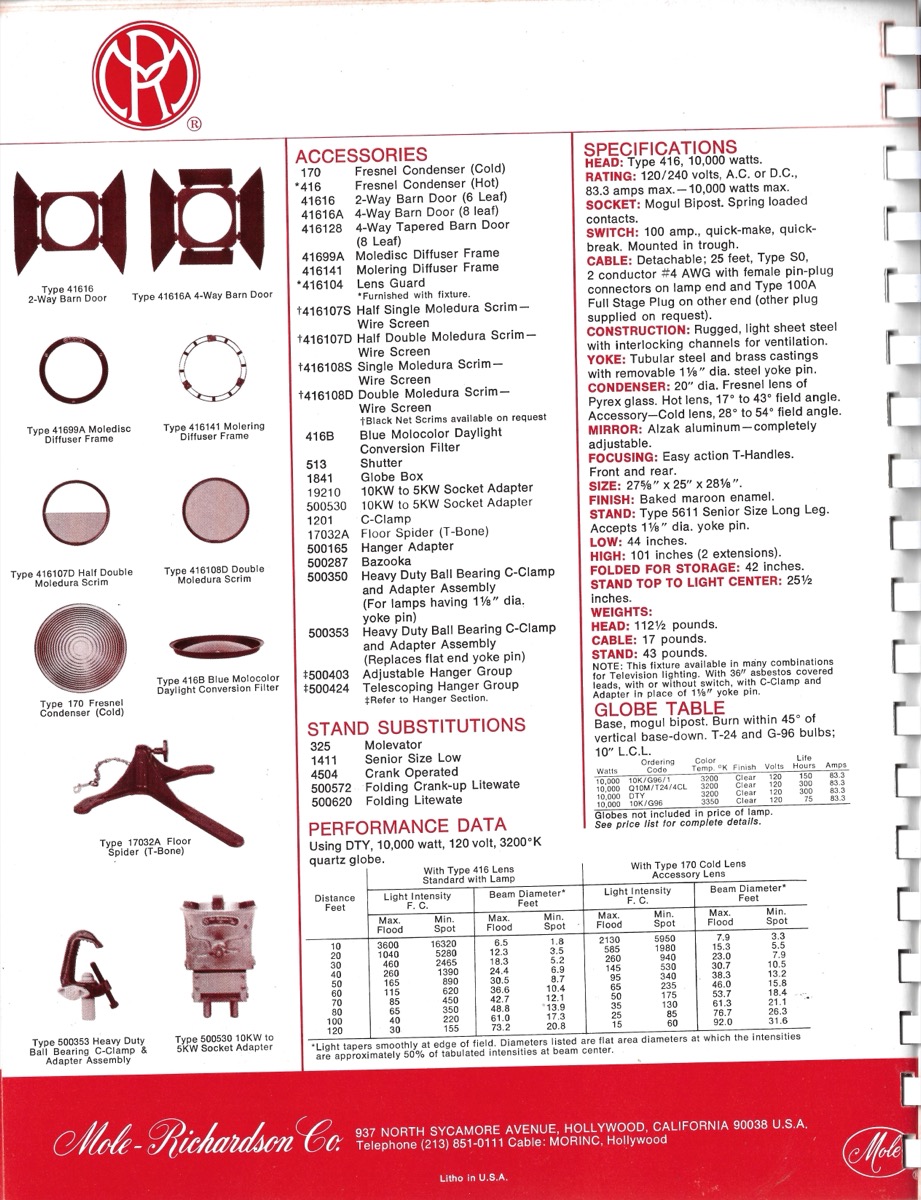
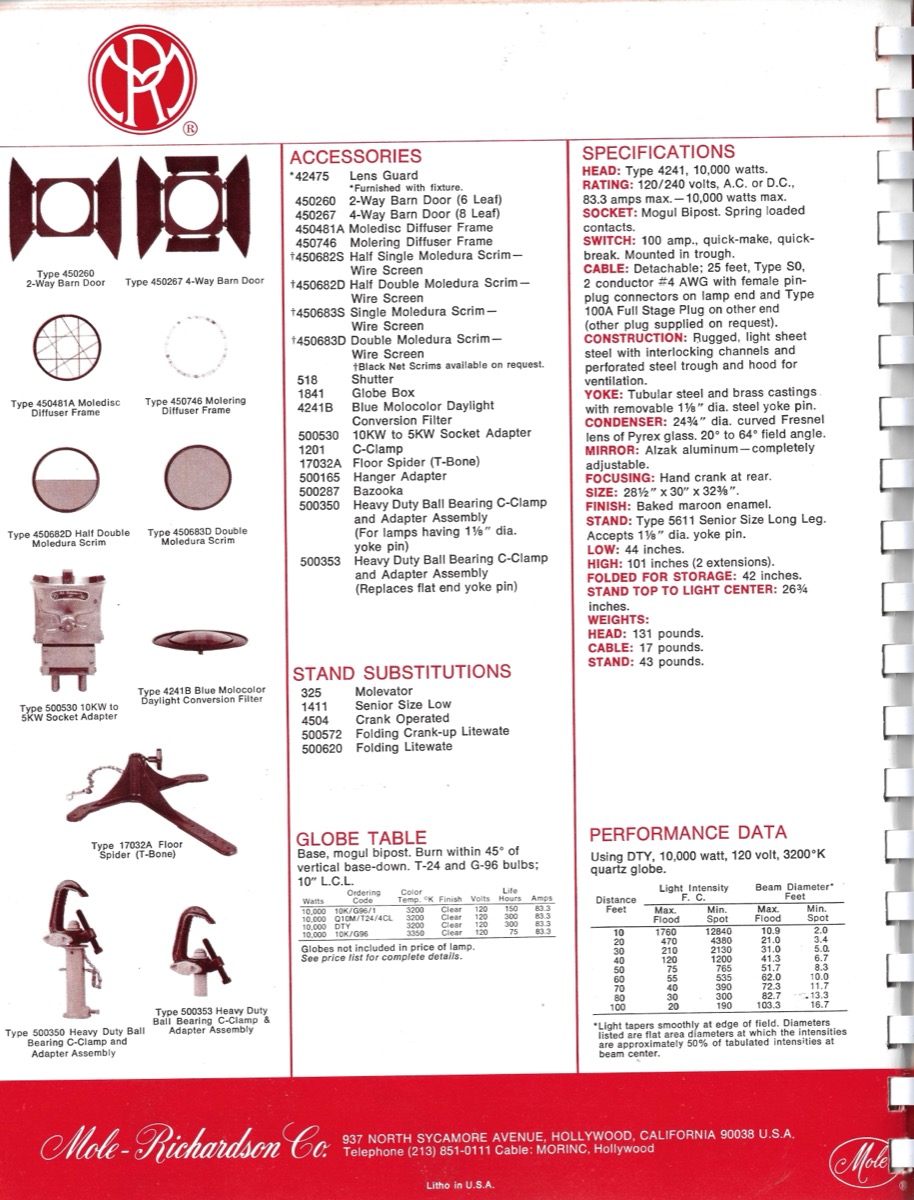
Mole-Richardson 10 kW to 5 kW Socket Adapter
Mole lists 19210 as the 10 kW to 5 kW socket adapter for the Type 2461. The 5 kW Skypan uses a different adapter to step down to 2 kW. 19210 documentation
Mole’s original factory catalogue also identifies 500530 as a 10 kW-to-5 kW socket adapter on its Type 416 page and Type 4241 page. The Type 416 page lists both 19210 and 500530; it does not establish interchangeability or supersession. Match the part to the exact fixture and lamp configuration.
K5600 Jo-Leko / Bug-A-Beam Compatibility
“Jo-Leko” describes a K5600 Joker used as the light source in an ETC Source Four optical system. The Source Four lens tube determines the nominal field angle and affects projected coverage. The two legacy conversions do not use the same parts.
Scroll the table sideways to see all columns.
| Conversion | Joker head | Required K5600 parts | What is modified |
|---|---|---|---|
| Jo-Leko 400 | Joker-Bug 400 in bare-bulb Bug-Lite configuration | Bug-A-Beam adapter and ETC Source Four body/lens tube | K5600’s FAQ specifies the BAB adapter for the 400 W conversion and does not list the modified back or pin extension required for the 800 W setup. |
| Jo-Leko 800 | Joker-Bug 800 in bare-bulb Bug-Lite configuration | Bug-A-Beam adapter, K5600-modified Source Four back/reflector and 800 W lamp-pin extension set | The modification belongs to the Source Four rear assembly/reflector so the lamp can pass through. The lens tube is selected separately. Do not omit the pin extension. |
K5600’s current Joker² 800 W kit is K0800S42 and identifies P0800S4, A0900BAB2 and P0800S4PINS. The Source Four lens tube can vary, so no single photometric curve applies to every Jo-Leko package. K5600 Jo-Leko FAQ (store login may be required) · Original K5600 400/800 Bug-A-Beam documentation · K5600 Joker² 800 kit listing (store login may be required) · K5600 system catalogue
For a projector booking, ask for the Joker generation, the K5600 kit and rear assembly, the exact lens tube, and the matching HMI head/ballast/cable package. An ordinary tungsten Source Four uses HPL lamps in its own lamp housing. ETC’s Source Four manuals and HPL photometry describe the stock fixture; those readings do not apply to the K5600 conversion.
Common Questions
Does a socket adapter change 120 V to 230 V?
No. A passive socket adapter passes the supply through. Read the voltage on the lamp itself, not just the number on the adapter. The adapter’s voltage rating is a limit, not its output.
Can I stack two lamp adapters or use a splitter to add capacity?
Use a single manufacturer-specified part for the required conversion. Stacking adds contacts and moves the load farther out of the lampholder; splitting adds more load to the same fixture. If the assembly isn’t documented or the bulb won’t clear the shade, choose a different lamp or a purpose-built fixture.
Can I run grounded equipment from a lamp socket outlet?
The two-slot Leviton 125 and 1406 have no equipment-grounding contact. Use a suitable grounded supply for equipment that requires one. A socket adapter is also not a substitute for production power distribution. A three-slot face on an Edison socket adapter does not prove that the ground slot is connected. U.S. CPSC staff documented this shock hazard in screw-in adapters with a ground-shaped outlet.