
Last Updated 13 hours ago
Overview
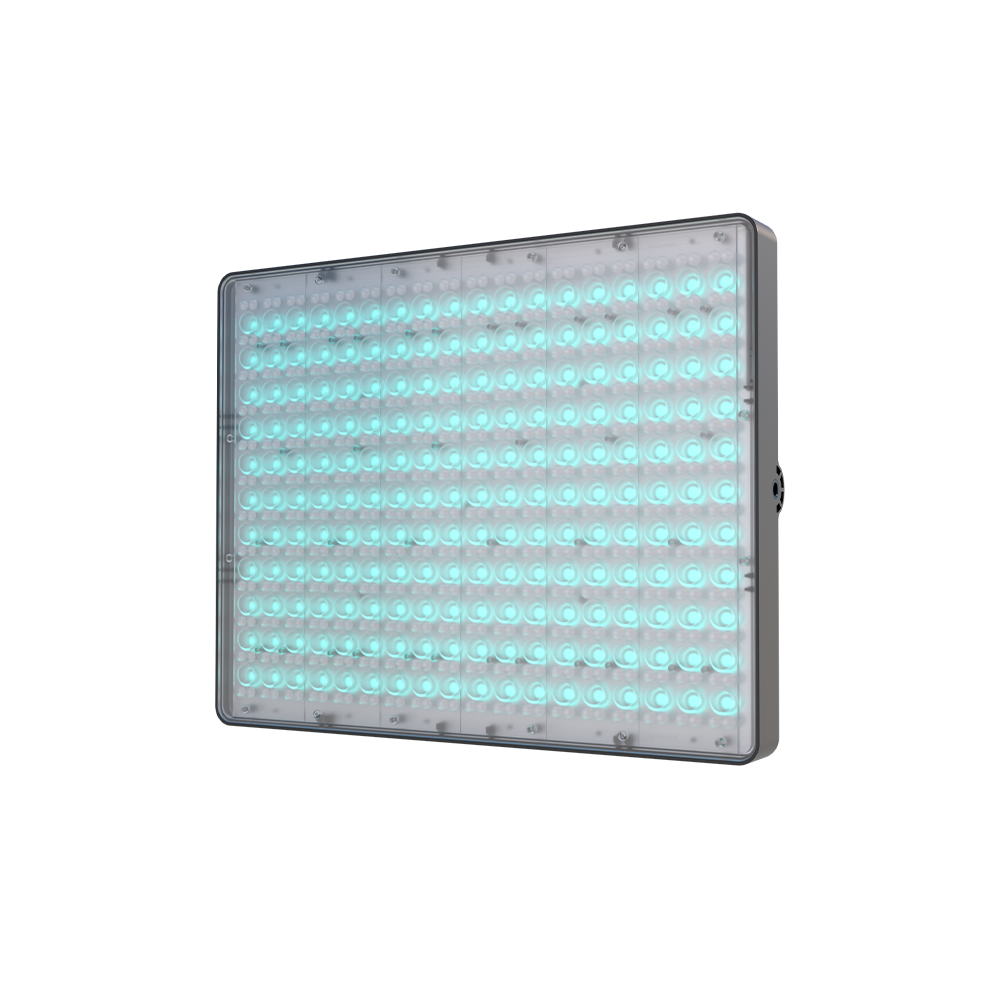
The amaran P60c is a compact RGBWW LED panel with a 60 W output class, optical reflector array, external power adapter and rear NP-F battery support. It is useful for portable interview packages, small interiors, accents and full-colour location work. Its supplied-style softbox changes the relatively concentrated bare-panel output into a broader soft-light arrangement.
The P60c is the full-colour model, distinct from the bi-colour P60x. It is also different from a flexible F-series mat: the P60c’s rigid lensed face, mounting hardware, fan and battery arrangement are part of the working system. The bare fixture’s 45° beam should not be confused with a very broad undirected soft panel.
Key specifications
| Specification | Details |
|---|---|
| Engine | RGBWW LED panel with optical reflector system |
| Maximum LED output / consumption | 60 W / 78 W |
| CCT range | 2500–7500 K |
| Bare beam angle | 45° in the manufacturer specification |
| Colour metrics | CRI ≥95, TLCI ≥96; SSI D32 ≥83, D56 ≥74 |
| Control | Onboard and Sidus Link Bluetooth mesh |
| Console-control distinction | No native DMX/CRMX route is listed in the checked manual |
| Mains power | Appropriate supplied-type adapter for 100–240 V, 50/60 Hz |
| Battery arrangements | Two Sony NP-F-style batteries; specified external battery supply arrangement also documented |
| NP-F voltage listed | 6.5–8.4 V |
| External V/Gold Mount battery voltage listed | 12.5–16.8 V; use the approved connection |
| Dimensions | 271 × 213 × 43.4 mm |
| Published lamp-head weight | 1880 g in the manual |
| Cooling | Active |
| Operating temperature | −20 to 45°C |
Strengths and limitations
Strengths
- A compact lensed panel and pop-up softbox make a quick small-space package.
- AC and dual NP-F operation suit compact location work.
- RGBWW, tint, gels and presets offer several colour roles.
Limitations
- The native optical beam is directional; a panel is not automatically a broad soft source.
- Use the specified power arrangement and suitable matched batteries.
- The supplied threaded-pin mounting system needs careful tightening and support.
Practical uses
The P60c is useful when a compact rigid head needs to travel quickly between small locations. Its bare optical design gives more concentration than a very broad mat, while a softbox makes it more suitable as a close key. Select the configuration for the subject distance rather than treating every LED panel as the same kind of source.
A bare small panel remains a relatively small apparent source and may create visible point structure in reflective objects. Diffusion can make its face more uniform, while placing a larger bounce close to the subject can create a different reflection and shadow character. Both choices reduce the useful level compared with the bare chart.
| Setup | Working approach |
|---|---|
| Interview key | Bring the diffused source close enough to appear large, then use the grid or flags to keep spill off the background. |
| Background accent | Position the source for the intended field and check the actual subject exposure rather than the brightness of the illuminated panel. |
| Compact location kit | Plan the stand, power source, cable path and access to controls as one package. |
| Coloured practical or background | Use the RGBWW controls for a nearby accent and check the colour-specific output. |
Output and colour
The manual’s output chart gives the following manufacturer averages. These are the bare optical panel’s readings, not guaranteed softbox illumination. The 45° beam concentrates the light, which helps explain the strong centre value for a relatively small panel.
| CCT | At 1 m | At 2 m |
|---|---|---|
| 3200 K | 5,200 lux | 1,400 lux |
| 4300 K | 5,600 lux | 1,460 lux |
| 5600 K | 5,900 lux | 1,550 lux |
| 7500 K | 6,300 lux | 1,650 lux |
The RGBWW engine supports tunable white and HSI full-colour operation. Dedicated warm/cool whites are useful for skin-tone work, while saturated settings can add a controlled background colour or motivated practical cue. Meter and view the selected colour through the actual camera; equal intensity percentages do not produce equal exposures across hues.
The product describes gel presets and built-in effects in addition to CCT and HSI modes. Use those as controlled creative tools and save the settings needed for continuity. A phone’s colour-pick result is a starting point rather than a calibrated guarantee that a product label or fabric will match exactly on camera.
Tests and reviews
Erik Naso’s 1 m test at a 5600 K setting reported 5910 lux, 5441 K and extended CRI 93.07 for the P60c.
Power and batteries
The light supports two Sony NP-F-style batteries, and the manufacturer describes more than an hour from suitable NP-F970 packs. Actual capacity, discharge ability, age and temperature affect that result. A battery labelled NP-F970 by a third party is not proof of the same cells or sustained current capability as the manufacturer’s test pack.
The maximum 78 W consumption is the useful planning figure for the complete light, separate from the 60 W output class. Use the documented adapter or external-battery arrangement with correct voltage, polarity and cable capacity. Do not assume a generic D-Tap or barrel cable is appropriate because it fits.
The P60c can charge installed NP-F batteries when connected to its proper mains-power arrangement. Confirm the charging indication and the manufacturer’s operating conditions, and allow time to recharge a pair between setups. A fixture that operates from an adapter but cannot reliably charge or run from its batteries needs a different assessment from a fully working location kit.
Control, cooling and camera operation
Local knobs provide immediate control and Sidus Link adds Bluetooth-mesh operation for several lights. This is useful when the head is awkward to reach or when an interview package needs quick matching changes. Pair it through the intended app workflow and check the saved settings before a take.
The P60c supports onboard and Sidus Link operation. It has no native DMX/CRMX receiver. Do not specify it as a directly console-addressable wireless-DMX panel based on a general “wireless control” listing. If the production requires console cueing, select a documented control arrangement or a fixture designed for it.
Modifiers, rigging and the working package
The P60c uses active cooling. Test the actual unit at the chosen brightness and ambient temperature for sound-sensitive work, and keep its airflow clear. Moving it farther from a microphone may change both lighting quality and exposure, so assess the combined result rather than solving noise independently of the shot.
Use the correct yoke/support, lock the tilt and provide suitable retention for overhead mounting. Support the adapter and cable so they do not pull on the head. Protect the diffusion surface, battery latches and controls during transport, and keep the fixture and power connections protected from weather as directed in the manual.
Alternatives and related fixtures
| Fixture | Choose it for |
|---|---|
| amaran P60x | A simpler bi-colour panel. |
| amaran COB 60x S | A compact Bowens point source with a different modifier and shadow-control approach. |
| amaran F21c | A larger, flexible RGBWW emitting area and a separate controller. |
What people are saying
Erik Naso: useful output, with the mount as the weak point
In his hands-on review, Naso liked the construction, softbox and power options. He preferred the P60c’s colour flexibility, but disliked the supplied tilt adapter and threaded mounting pin on both panels, using a grip head instead.
Videos
Gerald Undone: P60c and P60x review
A paired review of the two optical panels.
Jake Sloan: P60c and P60x
A hands-on assessment of the colour and bi-colour models.
Rental and used-fixture checks
Inspect the emitting face, enclosure, mount, battery contacts/latches, power connector and fan. Test CCT, saturated colours, low-end dimming and app control, then test battery runtime and charging. Check that the proper adapter, mounting parts, softbox/diffuser and case components are included in the listing.
The P60x is an alternative if only tunable white is required. A larger Nova P300c offers a different source area and professional control package, while a flexible mat is easier to fit into some shallow placements. The P60c’s strength is a compact full-colour panel with a practical battery-supported location workflow.
Check the mounting pin, all threaded mounting points and the tilt adapter under the actual panel, softbox and battery load. Inspect the diffuser, softbox retention, DC connector and NP-F contacts. Verify both battery operation and charging from the specified AC supply, then test app pairing and cooling.
Documentation and specifications
Official P60c product information and operating manual and photometrics. The LED-panel guide explains how emitting area and optics affect the result.
Product photograph: amaran.
Browse amaran lights · LED panels · all equipment.