
Last Updated 1 day ago
Overview
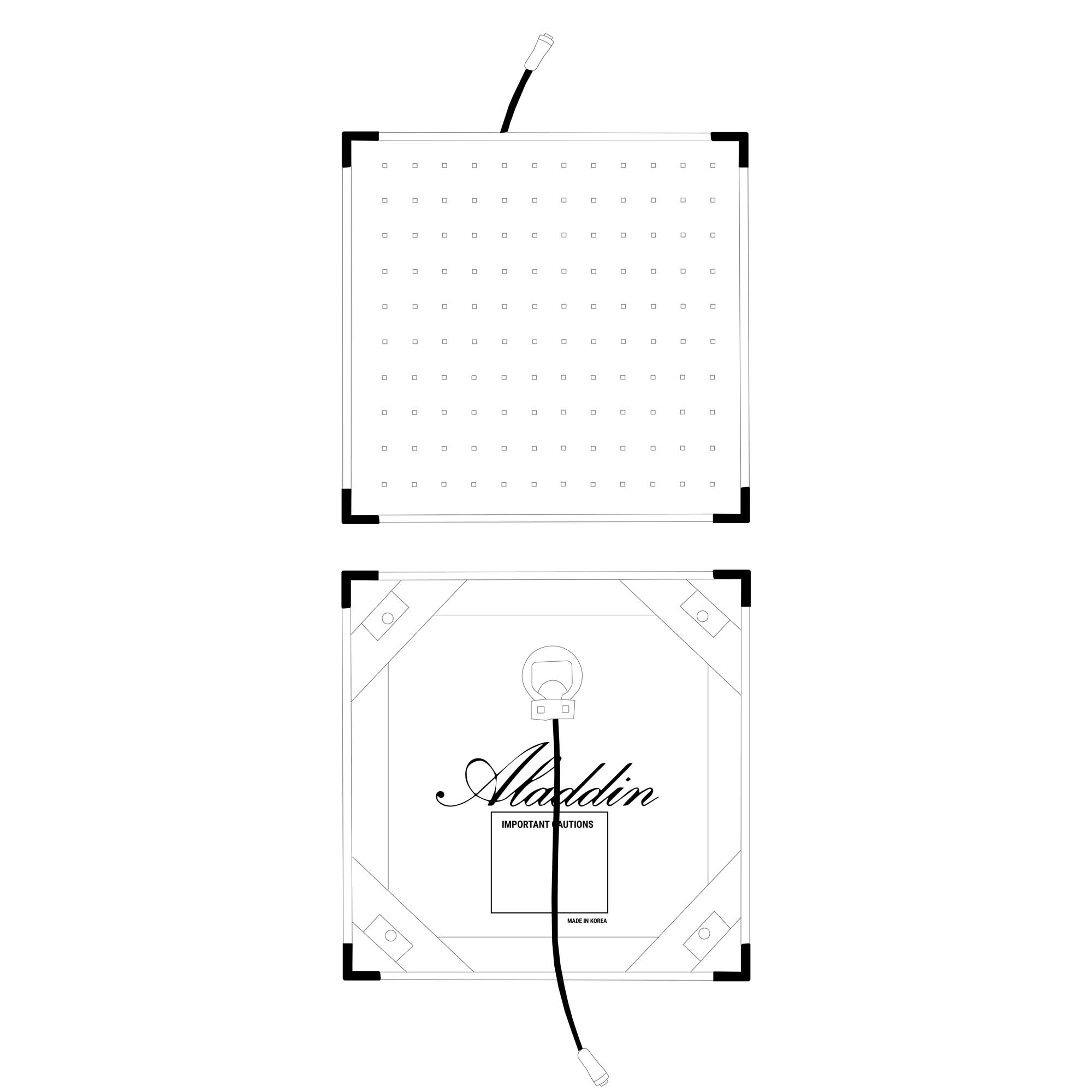
The Aladdin BI-FLEX M7 is a thin, flexible one-foot-class bi-colour LED panel rated at 70 W. Its 300 mm square head is useful for compact interview keys, close fill, vehicle interiors and hidden lighting positions where a rigid panel’s weight or depth is inconvenient.
The M7 is the Micro LED 70 W model, not the older 50 W BI-FLEX 1. It uses a separate dimmer and power arrangement, with V-mount and Gold-mount kit options. The small panel’s weight does not describe the complete controller, battery, holder and modifier package.
Key specifications
| Specification | Details |
|---|---|
| Fixture class | Flexible bi-colour LED panel with external dimmer |
| Rated head power | 70 W |
| White range | 3000–6000 K |
| Colour metrics | Current product page CRI 98 / TLCI 98; 2022 manual CRI Ra 97 / TLCI 98 |
| Head format | 300 × 300 mm; 5 mm thickness in the 2022 manual |
| Head mass reference | 237 g panel in the 2022 manual; controller and support additional |
| Published beam angle | 140° |
| Manual dimming range | 1–100% |
| Power | Approved external supply / battery through matching dimmer; see revision notes |
| Protection ratings | Panel IP32; dimmer IP21 on product page |
| Operating ambient | −10 to 40°C in the 2022 manual |
| Controller / battery mount | Model-specific external dimmer; V-mount / Gold-mount kit options |

Strengths and limitations
Strengths
- A thin emitting head fits low-profile soft-light rigs.
- Separate power and controls allow accessible placement.
Limitations
- Head-only mass excludes support, diffusion, controller and cables.
- Use the matching dimmer, connector system and approved battery arrangement.
Practical uses
| Setup | Working approach |
|---|---|
| Low-profile overhead | Support the mat and controller separately with the correct frame and retention. |
| Soft key | Build diffusion before metering and use a skirt or grid for spill. |
Output and colour
The following lux values are read from Aladdin’s model-specific 3200 K / 5600 K graphic. The distances are kept as labelled: 0.6, 1, 2 and 3 metres. The graphic does not explicitly identify an added diffuser or grid, so the numbers should not be assigned to an unspecified softbox configuration.
The panel’s broad output differs from a narrow spotlight peak. Fit the intended diffusion and spill control and assess the level across the working area. A close rectangular source also has meaningful physical size, so use the documented distances rather than promising a simple extrapolation for every placement.
| White setting | 0.6 m, lux | 1 m, lux | 2 m, lux | 3 m, lux |
|---|---|---|---|---|
| 3200 K | 4,460 | 1,660 | 460 | 225 |
| 5600 K | 5,100 | 1,900 | 520 | 260 |
Power and batteries
The current page lists a 12–30 V DC dimmer supply and 90–260 V AC adapter description. The 2022 manual specifies 12–30 V DC and an automatic 100–240 V AC power unit. Use the actual approved adapter’s regional label and matching controller, rather than assuming the widest range from a marketing line applies to every supplied PSU.
The product page gives CRI 98 / TLCI 98, while the 2022 manual lists Ra 97 / TLCI 98 and a 237 g panel. Those source-specific values are identified rather than blended into a new specification. The manual’s startup text also contains a stray lower-power reference, but its technical table and battery equation identify the M7 as a 70 W model.
Use the matching external dimmer and approved locking interconnects. The head connection is not an invitation to wire an arbitrary battery straight to the emitter. Identify voltage, continuous current capability, connector rating and the complete supply arrangement before battery operation.
As a planning calculation, 70 W divided by 14.8 V is approximately 4.7 A before system losses. A 100 Wh battery divided by 70 W gives about 1.4 hours of ideal energy-only runtime; actual duration is shorter or different with losses, protection limits, output setting and battery condition.
Control, cooling and camera operation
The documented white range is 3000–6000 K. The controller mixes warm and cool white; it does not supply independent saturated RGB colours. Check skin, textiles and product colours through the camera when matching another source at the same nominal Kelvin setting.
The 2022 manual lists 1–100% dimming. Check low-end fades and the route to blackout on the actual dimmer/DMX configuration rather than silently rewriting that as a verified continuous 0–100% operating range. Test the intended frame rate, shutter and level when flicker or low-level stepping matters.
The archived manual specifies two-channel white/bi-colour DMX through a separate attachment. The current page lists the MM-DIM-LM dimmer and a model-specific MFL70BIADAPT cable for connecting the M7 panel to that newer unit. Match the panel, dimmer, adapter and actual DMX/radio features; a newer controller listing does not make every older M7 kit wireless.
Set the correct profile and address for the actual dimmer and test local controls, low fades, blackout and signal loss. A driver whose name contains a higher wattage is not, by itself, proof of compatibility with every panel or cable in the brand’s range.
The manufacturer manual limits bending/folding to no more than 90 degrees and warns against tape directly on the emitters. Follow the intended folding/storage method, protect the LED face and avoid sharp local creases or pressure from heavy objects. Let the panel cool before placing it in a pouch.
The manual calls for the X-Bend or frame to maintain airflow and specifies −10 to 40°C operation. Passive cooling still requires heat to escape; flexible construction does not make it suitable for being wrapped in insulating material at full output.
The page lists IP32 for the panel and IP21 for the dimmer. Those are different protections and do not establish a waterproof complete kit. Protect the controller, supply and connections from wet conditions and follow the actual unit’s instructions.
Inspect the fabric or flexible substrate, attachment points, LED tracks, short lead and locking plugs. Test every warm/cool region for uniform response and confirm that the dimmer, AC supply, battery mount and intended DMX/radio route all function. Support an elevated head and its control unit independently with suitable retention.
Using the newer MM-DIM-LM
The December 2024 MM-DIM-LM manual names both BI-FLEX M3 and M7 as compatible heads. Switch off before a panel change, use the approved model cable and check the detected sheet type after startup. Green/magenta and hue functions are for compatible RGBWW panels; connecting an M3 or M7 does not add a colour-mixing emitter.
Wired DMX uses MM-YDMX to the mini-jack socket. Select Wired or LumenRadio in the menu and allow the controller to reboot, then match the actual bi-colour profile. The Simple/Expert colour profiles published for MOSAIC MINI should not be assigned to a bi-colour head merely because the same dimmer can operate both.
Modifiers, rigging and the working package
The square flexible face can fit above a dashboard, beside a practical object or close to an interview subject. Use the intended support rather than allowing its thinness to encourage a sharp crease. Flexible construction is a placement option, not permission to clamp or fold across individual emitters.
An X-Bend or frame can hold the panel flat for a conventional soft key. A softbox or diffuser creates a more unified face for close subjects and reflective products. The one-foot area remains a modest apparent source if it has to sit far away; a larger mat may be more suitable for coverage or softness.
Aladdin lists the 1X1-XB X-Bend, ball-head stand mount, 1X1 frame, softbox, grid and round ball-diffuser accessories. The basic system lists the panel, dimmer, AC adapter, holder, extensions, diffuser and pouch. A case or larger modifier package depends on the exact kit SKU.
Choose the diffuser for the reflected image and shadow quality, then choose a grid or flags to control spill. A grid does not turn the mat into a sharply focused projector. Record the panel shape, holder, diffuser, grid, CCT and intensity when a setup needs to be repeated.
Alternatives and related fixtures
The larger BI-FABRIC 2 gives a 300 × 600 mm rectangular face at a 100 W rating. A LiteMat 4 Plus is a different, larger supported-head/controller system. Choose M7 for its compact flexible bi-colour source and a complete compatible package.
| Fixture | Choose it for |
|---|---|
| Aladdin BI-FABRIC 2 | A larger rectangular bi-colour face. |
| LiteMat Plus 1 | A different support, dimmer and connector system. |
| MOSAIC MINI 1×1 | 300 × 300 mm RGBWW mat, 50 W white / 20 W RGB. The MM-DIM-LM and compact support options suit a portable square source. |
| BI-FLEX M3 | 300 × 125 mm, 30 W bi-colour micro-LED mat. Choose the narrow compact head where a square source or RGB colour is unnecessary. |
| BI-FABRIC 2 | 300 × 600 mm, 100 W bi-colour fabric head. A rectangular white source with its own controller and revision-specific power details. |
What people are saying
TECH Rehab: compact flexible lighting
TECH Rehab praises the M7’s small flexible format, colour and output relative to its size. The review sees it as a useful addition to an existing lighting kit. View the source.
Videos
Aladdin BI-FLEX M7: review and operation
A walkthrough or review of the fixture and its working package.
Rental and used-fixture checks
Check the exact model and revision, complete power package, mounting hardware and control leads. Inspect emitting surface, connectors and support points. Test the intended operating level, fade and camera settings before rigging.
Documentation and specifications
official model and accessory information, manufacturer operating manual and published photometric graphic.
Product photograph: Aladdin official product photograph.
Browse Aladdin lights · LED mats · all equipment.