
Last Updated 22 hours ago
Overview
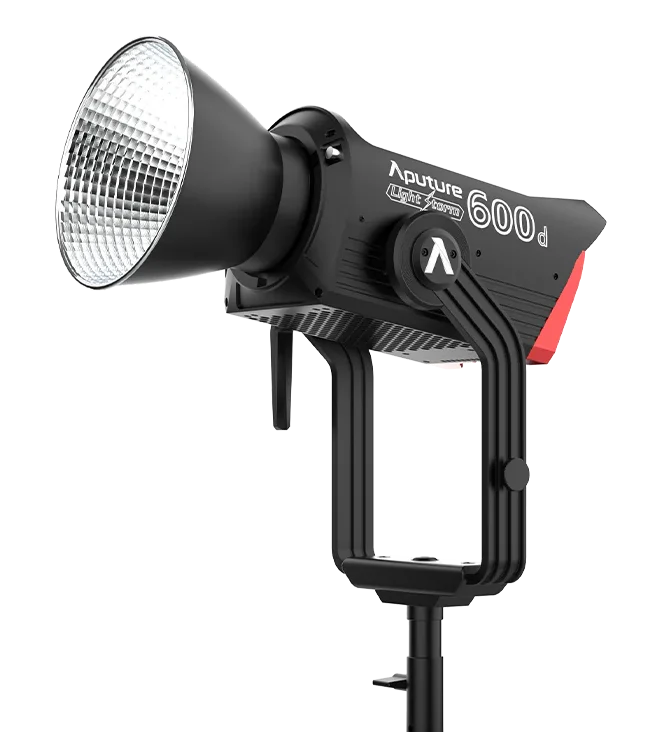
The Aputure Light Storm LS 600d is the non-Pro version of the 600W-class daylight Bowens-mount fixture. It retains the same published output class while using a lighter controller and a simpler control package. It supports Sidus Link and wired DMX, but does not have the Pro model’s internal CRMX or Ethernet control.
It is useful as a daylight key, bounce source or window light when the simpler controller is sufficient. The absence of “Pro” is important for both weather protection and power/control planning; do not order it as an interchangeable 600d Pro package.


Select a photograph to view it at full size.
Key specifications
| Specification | Details |
|---|---|
| Colour / CCT | Daylight; 5,600K ±200K |
| Maximum electrical input / LED power | 720W / 600W |
| Colour references | CRI/TLCI ≥96; SSI D56 ≥72 |
| Native / Hyper-Reflector beam | 105° / 55° |
| Accessory interface | Bowens mount |
| AC supply | 100–240V, 50/60Hz |
| DC input | 48V, 15A through the dedicated 3-pin XLR input |
| Battery operation | Two supported V-Mount or Gold Mount batteries; onboard battery path limited to half output |
| Head with yoke / controller | 4.69kg / 3.24kg |
| Head cable | Standard 3m LS 600 Series 5-pin cable; maximum supported length 7.5m |
| Control | Onboard, Sidus Link, compatible 2.4GHz remote and 5-pin wired DMX |
| Operating temperature | −20°C to 45°C |
Technical reference: Aputure product information and downloads.
Strengths and limitations
Strengths
- Useful daylight output with a lighter controller than the Pro package.
- Bowens interface supports a wide modifier ecosystem, including the F10 Fresnel.
- Sidus Link and wired DMX cover many small-crew and studio uses.
Limitations
- No internal CRMX receiver or Ethernet control hardware.
- Battery plates do not deliver the same full-power operation as the dedicated 48V input.
- The non-Pro unit does not have the Pro package’s weather-resistant construction.
- Fixed daylight output needs gels or another fixture for warm light, tint correction or saturated colour.
Practical uses
| Setup | Working approach |
|---|---|
| Interview soft key | Use a suitable Bowens softbox, bring it close enough for the required softness and control spill with a grid or flags. |
| Window or wall bounce | Fill the selected surface rather than creating an intense centre hotspot. Meter the returned light on the subject. |
| Directional window light | Use the reflector or F10, then shape the beam through the intended opening. Meter after correction gel and glass. |
| Controlled studio | Use wired DMX when the cable route is practical; add an external wireless-DMX receiver only when the job requires it. |
Output and colour
The Hyper-Reflector and F10 change beam coverage as well as centre intensity. Compare the useful area and modifier arrangement, not just the highest lux number. These manufacturer readings are separate from measurements of the 600d Pro.
The colour temperature is fixed near daylight. Warming it with CTO reduces usable output, while a daylight reading does not predict the level after a softbox, grid and gel have all been fitted.
| CCT | Distance | Bare (lux) | Hyper-Reflector (lux) | F10 flood (lux) | F10 spot (lux) |
|---|---|---|---|---|---|
| 5600K | 1m | 22,150 | 98,500 | 89,200 | 224,200 |
Published photometrics: measurement configurations and full output tables.
Tests and demonstrations
Caleb Pike’s 600-series comparison covers the Pro daylight, bi-colour and full-colour models, and lists the non-Pro 600d among the related gear. Use it for family context rather than relabelling a Pro measurement as a separate non-Pro test.
Power and batteries
Maximum electrical draw is 720W. This is the figure to use when comparing an AC source’s continuous capability; the 600W class alone leaves out the complete system demand.
The two battery plates support specified battery voltage and current combinations at half output. Full-power DC operation uses the dedicated 48V, 15A path. Confirm battery compatibility and available output before promising a location setup.
The fixture accepts V-Mount or Gold Mount controller variants. Include the correct pair, charging plan and cables in a portable package, and compare the exposure of that battery configuration with the AC setup.
Control, cooling and camera operation
The manufacturer’s control FAQ explicitly separates this model from the Pro: onboard, Sidus Link, compatible 2.4GHz remote and wired five-pin DMX are available; internal CRMX and Ethernet are not.
A compatible remote is supported, but the original standard package did not include one. For console control over radio, an external wireless-DMX receiver and its power supply belong in the order.
Choose and test the dimming curve and fan mode before setting exposure. The published high-speed reference does not replace a camera test at the required shutter, frame rate and lowest fade level.
Modifiers, rigging and the working package
| Component / accessory | Package considerations |
|---|---|
| Head / controller | 4.69kg head with yoke and 3.24kg controller; support the controller separately. |
| Stand interface | 16mm baby / 28mm junior combination; choose support for the fitted modifier and head balance. |
| F10 Fresnel | A compatible directional option; add the lens and its barn doors to the working load. |
| Softboxes / lanterns | Approved Bowens accessories such as Light Dome and Lantern configurations; allow for depth and leverage. |
| Head cable | Correct 5-pin LS 600 Series cable; do not substitute a similarly shaped cable from another family. |
| Transport | Manufacturer kit-with-case reference 16.71kg before additional modifiers and batteries. |
Keep this non-Pro package protected from adverse weather. A weatherproof connector or a cable’s name does not establish weather protection for the whole fixture.
Alternatives and related fixtures
| Fixture | When to compare it |
|---|---|
| LS 600d Pro | Compare when internal CRMX, Ethernet or the Pro construction is required. |
| LS 600x Pro | Bi-colour adjustment when avoiding correction gels matters more than maximum daylight output. |
| STORM 400x | A newer tunable-white package; compare the required beam and available power rather than the model number. |
| LS 300d II | A smaller daylight source when the shot permits a lighter package. |
What people are saying
Aputure’s model comparison. The control FAQ is particularly useful for avoiding a mis-specified rental: the non-Pro controller cannot acquire internal CRMX or Ethernet through a firmware update. Read the 600d versus 600d Pro control comparison.
Caleb Pike, DSLR Video Shooter. His family comparison explains the choices between daylight, bi-colour and colour-mixing 600-series models. Watch the comparison with the model labels kept in view.
Videos
DSLR Video Shooter: 600-series comparison. Family context covering the Pro models; the non-Pro controller has the separate limitations described above.
Rental and used-fixture checks
- Read the non-Pro model label on both head and controller.
- Verify battery-plate type, battery current capability and the selected power path.
- Inspect the 5-pin head cable, Bowens catch, yoke brake and controller clamp.
- Test wired DMX and Sidus Link; include an external receiver if wireless DMX is required.
- Run warm and listen to the complete head-and-controller package.
Documentation and specifications
- Aputure product specifications, kit options and firmware downloads
- Product manual (PDF)
- DMX profiles (PDF)
- Non-Pro control options and differences from the Pro
- Photometrics, battery limits and technical specifications
Browse Aputure lights · COB lights · all equipment.