
Last Updated 2 days ago
Overview
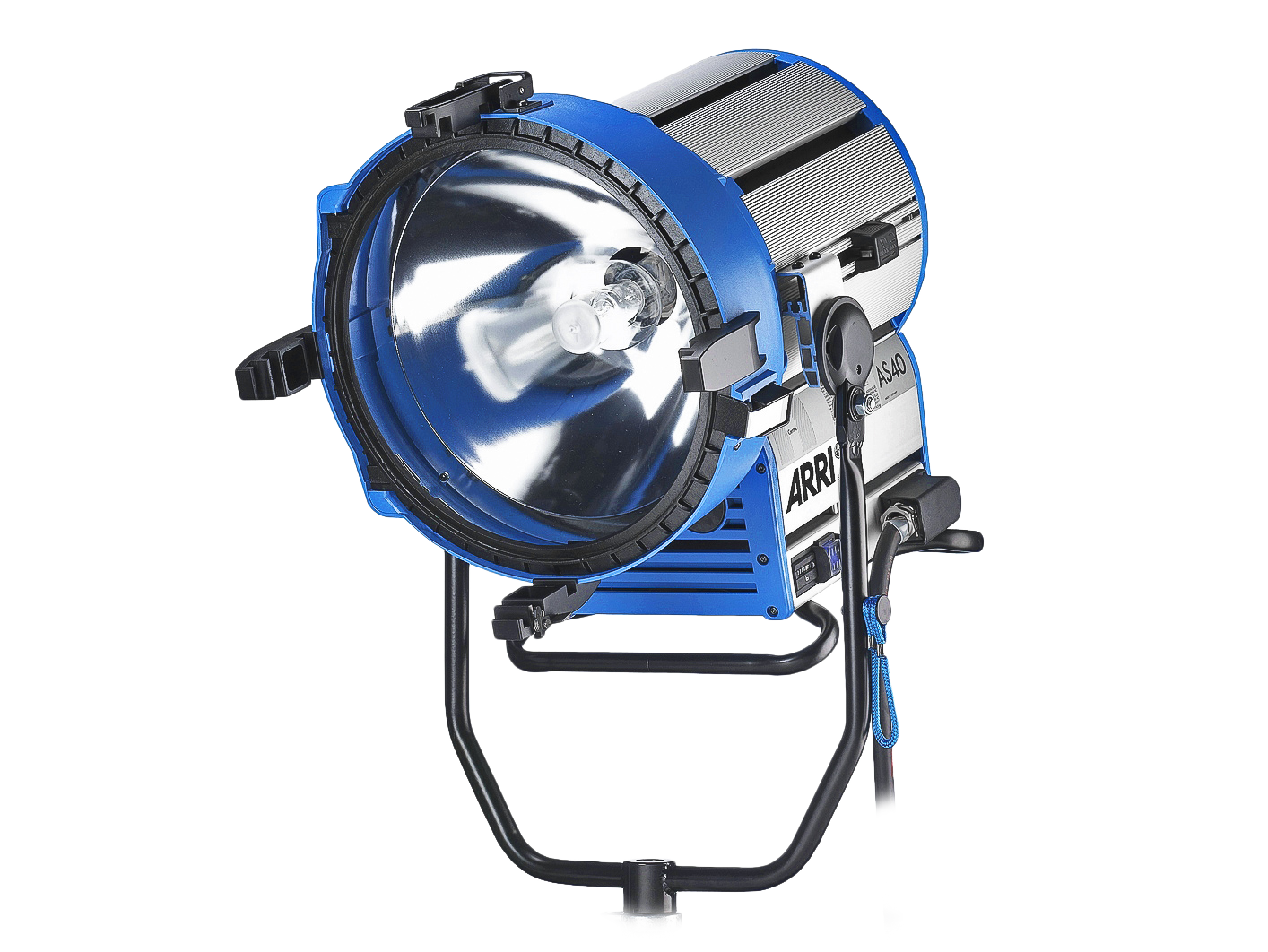
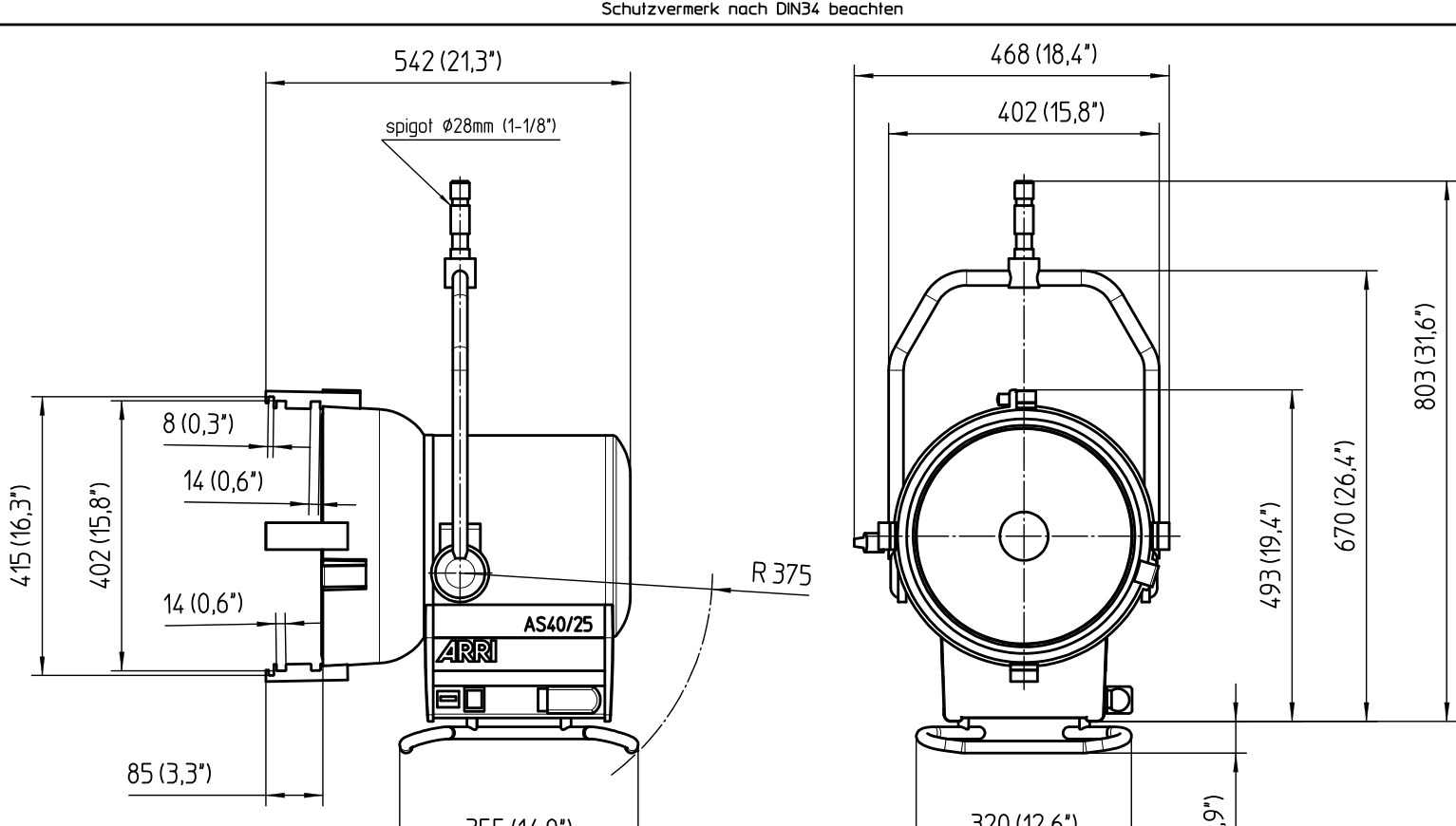

The AS 40/25 shares its housing with the M40/25 and takes the lenses, doors and scrims of the older ARRISUN 40/25. It gives the crew a choice between concentrated throw and a wider, asymmetric field.
Confirm whether the package runs 4,000 W or 2,500 W and which optic it includes. A visually similar M40 with the MAX reflector does not use the same configuration as the AS 40/25.
- Type Dual-wattage HMI PAR
- Power 2.5 or 4 kW lamp; chart uses 4 kW
- Colour Temperature Daylight HMI; depends on installed lamp and operating condition.
- Weight 19 kg in individual 2011 sheet; 24 kg in ARRI family table
- Beam Control Drop-in spread optics; 9° spot to 50° super-frosted in 4 kW chart
- IP Rating IP23 lamphead only; verify the complete package. Read the IP rating guide.
Key Specifications
| Specification | Details |
|---|---|
| Manufacturer and model | ARRI AS 40/25 |
| Source or rated power | 4,000 or 2,500 W HMI PAR |
| Optics, colour or format | G38 single-ended lamp |
| Head or system detail | 19 kg head |
| Wire scrim diameter | 400 mm, full single L2.81230.A |
| Four-leaf barn doors | 413 mm, L2.41200.0 |
Output Calculator
Select the published setup and a manufacturer distance, or enter a custom throw where supported. The results describe centre-beam output, not the brightness across the whole beam.
Camera Settings
If the calculator does not load, use the published photometric table or source on this page. JavaScript is required.
F-stop is a planning estimate, not a meter reading. It uses direct, on-axis illuminance and includes only the optics and diffusion named in the selected setup. Meter on set to account for lens transmission, filters, added diffusion, bounce, dimming and ambient light.
How the exposure estimate works
N = √(E × ISO × t / C), where E is illuminance in lux and t = shutter angle ÷ (360 × fps). The default C = 340 is a dome reference; C = 250 is a flat reference. These are calibration constants, not a measured T-stop. A small nonzero digit is tenths of a stop above the displayed full stop.
Distance estimates and comparisons
Published points are used as given. Between published points the calculator fits a curve through the two nearest readings. Outside those points it uses the inverse-square law only when the fixture’s dataset permits it. Distances outside a configuration’s supported range are reported separately. Comparisons use one shared distance and camera setup; equal lux does not imply equal coverage.
View published readings for the selected configuration
Strengths and Limitations
- A crew with older 40/25 lenses can reuse them on this head.
- The 2.5 and 4 kW lamps need different exposure assumptions.
Working with the AS 40/25
The narrow flood can lay a strip across a façade. A super flood gives up considerable centre intensity to fill a larger diffusion frame at the same throw.
Output and Photometrics
| Configuration | Distance | Lux | Foot-Candles |
|---|---|---|---|
| 4,000 W · Spot 9° | 10 m | 45,800 | 4255.0 |
| 4,000 W · Spot 9° | 15 m | 20,356 | 1891.1 |
| 4,000 W · Spot 9° | 20 m | 11,450 | 1063.7 |
| 4,000 W · Flood 42° × 20° | 10 m | 6,810 | 632.7 |
| 4,000 W · Flood 42° × 20° | 15 m | 3,027 | 281.2 |
| 4,000 W · Flood 42° × 20° | 20 m | 1,703 | 158.2 |
| 4,000 W · Narrow Flood 20° × 12° | 10 m | 20,700 | 1923.1 |
| 4,000 W · Narrow Flood 20° × 12° | 15 m | 9,200 | 854.7 |
| 4,000 W · Narrow Flood 20° × 12° | 20 m | 5,175 | 480.8 |
| 4,000 W · Super Flood 49° | 10 m | 3,040 | 282.4 |
| 4,000 W · Super Flood 49° | 15 m | 1,351 | 125.5 |
| 4,000 W · Super Flood 49° | 20 m | 760 | 70.6 |
| 4,000 W · Super Flood Frosted 50° | 10 m | 1,850 | 171.9 |
| 4,000 W · Super Flood Frosted 50° | 15 m | 822 | 76.4 |
| 4,000 W · Super Flood Frosted 50° | 20 m | 463 | 43.0 |
Photometric source and test conditions.
These September 2011 ARRI readings apply to 4,000 W, not the optional 2,500 W mode. The calculator stays within each configuration’s published distances; intermediate values are estimates, not additional manufacturer measurements.
Power and Controls
ARRI lists the EB 2.5/4 kW and EB MAX 2.5/4 for this head. The 7 m cable is L2.75620.0 for VEAM or L2.75620.F for Schaltbau. Check the sockets on the head and ballast before ordering the feeder.
Control and Camera Operation
The exact 2011 AS 40/25 sheet lists 19 kg; the ARRI family table lists 24 kg. The documents do not explain that difference. Verify the actual head weight and appropriate ballast instead of treating the figures as interchangeable.
Optics and Mounting
Older ARRISUN 40/25 glass fits the new housing. A 9° spot and a 42° × 20° flood give substantially different beam shapes.
Comparable Fixture
Similar name, different optics: The ARRI X40/25 is a broad open-face flood. The AS 40/25 on this page is the interchangeable-lens PAR.
For a 4 kW lensless daylight head, see ARRI M40.
What People Are Saying
Field Feedback at a Glance
These points summarize ARRI’s technical documentation and original launch reporting; they aren’t a survey of owners or an independent output test.
What worked
- Change the beam by choosing the lens, not by moving the head. ARRI’s 4,000 W chart runs from a 9° spot to a 50° frosted flood. At 15 m, the centre reading changes from 20,356 to 822 lux. ARRI photometry.
- Carry over existing 40/25 optics. ARRI’s launch notes say the new housing was over 3 kg lighter while retaining the predecessor’s accessory diameter, so existing lenses, barndoors, and scrims can still be useful. ARRI’s IBC launch notes.
- Plan a longer head run with the correct CCL ballast. ARRI’s compensation for cable loss is designed to maintain lamp power on long compatible runs; CCL is not a property of an arbitrary ballast. ARRI ballast and head specifications.
Drawbacks and limits
- Do not use the 4,000 W chart to estimate the 2,500 W lamp. The same head accepts both documented lamp ratings, but ARRI’s listed illuminance here is for the 4,000 W lamp. ARRI photometry.
- Bring the right ballast and head cable. ARRI lists VEAM and Schaltbau head variants. Check the actual connector set, ballast, lamp and available supply before a rental leaves the shop. ARRI order codes and operating manual.
- Allow for a 19 kg head before lenses and accessories. The replacement is lighter than the old head, but this is not a small stand package. IP23 also does not make it dust-tight or jet-proof. ARRI rigging and enclosure specs.
Videos
Bill Holshevnikoff’s ARRI walkthrough shows the older ARRISUN 40/25. It is useful for the predecessor’s lens workflow, not for identifying the newer True Blue AS 40/25, its ballast or its output. See the AS 40/25 operating manual for the current head on this page.
Rental and Used-Fixture Checks
Check the lamp rating, ballast and head-cable connector together. Confirm whether the package includes ARRI’s cable-loss-compensation ballast if the run calls for it.
Documentation
- AbelCine’s ARRI HMI and LED comparison shows how reflector and lens choices affect a daylight setup.