
Last Updated 5 days ago
Nanlux Dyno 650C Overview


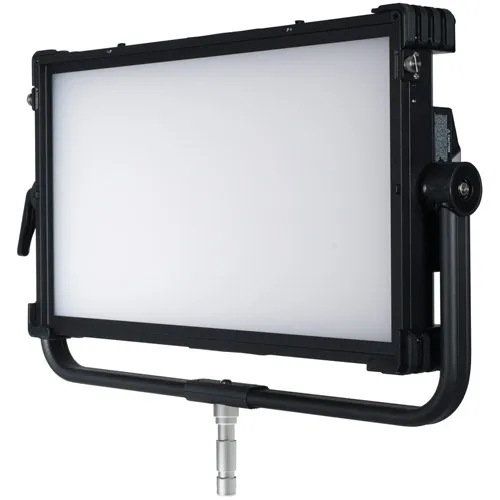
The Nanlux Dyno 650C is a large RGBWW soft panel with a broad native beam, green–magenta adjustment and a separate power supply. It is a different source shape and working package from a reflector-based Evoke fixture.
The Dyno 650C is a broad rectangular colour soft panel for large keys and washes. Its separate PSU, removable diffuser and front accessories add to the weight and transport space.
- RGBWW Broad Soft Panel Dyno 650C with separate power supply and standard diffuser. Learn about RGBWW
- 650 W Rated Fixture Class 100–240 V AC power system. Head DC rating 48 V, up to 14.6 A; use exact published AC current for circuit planning.
- Colour Temperature2700–20000 K Tunable white with green–magenta and full-colour modes.
- Weight 15.8 kg Head / 4.2 kg Power Supply. Standard diffuser, cabling, mounting and accessories add separate mass.
- Beam Control 160° native beam, with diffuser and matching spill-control accessories. Standard and Boost readings are separate.
- No Published Numeric IP Rating The reviewed model specifications do not establish weather sealing. Keep head and separate power equipment dry. How to Read an IP Rating.
Nanlux Dyno 650C Specifications
| Specification | Details |
|---|---|
| Engine / beam | RGBWW soft panel; 160° native beam |
| White range | 2,700–20,000K with green–magenta adjustment |
| Fixture class | 650W rated light |
| Published AC requirements | 100–240V; 6.36A at 110V / 3.18A at 220V / 2.91A at 240V |
| Head input | 48V DC, 14.6A maximum |
| Manufacturer colour references | Average CRI 95; TLCI 95 |
| Body dimensions | 857 × 173 × 630mm |
| Fixture / diffuser / PSU | 15.8kg / 1.8kg / 4.2kg |
| Output modes | Standard and Boost, with separate photometrics |
| Controls | Onboard, DMX/RDM, internal TimoTwo CRMX and NANLINK Bluetooth/2.4GHz |
Output Calculator
Select the published setup and a manufacturer distance, or enter a custom throw where supported. The results describe centre-beam output, not the brightness across the whole beam.
Camera Settings
If the calculator does not load, use the published photometric table or source on this page. JavaScript is required.
F-stop is a planning estimate, not a meter reading. It uses direct, on-axis illuminance and includes only the optics and diffusion named in the selected setup. Meter on set to account for lens transmission, filters, added diffusion, bounce, dimming and ambient light.
How the exposure estimate works
N = √(E × ISO × t / C), where E is illuminance in lux and t = shutter angle ÷ (360 × fps). The default C = 340 is a dome reference; C = 250 is a flat reference. These are calibration constants, not a measured T-stop. A small nonzero digit is tenths of a stop above the displayed full stop.
Distance estimates and comparisons
Published points are used as given. Between published points the calculator fits a curve through the two nearest readings. Outside those points it uses the inverse-square law only when the fixture’s dataset permits it. Distances outside a configuration’s supported range are reported separately. Comparisons use one shared distance and camera setup; equal lux does not imply equal coverage.
View published readings for the selected configuration
The Nanlux Dyno family documentation identifies this model and its operating modes. Use the exact published Standard or Boost measurements rather than combining them.
Strengths and Limitations
Strengths
- A broad rectangular surface supplies a soft key or colour wash without a narrow-beam optic.
- Built-in CRMX and Standard/Boost choices accommodate different operating setups.
Limitations
- The removable diffuser and PSU are additional published loads.
- Large coverage, added diffusion and saturated colours reduce the usefulness of a single peak-lux comparison.
Practical Uses
Use it for a broad key, soft fill, coloured wash or a larger diffusion source. Confirm stand clearance, access to the controls and the complete modifier package before lifting it into position.
| Setup | How to use this fixture |
|---|---|
| Large interview key | Use the panel directly or through a larger frame. The linked documentary setup uses a three-metre diffusion frame; its exposure depends on that complete arrangement. |
| Broad colour ambience | Choose hue and saturation before exposure. A broad beam can fill a room but may need a grid or flags to keep colour off faces or walls. |
| Rectangular reflection | Orient the emitting surface for the subject’s reflection. Compare the square Dyno 1200C when a different source shape is more useful. |
Output and Colour
The 650C is a broad 160° RGBWW soft panel. NANLUX publishes separate Standard and Boost figures; at 5,600K/3m they are 2,237 and 2,649 lux. Boost is an operating condition, not a new measurement of the same mode. A softbox or grid changes transmission and spill, while the rectangular surface creates different reflections from the square Dyno 1200C.
Manufacturer Photometrics
| White-light mode / CCT | 3m | 5m |
|---|---|---|
| Standard, 3,200K | 2,080 lux | 850 lux |
| Standard, 5,600K | 2,237 lux | 919 lux |
| Boost, 3,200K | 2,403 lux | 979 lux |
| Boost, 5,600K | 2,649 lux | 1,082 lux |
Sources: Nanlux Dyno 650C: www.nanlux.com reference; Nanlux Dyno 650C: www.nanluxamericas.com reference.
At 5,600K/3m, Nanlux lists 2,237 lux in Standard mode and 2,649 lux in Boost, an increase of about 18%. Grids and additional diffusion change the final output and coverage.
The brochure’s AC voltage/current pairs give approximately 700VA apparent power. The PSU label lists the supply requirements; apparent power and active power in watts are different electrical quantities.
Power and Batteries
The head is a 650W-class light with a separate 100–240V supply. Published AC references are 6.36A at 110V, 3.18A at 220V and 2.91A at 240V. Keep those requirements separate from the model’s light-engine class.
The head input is specified at 48V/14.6A maximum. The 4.2kg PSU, head cable and mounting arrangement remain part of the location package. Set Standard or Boost before establishing electrical and exposure conditions.
Control, Cooling and Camera Operation
| Control path | Hardware and operating notes |
|---|---|
| Local | Onboard white, colour, gel and effect operation. |
| Console | 5-pin DMX/RDM and internal LumenRadio TimoTwo CRMX. |
| App / remote | NANLINK Bluetooth/2.4GHz system, separate from console CRMX. |
| Profile | Installed firmware, selected colour mode and Standard/Boost setting recorded with the cue. |
A panel behind a large frame can still need spill control. Rehearse the intended effects and low-end fade after the grid/diffusion is fitted, because a visually subtle cue at the panel can become very different at the subject.
Run the chosen cooling mode at working intensity before approving dialogue sound. Keep rear ventilation clear and the supply accessible after rigging.
Modifiers, Rigging and the Working Package
NANLUX lists a 15.8kg fixture, 1.8kg removable diffuser and 4.2kg PSU. The fixture and diffuser subtotal is 17.6kg; a quoted bare fixture weight must not be used for the diffused rig. Include the actual yoke, grid/softbox, cables and mounting hardware as applicable, and support the separate PSU. The body is 857 × 173 × 630mm before the additional working clearance required by accessories.
| Component | Published reference |
|---|---|
| Fixture | 15.8kg |
| Removable diffuser | 1.8kg; fixture-plus-diffuser subtotal 17.6kg |
| PSU | 4.2kg separately |
| Body | 857 × 173 × 630mm before working clearance |
| Accessories | Correct softbox/grid, mounting adapter and full cable package |
Include the removable diffuser and other front accessories in the supported load. Inspect their retention, the yoke and mounting hardware with the complete rig assembled.
Alternatives and Related Fixtures
| Fixture | When to compare it |
|---|---|
| Nanlux Dyno 1200C | Choose the larger square Dyno when its source size and coverage justify the increased handling and power. |
| Aputure Nova P600c | Compare a four-engine soft-panel package when independent zones are a priority. |
| Creamsource Vortex 8 | Choose a native hard-panel beam when reach and diffusion flexibility matter more than the broad native source. |
What People Are Saying
Field Feedback at a Glance
What worked
- Broad overhead fill. On Kalki 2898 AD, cinematographer Djordje Stojiljkovic says the crew hung Dyno 650C and 1200C heads together for soft, sky-like fill. The account verifies both models, not their separate contributions. Read the cinematographer’s account.
- Room to soften a broad key further. A documentary crew member reports putting the 650C through a three-metre diffusion frame for an interview. The thread is a single first-person report, not a measured fixture test. Read the setup account.
- Independent colour-test material is available. The 2024 LMU tests include the exact 650C. Use them to judge the tested sample’s spectrum and camera response, not as replacements for Nanlux’s output chart. See the 650C in the LMU tests.
Drawbacks to plan for
- Accessories make this more than a small soft panel. David George’s review flags the case, softbox and mounting pieces. The listed 15.8 kg head and 4.2 kg supply are only part of what the crew needs to handle. See George’s handling notes.
- Keep the original 650C dry. The checked specifications do not establish a numeric IP rating for this unit. Plan protection for the head, controller connections and power supply, not just the panel face. Review the exact Dyno package.
- Choose the actual mode and modifier before estimating exposure. Standard and Boost have separate readings. A diffuser or grid changes the beam at the subject, so use the matching chart and meter the working setup. See the 650C configurations.
David George, The Practical Filmmaker
George likes the lamp but flags practical challenges with its accessories. The video walks through the case, softbox, power supply, junior adapter and controls, making package handling a central part of the review. Watch video.
Reddit, Documentary Production Example
A filmmaker describes using a Dyno 650C through a three-metre diffusion frame for a documentary interview, with a separate Forza as a backlight. It is a concrete example of enlarging an already soft panel into a broader key. View discussion.
Videos
The Practical Filmmaker examines the Dyno 650C and practical accessory issues.
Rental and Used-Fixture Checks
- Inspect diffuser, accessory attachments, yoke lock and the PSU/head cable.
- Confirm Standard/Boost, fan behaviour and the console personality before metering.
- Check the input label and include the separate PSU and every modifier in the package.
Documentation and Specifications
- Nanlux Dyno 650C: www.nanluxamericas.com reference
- Nanlux Dyno 650C: www.nanlux.com reference
- Nanlux Dyno 650C operating manual
- ARRI SkyPanel S60
- Creamsource Vortex 4
- Litepanels Gemini 2×1 Soft RGB LED Light Panel
Browse Nanlux lights · LED panels · all equipment.