
Last Updated 2 days ago
Creamsource Vortex 8 Overview
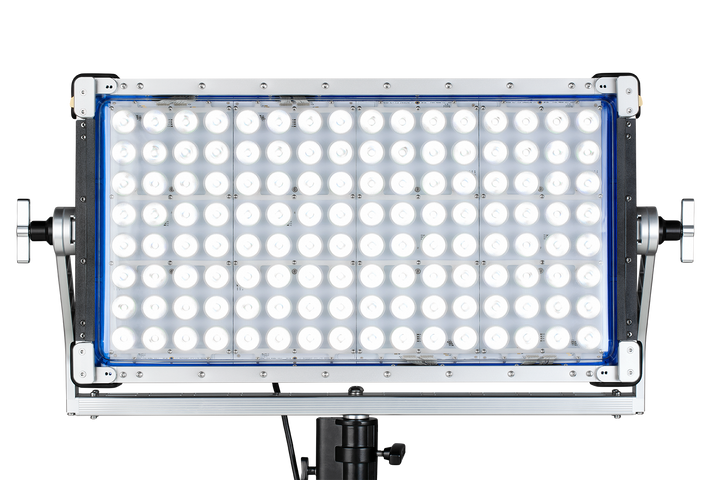
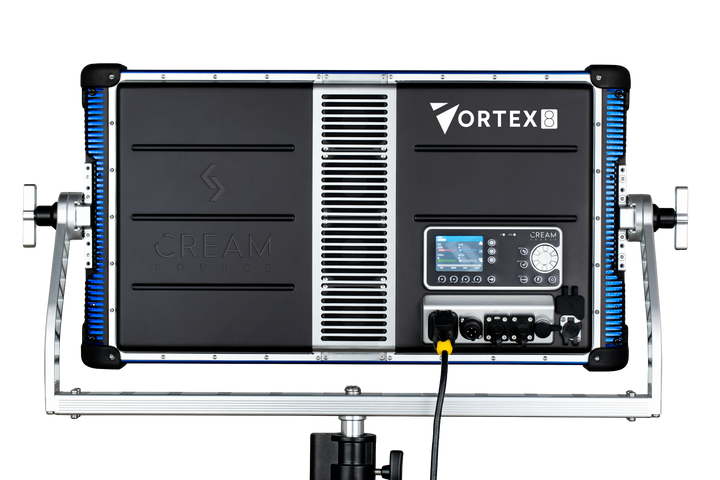
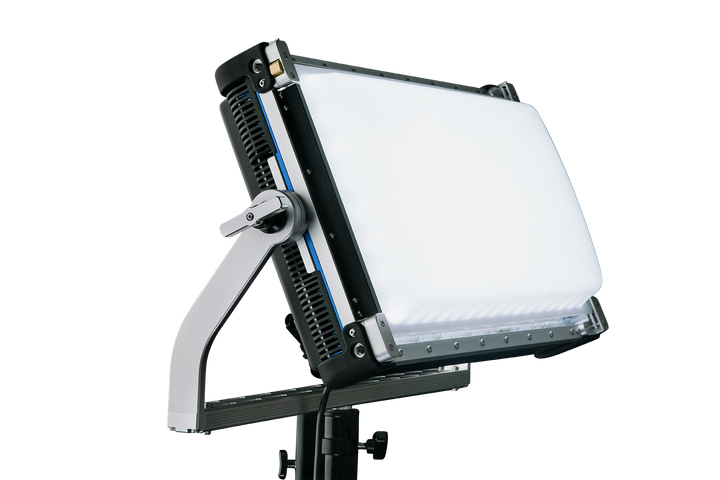
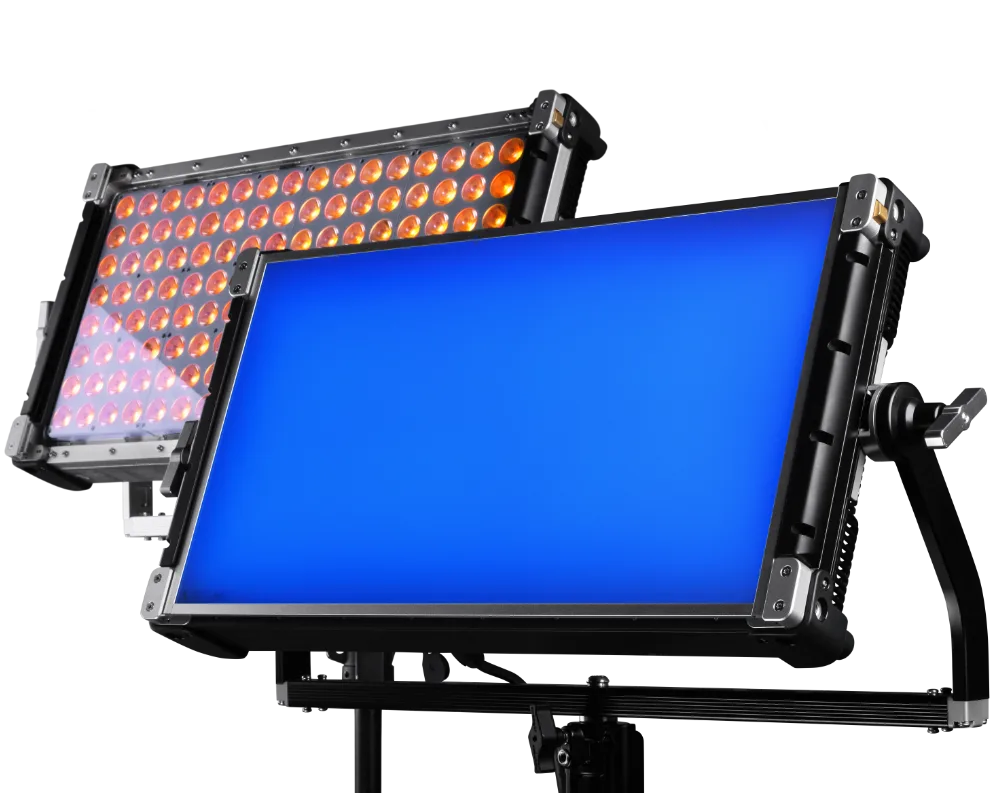
The Creamsource Vortex8 is a colour-tunable hard LED panel with narrow native optics, eight controllable zones and an IP65-rated housing. Flat diffusion, a dome or a softbox changes its beam and apparent source size; it is distinct from the Vortex8S soft model.
The original Vortex8 starts as a narrow hard panel and can be diffused into several soft-source arrangements. Its eight zones and built-in communications suit programmed lighting, while the fitted modifier determines the final source character.
- Vortex8 Hard LED Panel RRGBBW engine and 8 controllable zones; distinct from the Vortex8 Soft. Learn about RRGBBW
- 660 W Maximum AC Input 650 W product class does not replace the 660 W fixture specification.
- Colour Temperature2200–15000 K Tunable white with tint and saturated colour control.
- Weight 17.83 kg With Yoke. 15.9 kg head plus 1.93 kg yoke; 48 V DC input, rated up to 13.75 A in the fixture specifications.
- Beam Control 20° native half-peak angle with hard optics; fit a compatible diffuser, dome or softbox when broader coverage is needed.
- IP RatingIP65 With Sealed Connections Dust-tight and tested against water jets, not immersion. Use the manufacturer’s specified connected arrangement. How to Read an IP Rating.
Jump to Output Calculator ↓ · Compare output
Compare this fixture’s optics and rental kit in the SkyPanel X21, Vortex8 and NOVA II 2×1 lighting comparison.
Creamsource Vortex 8 Specifications
| Specification | Details |
|---|---|
| Exact model | Original Vortex8 hard panel, distinct from Vortex8S |
| Engine / white range | RRGBBW; 2,200–15,000K with tint and colour controls |
| Native optics / zones | 20° half-peak angle / eight controllable zones |
| Maximum AC input | 660W; 100–240V, 6.6A maximum |
| DC input | 48V, 13.75A maximum; full-brightness DC supported |
| Manufacturer colour references | Typical CRI 95; TLCI 95 |
| Head / yoke | 15.9kg / 1.93kg |
| Dimensions with yoke | 831 × 551 × 164mm |
| Control | Onboard, DMX, internal TimoTwo CRMX, Ethernet and supported CreamOS facilities |
| Protection / ambient | IP65 prescribed configuration / maximum 40°C |
Output Calculator
Select the published setup and a manufacturer distance, or enter a custom throw where supported. The results describe centre-beam output, not the brightness across the whole beam.
Camera Settings
If the calculator does not load, use the published photometric table or source on this page. JavaScript is required.
F-stop is a planning estimate, not a meter reading. It uses direct, on-axis illuminance and includes only the optics and diffusion named in the selected setup. Meter on set to account for lens transmission, filters, added diffusion, bounce, dimming and ambient light.
How the exposure estimate works
N = √(E × ISO × t / C), where E is illuminance in lux and t = shutter angle ÷ (360 × fps). The default C = 340 is a dome reference; C = 250 is a flat reference. These are calibration constants, not a measured T-stop. A small nonzero digit is tenths of a stop above the displayed full stop.
Distance estimates and comparisons
Published points are used as given. Between published points the calculator fits a curve through the two nearest readings. Outside those points it uses the inverse-square law only when the fixture’s dataset permits it. Distances outside a configuration’s supported range are reported separately. Comparisons use one shared distance and camera setup; equal lux does not imply equal coverage.
View published readings for the selected configuration
Power planning: Creamsource’s full fixture specifications list 660 W maximum AC and 48 V/13.75 A input. Its CreamOS power-limit guide lists a selectable cap of up to 650 W. The latter is a setting, not a substitute for the fixture input rating and approved supply requirements.
Strengths and Limitations
Strengths
- A narrow native beam can be diffused into several source configurations.
- Eight zones, internal CRMX and Ethernet suit programmed environmental effects.
Limitations
- Native-hard photometrics overstate the light available through a broad soft modifier.
- A complete head/yoke is heavy, and cooling/High-Speed configuration needs camera and sound testing.
Practical Uses
Use it as a directional panel source, through a larger diffusion frame, or for programmed multi-zone effects. Include the yoke and modifiers in the rigging load and test the selected cooling mode during the sound check.
| Setup | How to use this fixture |
|---|---|
| Hard doorway or window beam | Use native optics and grip to shape the path. The linked horror-film breakdown illustrates a defined beam through curtains. |
| Large interview key | Use the appropriate diffuser, dome, softbox or external frame. The testimonial example below builds soft keys from two hard panels through separate six-foot frames. |
| Changing environment | Address the eight zones with the correct profile and orientation for fire, screen or moving-light interaction. |
Output and Colour
The original Vortex8 has 20° native optics and eight controllable zones; it is distinct from the 110° Vortex8S soft model. The manufacturer's bare/native table lists 13,900 lux at 3m/5,600K. A flat diffuser, dome or softbox spreads the beam and changes the reading. Compare it with a soft panel only after matching coverage and diffusion, and check individual-zone/saturated-colour performance separately.
Vortex8 Configuration and Output
| Native 20° output | 1m | 3m | 5m |
|---|---|---|---|
| 3,200K | 68,200 lux | 12,700 lux | 4,800 lux |
| 5,600K | 73,500 lux | 13,900 lux | 5,200 lux |
Sources: Creamsource Vortex 8 specifications; Vortex8 product page.
The native-hard figures use the panel without a flat diffuser or dome. Diffusion reduces the centre reading and spreads the light over a wider field. Soft-source comparisons also depend on emitting area and coverage.
A whole-panel white reading also differs from a cue that illuminates only a few zones or uses saturated colour. Set the actual spatial and colour look before deciding whether the setup has enough exposure.
Power and Batteries
Creamsource’s current support specification lists 660W maximum AC input and 100–240V/6.6A maximum. The lamp is also marketed as a 650W fixture class; that class name is not the maximum input reference.
A suitable 48V DC source at up to 13.75A can support full brightness. Include the correct sustained-capability supply and cable. The integrated PSU keeps the head self-contained on AC, but the head and yoke together weigh 17.83kg before modifiers.
Control, Cooling and Camera Operation
| Control path | Hardware and operating notes |
|---|---|
| Direct / wired | Onboard interface and standard 5-pin DMX; use the installed CreamOS chart. |
| Wireless | Integrated LumenRadio TimoTwo CRMX. |
| Network | Ethernet with the supported firmware/protocol configuration. |
| Spatial control | Eight zones, with the selected precision/personality determining channel footprint. |
| Camera work | High-Speed mode and sync input are separate operating facilities. |
Creamsource specifies over 5,000fps flicker-free capability in High-Speed mode. Treat that as the stated mode capability and test the actual camera, shutter, dimming level and sync arrangement. It does not describe every arbitrary combination of settings.
Set fan behaviour before dialogue and exposure approval. For a spatial cue, label panel orientation and run a zone-identification chase while the unit is accessible; a rotated head can reverse the apparent direction of movement.
Modifiers, Rigging and the Working Package
Compatible accessory profiles · Creamsource Vortex8 Wide Lens and Intensifier
The 15.9kg head excludes the 1.93kg quick-release yoke, giving 17.83kg before front accessories, clamps or cable load. The housing provides eight 3/8-inch rigging inserts and two front filter rails. Verify quick-release engagement and the retention of the flat diffuser or other accessory. IP65 depends on the prescribed sealed connections; the maximum ambient specification is 40°C.
| Part | Working requirement |
|---|---|
| Head and quick-release yoke | 15.9kg + 1.93kg before accessories |
| Rigging interface | Eight 3/8-inch inserts and appropriate rated hardware |
| Front system | Two filter rails and retained diffuser/dome/softbox arrangement |
| Power and data | Supported sealed connections for prescribed IP65 operation |
| Clearance | Working tilt, cable bend and cooling space with the actual modifier |
Inspect quick-release engagement and front accessory retention with the lamp at its intended angle. An IP65 housing does not eliminate connector or cable-routing requirements, and maximum ambient is 40°C.
Alternatives and Related Fixtures
Family comparison: the hard fixture and its Soft counterpart.
| Fixture | When to compare it |
|---|---|
| Creamsource Vortex 4 | Choose the smaller four-zone Vortex4 when its output and area suffice; compare complete yoke weights. |
| Aputure Nova P600c | Choose a broad native soft panel with four engines if hard-beam reach is unnecessary. |
| ARRI SkyPanel X | Compare the modular SkyPanel system when selectable hard/soft optics and larger arrays are required. |
What People Are Saying
Field Feedback at a Glance
These readings describe Allard’s sample and setup. They are separate from the manufacturer’s calculator data.
What worked
- Allard measured about 73,000 lux bare at 1 m at the 5,600 K setting, with the light concentrated in its 20° native beam. Matthew Allard ACS, Newsshooter.
- The supplied diffusion spread the beam to roughly 60° in his test and made a softer source without a large softbox. Matthew Allard ACS, Newsshooter.
- Allard found the weather-rated housing rugged and the diffuser straightforward to slide into the front rail. Matthew Allard ACS, Newsshooter.
Drawbacks to plan for
- With the supplied diffusion in place, he measured 10,200 lux at the beam centre at 1 m. The panel spread light wider, so this isn’t a measure of total light lost. Matthew Allard ACS, Newsshooter.
- With that same diffuser, his test unit read 5,983 K at a 5,600 K setting. Meter with the actual diffuser fitted when matching other lights. Matthew Allard ACS, Newsshooter.
- He found it a heavy panel to move. Check the manufacturer’s current head and yoke weights before choosing the stand. Matthew Allard ACS, Newsshooter.
Reddit, Gaffer’s Production Breakdown
A gaffer describes using two Vortex8 panels through separate six-foot diffusion frames for a testimonial interview, with a LiteMat Plus 4 overhead for fill. View discussion.
Reddit, Horror-film Lighting Breakdown
Another gaffer uses a Vortex8 outside a doorway to send a defined beam through curtains, then shapes it with a solid. The contrast with the interview setup demonstrates how the chosen diffusion and grip change the same lamp’s role. View discussion.
The Man in My Basement: augmenting a CRT on set
In an American Cinematographer production account, the crew explains that the CRT alone could not reach their intended exposure. They synchronized the Vortex8 lighting with the recorded TV footage so colour and flicker stayed in step. Additional units hidden downstairs carried the flicker across the set as the actor moved upstairs. The account does not name a control protocol.
Videos
Creamsource Vortex8 video overview.
Rental and Used-Fixture Checks
- Check every zone and select the correct pixel/precision profile.
- Inspect quick-release yoke, rigging inserts, filter rails and accessory latches.
- Confirm 48V supply capability if using DC and test fan/High-Speed behaviour on camera.
Documentation and Specifications
- Vortex8 product page
- Creamsource Vortex 8 specifications
- ARRI SkyPanel S60
- ARRI Orbiter
- Nanlux Dyno 650C
Browse Creamsource lights · LED panels · all equipment.